A new project has been opened in ePlanning but no documents have been posted for public review.
The former cattle ranch would have a capacity of 500 wild horses according to the description.
RELATED: BLM Seeks More ORPs?

Western Horse Watchers Association
Exposing the Hypocrisy, Lies and Incompetence of the Wild Horse Advocates
Around the ranch
A new project has been opened in ePlanning but no documents have been posted for public review.
The former cattle ranch would have a capacity of 500 wild horses according to the description.
RELATED: BLM Seeks More ORPs?
The final planning documents have been copied to the project folder.
The Decision Record authorizes the solicitation of a five-year contract to pay for space, feeding, training and care for up to 200 wild horses and burros at the Wyoming Honor Farm in Riverton.
Most of the training is accomplished by inmates, which helps them transition back into society according to the news release.
RELATED: Wyoming Honor Farm EA Out for Review.
The nonprofit has two positions to fill according to a February 15 help wanted ad on RanchWork dot com.
RELATED: Colorado Wild Horse Refuge Still Needs Ranch Hands.
He’d like to reunite them with native peoples according to this report by KX News and until that happens, his daughter will continue the mission.
Thought to be descendants of Sitting Bull’s ponies, they represent the original wild horses of Theodore Roosevelt National Park.
The horses you see today, the subject of much clamor, were put there by the Park Service as an exhibit.
RELATED: Frank Kuntz Running Out of Time to Care for Nokota Horses.
The baby was adopted but the mom stayed behind according to a story dated December 25 by The Salt Lake Tribune.
Now, the manager of the sanctuary is worried that the mom might start World War III with another mare at the facility so she’ll be offered for adoption.
Facilities must be in Colorado, Idaho, Kansas, Montana, Nebraska, Nevada, North Dakota, Oklahoma, Oregon, South Dakota, Utah, Washington or Wyoming according to today’s news release, with a capacity of 200 to 10,000 wild horses for five to ten years.
A pre-solicitation notice says the agency is not seeking proposals at this time.
The document was copied to the project folder today.
Comments will be accepted through January 2 according to the news release.
In Alternative 1, the Proposed Action, the BLM would award a five-year contract to pay for space, feeding, training and care of up to 200 wild horses and burros.
Alternative 2 would end the inmate training program, which started in 1988.
The facility held 141 horses and 8 burros as of September 23.
RELATED: Scoping Begins for Wyoming Honor Farm Contract Renewal.
Two new projects have been opened in ePlanning:
Comments will be accepted through November 15.
The agency sends mares to both ORPs according to the September 2024 Facility Report.
RELATED: BLM Weighs Four New ORPs.
The BLM sends wild horses to two off-range pastures near Teterville, a ghost town east of Cassoday KS.
If those are mares at 0:45, it would be Teterville West.
The population as of September 1 was 332 according to the facility report.
The agency removes wild horses from their lawful homes in the American west and holds them at facilities like this one at a cost of two dollars per head per day so it can collect 4.5 cents per head per day from ranchers who graze livestock in their stead.
Brand Rock Ranch covers 18,108 total acres west of Roundup MT, including 8,207 deeded acres, 9,261 public acres and 640 state acres.
It’s about 50 miles north of the Billings School of PZP Darting and Public Deception.
The property consists of three parcels, two with grazing preference on BLM lands, according to the agent’s listing.
The Operator Information Report at RAS tied the ranch to authorization 2500711.
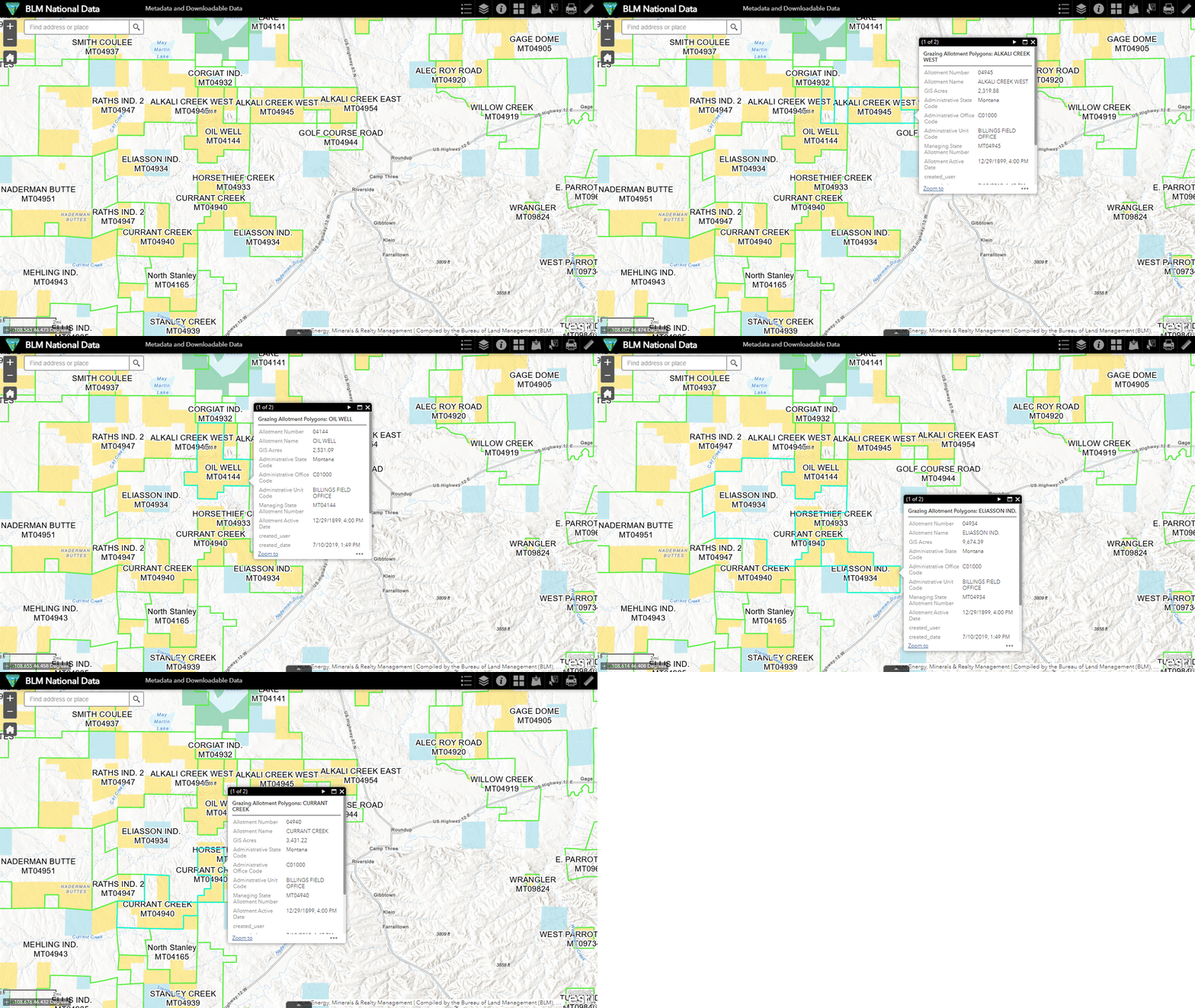
The Allotment Information Report tied the authorization to these parcels:
The allotments offer a combined 1,973 active AUMs on 9,482 public acres according to the Allotment Master Report.
That’s equivalent to 164 wild horses, or 17.3 wild horses per thousand public acres.
The bureaucrats and ranchers tell us that public lands in the western U.S. can only support one wild horse per thousand acres (27,000 animals on 27 million acres).
The land ratio is on the low side. You must acquire approximately 8,200 deeded acres to access 9,500 public acres, or 1.16 public acres per deeded acre.
Properties with ratios of three to five might be more attractive from the viewpoint of profitability and return on investment.
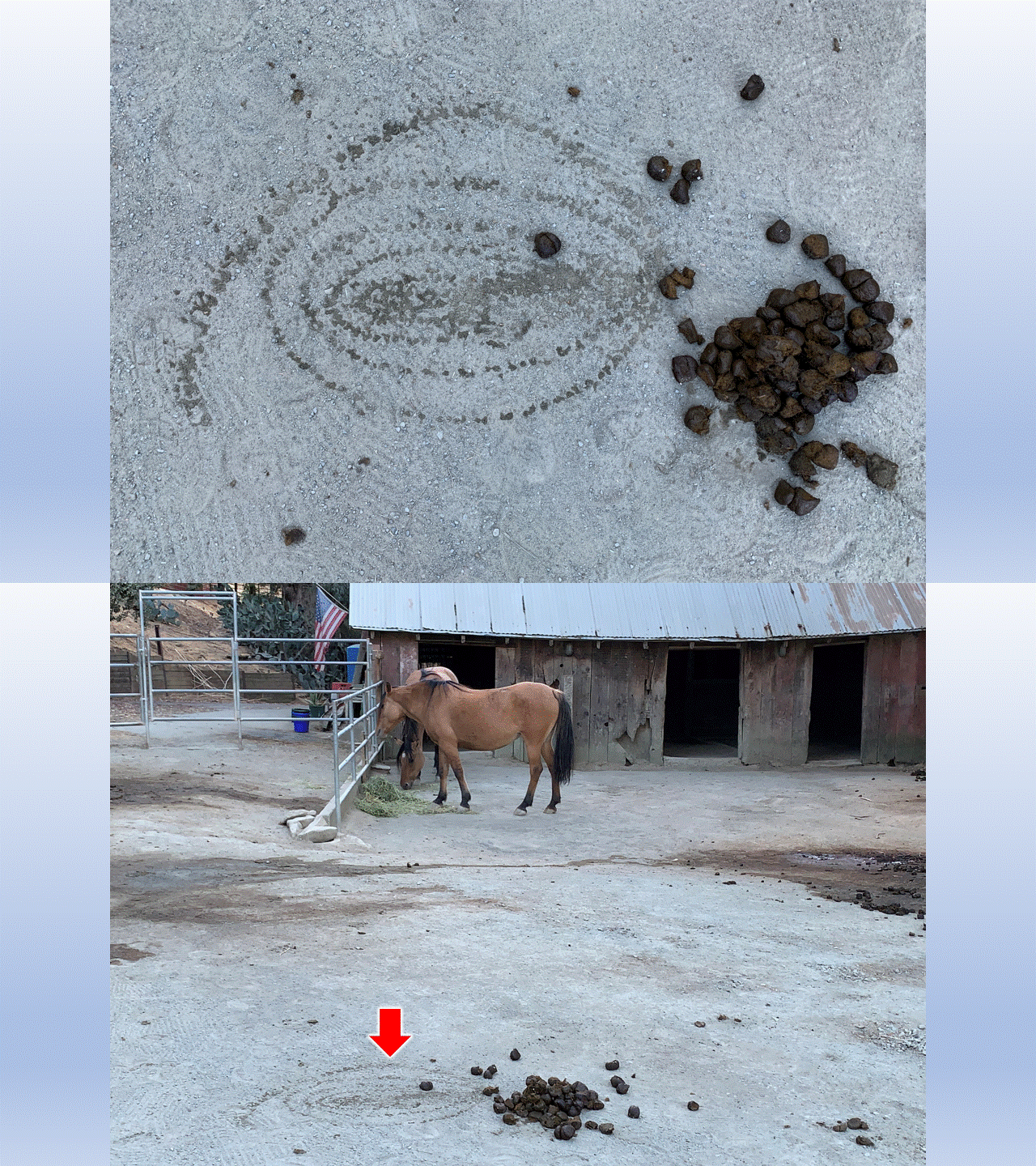
Geldings usually don’t do this, but stallions may pee on the poop of their mares as a sign to other stallions.
In this case he was a bit off aim.
We know what the advocates think about foals.
One is bad enough but two will put them into high earth orbit.
Advocates with Wild Horse Connection, still denying any responsibility for the roundup, will hold an estate sale this weekend to provide food and shelter for the horses until they find new homes, according to an ad on Craigslist.
Western Horse Watchers estimates the cost of hay for 24 former wild horses to be around $3,600 per month.
Preliminary tests indicate that a shipment of feed to the Beutler & Son ranch contained monensin, an additive used in the beef and dairy industries, according to a report by KOCO News of Oklahoma City.
The substance is toxic to horses.
In a statement on socialist media, the manufacturer confirmed that it was an isolated case, likely due to a faulty cleanout procedure and sensor malfunction.
The remarks suggest that the feed came from a batch plant, where the same equipment is used for multiple products.
The report by AP News did not indicate if they were insured and if it was an isolated case.
Four new projects have been opened in ePlanning and draft environmental assessments have been posted for public review.
Comments will be accepted through September 3.
These and other such pastures support three tenets of rangeland management.
Taxpayers foot the bill for removal, processing, transport and stockpiling of wild horses.
Ranchers who graze livestock in their stead profit handsomely from the arrangement because they pay almost nothing for it.
RELATED: BLM Seeks Off-Range Pastures for Wild Horses and Burros.
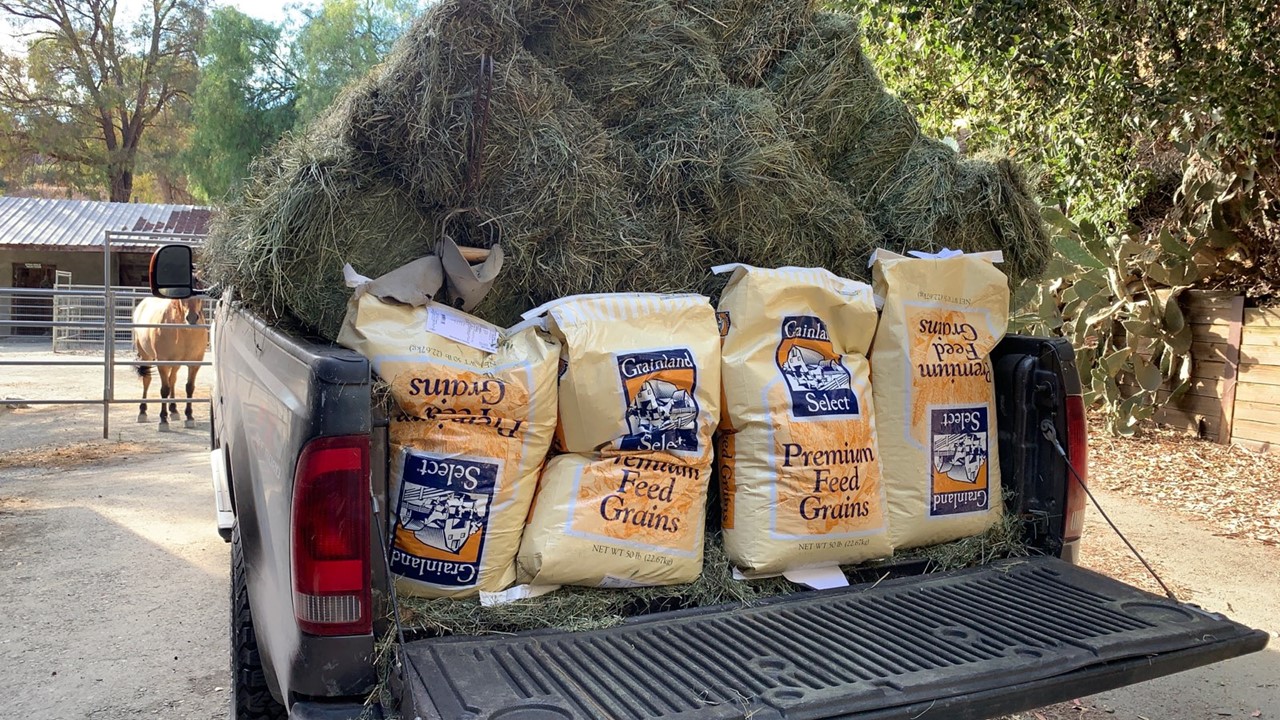
A few years ago twenty bales would fit in the bed of the truck with no room to spare.
But lately there’s space for sacks of grain as shown in the following photo.
Another example of shrinkflation?
They may be getting smaller but they were heavy and the flakes were dense.
Maybe the grower has increased the compaction of his baling machine.
The price on July 31 was $30 per bale, 20 bales minimum, compared to $19 three years ago.
That puts the cost of feed at $150 per AUM assuming five bales per month per horse.
Forage on public lands in the western U.S. sells for $1.35 per AUM.
Now do you see why more and more wild horses are being forced into taxpayer-funded feedlots as more and more livestock occupy their lawful homes?
RELATED: Price of Hay Eases Slightly?
The event runs from June 7 to June 9 at the Murieta Equestrian Center in Rancho Murieta, CA.
Gates open at 9:00 AM.
The schedule includes a mustang demo at 9:30 on Day 1 but it’s not clear who will be presenting and if BLM staff will be on site to interact with the public.
Story by KEYT News of Santa Barbara.
 Western Horse Watchers Association