They were so proud of it at the January WHBAB meeting but have since scrubbed it from their website.
They are phonies, allies of the bureaucrats and ranchers, leaders of the blind.
RELATED: CAAWH Goes Dark on Virginia Range Darting Program.


Western Horse Watchers Association
Exposing the Hypocrisy, Lies and Incompetence of the Wild Horse Advocates
Opinion
They were so proud of it at the January WHBAB meeting but have since scrubbed it from their website.
They are phonies, allies of the bureaucrats and ranchers, leaders of the blind.
RELATED: CAAWH Goes Dark on Virginia Range Darting Program.
Labels might be more effective.
Just say where it was produced—at the expense of America’s wild horses—and let consumers decide.

The list is current as of March 6.
PZP is on page 33 as Zonastat-H.
GonaCon-Deer is in the report but GonaCon-Equine is not.
Restricted use pesticides are not available for purchase or use by the general public.
You must have a diploma from the Billings School of PZP Darting and Public Deception to sterilize mares with Zonastat-H.
Most wild horse advocates wear their certificates as badges of honor.
If a proposed project does not include public lands, it’s not worthy of your support.
Moving wild horses off the range and into private care is exactly what the ranchers want.
The best value for your investment, and the best option for the horses, is to buy deeded acreage tied to grazing allotments, as American Prairie is doing for bison in Montana.
She currently serves as president of the Western Energy Alliance according to a report by AP News.
Western Horse Watchers was unable to find a statement opposing wild horses at the WEA public lands page.
You’ll have to go the American Farm Bureau Federation or Public Lands Council for that.
The advocates would have you believe that drilling and mining are the greatest threats to these animals, as permitted grazing devours entire HMAs and beyond.
As of today, the BLM org chart shows the director’s position as vacant.
RELATED: Shultz to Head Forest Service.
One of the objectives in the Land Management Plan for the Tonto National Forest is to evaluate at least one vacant allotment every two years to (1) convert it to forage reserves, (2) grant it to a current or new permittee or (3) close it to permitted grazing.
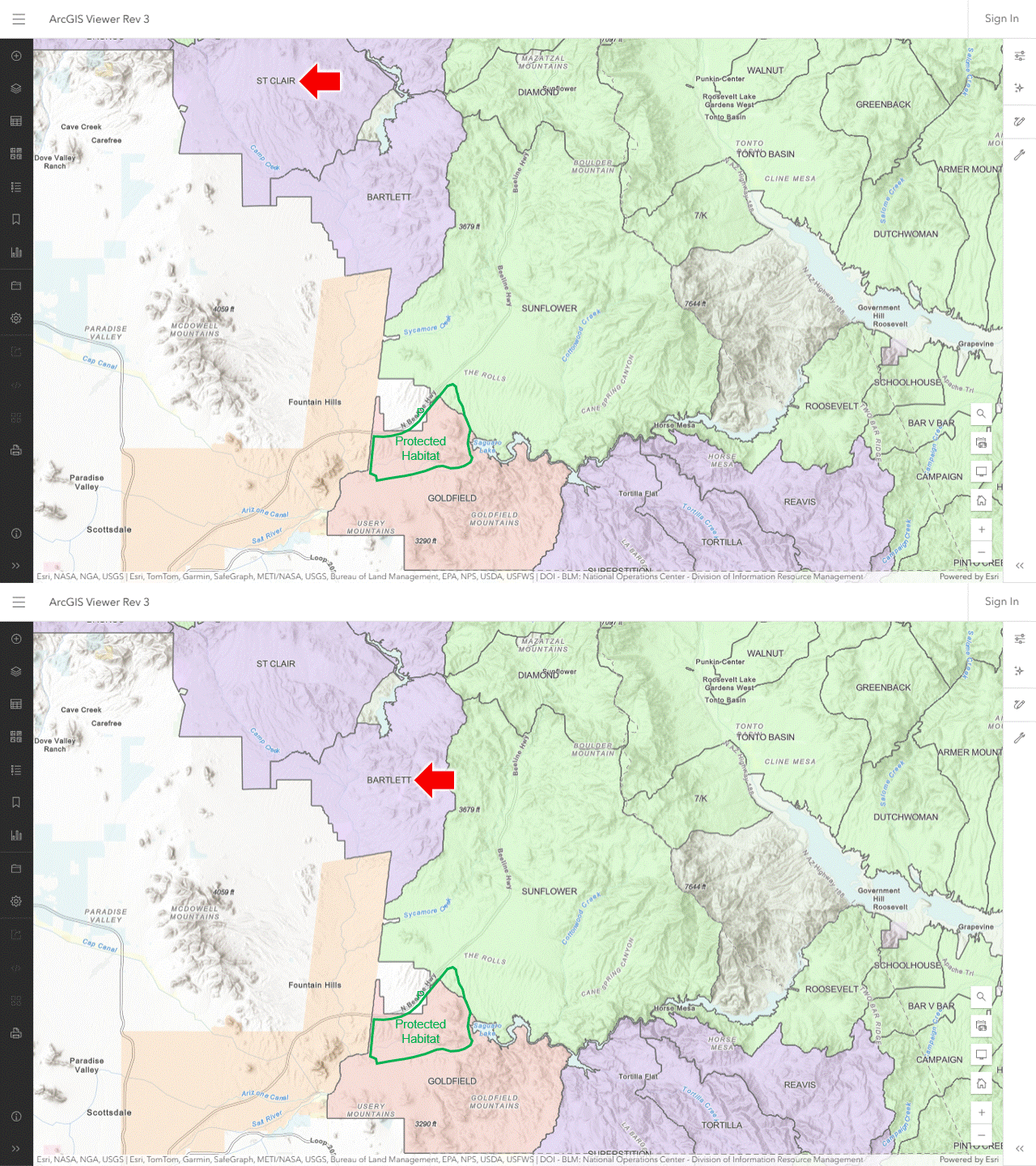
The 2018 report on forage availability states in Appendix 5 that the Goldfield, Bartlett, St. Clair and Sunflower allotments are most similar in vegetation, soil, and topography to the Salt River horse zone.
The ArcGIS viewer indicates that Bartlett and St. Clair are vacant.
Appendix 5 also indicates that the two allotments offered a combined 7,404 AUMs on 116,430 acres, equivalent to 617 wild horses, or 5.3 wild horses per thousand acres.
Your faithful public servants claim the rangelands in the western U.S. can only support one wild horse per thousand acres.
If the advocates had a base property that met Forest Service requirements, they could ask the agency to attach it to one or both of the allotments, securing grazing preference thereon.
The livestock type would be horses and the season of use would be 12 months.
This would probably require a NEPA review, which could span several years, complete with blowback from ranching interests.
But it would be better for the horses compared to their current situation, crammed into a 20,000-acre habitat with the number of viable mares decreasing every year.
RELATED: Leadership Needed at Salt River.
Pay no attention to what the advocates post on socialist media about wild horses.
The herds they monitor are not wild.
They’ve been altered by massive human involvement and massive doses of pesticides.

In this role, you’ll sell mass sterilization as wild horse preservation.
The successful candidate will have a demonstrated commitment to animal/wildlife conservation, equine protection and diversity-equity-inclusion.
Even if you didn’t know what they’re doing to the Virginia Range herd, and want to do to other herds, that last qualification is reason enough to withhold your financial support.
RELATED: Help Wanted: CAAWH Seeks Development Director.

Consider two approaches to herd management:
A. Obtain grazing privileges on one or more allotments in the Tonto National Forest and flip the preference to horses, as Wild Horse Refuge did in Colorado.
B. Sterilize the mares with PZP.
Which one requires a long-term strategy, some diplomacy and tact, a solid donor base and a sincere desire to protect the horses?
Which one can be done by trained monkeys?
RELATED: Salt River Herd Doomed?
Consider two options for wild horse management. One was announced by the Forest Service, the other proposed by the advocates.
Can you tell which is which?
Alternative A
Alternative B
Let’s add headings and change the numbers to reflect the way they were sold to the public.
Alternative A – Motorized Removal
Alternative B – Nonmotorized removal
Now can you tell the difference?
The bureaucrats decided to implement Alternative B, the plan submitted by the advocates.
Why is it a hoax?
Because the volunteers are sterilizing the mares.
The final population will be zero.
RELATED: Advocates, Not Forest Service, Destroying Salt River Herd
This commentary in High Country News was written 30 years ago.
Remarks pertain mostly to allotments in Arizona, including Sunflower, from which the Salt River horses were removed.
If the figures were updated, the memo could be sent to DOGE.
RELATED: Repurposing Sunflower.
As you read this article about the fertility control program, think of Simone Netherlands as a marionette with Suzanne Roy pulling the strings.
The events leading to the current situation are discussed in a 2019 report to the Arizona Department of Agriculture and U.S. Forest Service.
In a nutshell, the Forest Service announced that it would be removing wild horses from the Tonto National Forest and the advocates stepped in and said “Let us do that.”

Recalling the early days, Netherlands said “At that time, we narrowly escaped removal of the Salt River Wild Horses and offered our way of management to both the state and the federal government.”
What she meant was their way of removal.
One of her most outrageous statements involves birth rates and breeding patterns: “If we do want the mare to have a baby, we just don’t dart her that year,” as if conception can be switched on and off like a light bulb—a reference to the sperm-blocking theory.
The longer a mare has been treated with PZP, the longer she takes to regain fertility, about a year per year.
After five years of treatment, she won’t recover. She’s said to be self-boosting, a codeword for sterile.
Clearly, the horses are not in control of their future.
The management plan allowed ten years for birth control and natural attrition to reduce the herd to 100-200 head, from an initial size of around 400.
Do you think after a decade of nonstop darting the herd will come in for a soft landing, finally in balance with its surroundings?
That’s what they tried at Assateague Island and the herd was still shrinking eight years after the darting program was shut off.
Don’t be fooled by the advocates.

If it’s done with pesticides, they fully support it.

If the BLM announced it will zero-out the Rock Springs HMAs with PZP, the advocates would drop their lawsuits and offer to do it at no cost to the government.
They are phonies, allies of the ranchers, leaders of the blind.
RELATED: Court Hears Arguments in Rock Springs Grazing Appeal.
Would you attend a lecture based on lies and propaganda?
Consider this statement, taken from the undated announcement:
Wild horse populations grow at a rate of 15-20% per year and compete with cattle, deer, elk, and bighorn sheep for valuable forage and water resources, which threaten fragile riparian ecosystems through soil compaction and overgrazing. While most U.S. policies advocate for the removal of these “non-native” horses, horse advocates continue to push for more territory and rights.
Cattle are the nonnative species and on public lands they outnumber wild horses by a huge margin.
Growth rates of 15-20% per year require birth rates of at least 20-25% per year and this is rarely seen in roundup data.
In discussions of wild horses, conservation is a codeword for eradication, make sure ranchers get most of the resources.
BLM allotments in Arizona support livestock equivalent to 53,662 wild horses on 10,090,546 public acres, or 5.3 wild horses per thousand public acres.

Remember last April, at the Save Our Wild Horses Conference in Reno, when they were higher than a kite on HMAPs?
Now that the plans are rolling out, they’ve developed a bad case of amnesia.
Consider the Pancake HMAP, just released. It’s discussed in Appendix XIII of the Final EA for management actions in the Complex.
This must be good for the herd because it doesn’t include aerial shooting.
RELATED: Antelope-Triple B HMAP Proves Advocates Are Ill-Informed About Wild Horses.
The river flows westward through a mountainous area in the Tonto National Forest until it reaches Saguaro Lake.
Along the way, it passes the Sunflower Allotment to the north and the Reavis, Tortilla, Superstition and Goldfield Allotments to the south.
Then it flows west southwest through Goldfield before crossing into BIA land.
The Saguaro WBT overlaps the southern portion of Sunflower but it is inactive, the equivalent of an HA on BLM land.
Sunflower is permitted for cattle according to the ArcGIS viewer.
Reavis, Tortilla and Superstition are vacant and Goldfield has been closed.
In years past, wild horses were spotted around the lake, including the Butcher Jones Recreation Area at the southern edge of Sunflower.
They can also be found at Coon Bluff and the Phon D Sutton Recreation Area, both of which are at the western end of Goldfield.
Robbing forage from Sunflower livestock would be unacceptable but there are probably fences keeping them out of that area so there must be some other reason the advocates are sterilizing the mares with PZP.

Here’s a simple pass/fail test:
If the answers are No, they represent victory for the ranchers and failure for the horses.
Most sanctuaries fall into this category, which is why the advocates like them.
The project includes deeded acreage in the Buckeye and Pine Nut allotments, which overlap the Pine Nut Mountains HA.
The Authorization Use Report shows they’re permitted for cattle and sheep.
Bottom Line: It’s in an area where livestock are welcomed but horses are not.
RELATED: Fish Springs Land Trust Helps Livestock or Wild Horses?
Translation: Massive human involvement, poisoning the mares with PZP.
Added to AdvocateSpeak decoder.

Velma’s first encounter with the horse runners occurred 75 years ago.
The Virginia Range was ground zero.
Today, it is the site of the world’s largest mass sterilization program, an insult to her legacy and harbinger of changing attitudes toward wild horses—among those who claim to be their voices.
Women have always been at the forefront of the movement but today’s women are not like those of 1950.

They’re liberals—anti-God, anti-life and anti-family.
For them, wild horse preservation came of age with the advent of PZP, a restricted-use pesticide that sterilizes mares after five years of treatment.
That aligned with their wicked ideology and explains what you see today.
 Western Horse Watchers Association