They’re not playing for the home team.
RELATED: Defund the Advocates Day Set for December 2.


Western Horse Watchers Association
Exposing the Hypocrisy, Lies and Incompetence of the Wild Horse Advocates
Opinion
Like radioactive decay, the advocates emit a steady stream of harmful information about wild horses.
Equating mass sterilization with wild horse conservation is one example.
Lying about rapid development is another.

Their followers don’t realize they’re being exposed to propaganda that promotes rancher prosperity, not equine welfare.
The only hope for these nitwits is to get them to Betty Ford clinics or similar institutions where they can be deprogrammed and educated in rational thought.
It’s about rancher prosperity.
The bill would authorize research to determine if unmanned aerial systems can be used to gather and manage wild horses and burros, including application of fertility control, according to the text.
If successful, the technology could advance mass sterilization as an alternative to motorized removal, a dream-come-true for the advocates.
No more bouncing over rough terrain in a 4WD and stalking the animals with clipboards and darting rifles.
Unlike the automatic darting machine developed by Wildlife Protection Management, which must be stocked with hay to attract the animals, drones can go on the offensive, taking the pesticides to them.
RELATED: Unmanned Aerial Systems for Wild Horse Roundups?
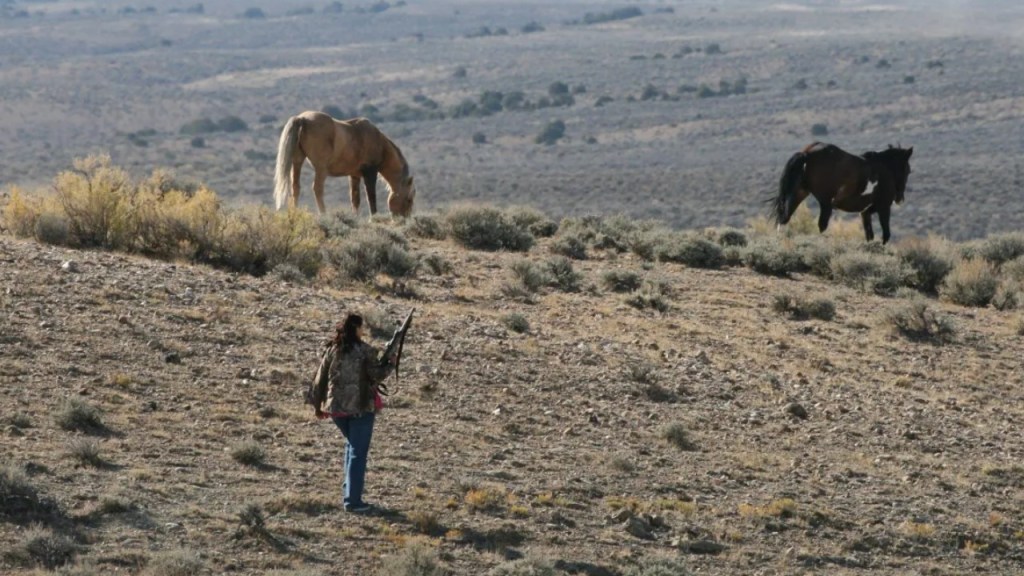
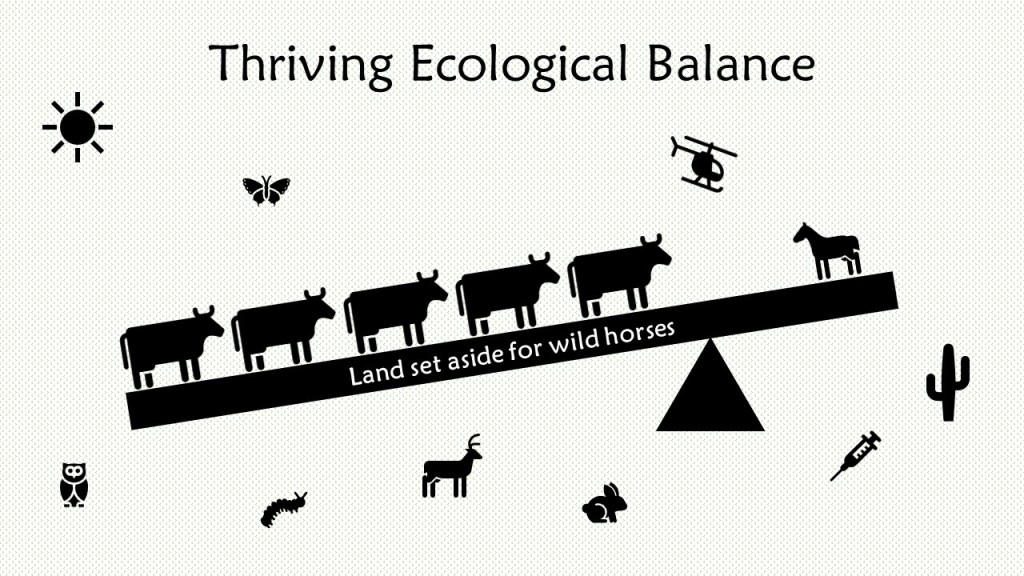
They rob too much forage from the most noble and deserving nonnative species on America’s public lands, placed there by high-net-worth individuals who pay almost nothing for the resource and the services rendered on their behalf by the government.
Put simply, they interfere with redistribution of wealth, a hallmark of liberalism.
(Don’t be fooled by politicians who try to market themselves as conservatives while defending the practice.)
With few exceptions, Appropriate Management Levels are artificially low and do not reflect genetic viability or carrying capacity.
They represent the number of horses allowed by plan, a limit the bureaucrats and ranchers are willing to tolerate.
Carrying capacity = Horses allowed by plan + Horses equivalent to livestock
The advocates reinforce the scam with their darting programs.
RELATED: Equivalent Horses and Stocking Rates for Allotments.
Contrary to his October 27 op-ed in The Blaze, the wild horse and burro program is a grazing program ancillary, supporting three tenets of rangeland management:
It’s not “a war on wildlife, propping up special interests while ranchers and communities bear the brunt of unbalanced ecosystems and federal overreach” as stated in the commentary.
Ranchers are the special interest.
Then there’s the unsubstantiated claim that horse meat derived from public lands re-enters U.S. markets illegally from Mexico and Canada as a diluent of ground beef.
And the misallocation of water.
The guy’s as ill-informed about wild horses as the wild horse advocates.
RELATED: Who’s Advising Bobby Khan About Wild Horses?

Its affiliates page displays logos of trade groups representing meat and wool producers but none from the wild horse advocates.
Its policy statement acknowledges the support of some groups in developing the “Path Forward,” a 2019 plan for ranching superiority in the lawful homes of wild horses.
Since then other groups have stepped forward with projects that demonstrate the feasibility of mass sterilization as an alternative to motorized removal, notably at the Salt River and Virginia Range.
So why won’t PLC bring them on board and recognize their contributions to the ranching agenda?
A partners page would be a great way to do that.
RELATED: What Makes the Advocates Evil?
The ranching advocacy group voiced its opposition in an October 22 news release.
The President’s plan to boost supply suggests that domestic cattle production is low but does not indicate why.
If producers were holding back to boost prices, the way OPEC does to raise the price of oil, the proposal would indeed be misguided.
They should be investigated for collusion and restraint of trade.
Curiously, the Public Lands Council, a subsidiary of NCBA and cheerleader for the public-lands ranchers, released no such statement.
What are the odds that its lobbyists are working the rooms in Washington to accelerate wild horse roundups in favor of cattle production?
The advocates, in the tank for the ranchers, are always ready to augment or supplant the removals with their mass sterilization programs.

When all you have is a darting rifle, everything else looks like a mare’s butt.

Stay barren!
RELATED: Foal-Free Friday, Massive Human Involvement Edition.

The problem goes all the way back to Eve.
Nowhere is it more evident than in the wild horse world.
Refer to this opinion piece in Compact for a survey of the situation.
It is still controversial, even in conservative circles, to say that there are too many women in a given field or that women in large numbers can transform institutions beyond recognition in ways that make them cease to function well.
The Great Feminization
The BLM must pay $4.78 per head per day for the contract extension, according to a report by The Colorado Sun, up from $4.45.
That works out to about $143 per AUM.
The agency receives $1.35 from ranchers for every AUM on public lands liberated by removal of wild horses therefrom, an irrational and unsustainable practice.
The advocates would solve the problem by poisoning the mares with ovary-killing pesticides, leaving everything for the ranchers.
The article said that alfalfa hay is higher in nutrients and more expensive than grass hay or alfalfa-grass mix, which is contrary to experience.
In this area alfalfa usually costs a few dollars less per bale than grass or mix, which explains why it’s a mainstay of diets in off-range corrals.
Some horses cannot adapt to the feed, which is not found in their lawful homes.
RELATED: BLM Pulling Wild Horses and Burros from Cañon City Prison.
They’re obsessed with pesticides.

They’re managing the herds to extinction.
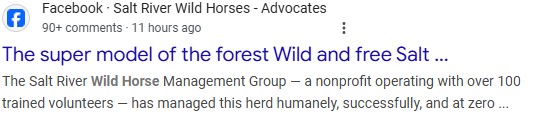
They’re selling mass sterilization as wild horse conservation.

They want the horses to suffer and the ranchers to prosper.

Their followers ratify the destruction.
Is it because they’re female or because they’re liberals?
Would you vote for a candidate who talks like that?
Then why do you give money to the advocates?

If we don’t poison the mares with ovary-killing pesticides, the herds might grow.
The Wild Horse and Burro Protection Act would phase out the use of helicopters and fixed-wing aircraft for rounding up free-roaming horses and burros, a practice that leads to population growth according to the advocates.

The alternative would likely be long-term use of immunocontraceptives, sometimes referred to as mass sterilization, a service they provide.
The bill would not link Appropriate Management Level, an undefined concept in the statute, to principal use.
It would not repeal the Burns Amendment.
The statement reveals their attitude toward wild horses and burros.
They hate foals. They view these animals as pests and think reproduction is a defect, not an essential characteristic, of nature.
The bill will go nowhere in Congress but it’s a great way to keep their base fired up and the donations rolling in.
RELATED: Shrinking Populations and Managing to Extinction.

Do you see the contradiction in this statement?

Fertility control is the leading cause of stunted and shrinking populations!
Who’s publishing this garbage?
The group that’s driving the Virginia Range herd to extinction via mass sterilization.
Its affiliate at the Salt River is doing the same thing.
These people are shallower than a dry creek on the 92nd day of a drought.
If they don’t include public lands and don’t displace livestock therefrom, they’re not worthy of your support.
Nonprofits operating solely on deeded acreage do the will of the public-lands ranchers.
The model employed by American Prairie gives hope to wild horses.
They buy base properties tied to grazing allotments and flip the preference to bison.
The problem in the wild horse world is that those who claim to be voices for the horses are actually servants of the ranchers.
If the Public Lands Council isn’t howling about your project, you’re not doing it right.
RELATED: Defund the Advocates Day Set for December 2.

The editors placed it behind a paywall so the identity of the writer is not known.

Western Horse Watchers will not subscribe to any news source, whether it’s written by liberals or conservatives.
The Decision Record authorizes Alternative A, the Proposed Action, discussed in section 2.4 of the Final EA.
Details of the new HMAP can be found in Appendix XIII.
Recall the rallying cry in the Nevada Current op-ed: “America’s wild horses have faced competition from livestock, unfair resource allocation, and shrinking habitat for generations.”
How does the new plan fix any of that?

It doesn’t. The only change the advocates want is more government spending on services they provide.
RELATED: Antelope-Triple B Preliminary EA Out for Review.

In some circles it’s known as Giving Tuesday but think of it as an opportunity to give the advocates the boot.
The legacy contractors use helicopters to take wild horses off the range.
Other suppliers use baited traps.
The advocates prefer ovary-killing pesticides.
Although their methods differ, they are united by a shared goal.
RELATED: Foal-Free Friday, Searching for Integrity Edition.

Now they’re billing it as education and awareness.
The Campaign Against America’s Wild Horses will serve cookies and hot cider on October 23 as they try to convince you that mass sterilization is a humane alternative to motorized removal.
How stupid do you have to be to believe anything from these phonies?
RELATED: An Evening of Education and Advocacy for Wild Horses?


