They are the pesticide pushers, enemies of America’s wild horses and servants of the public-lands ranchers.
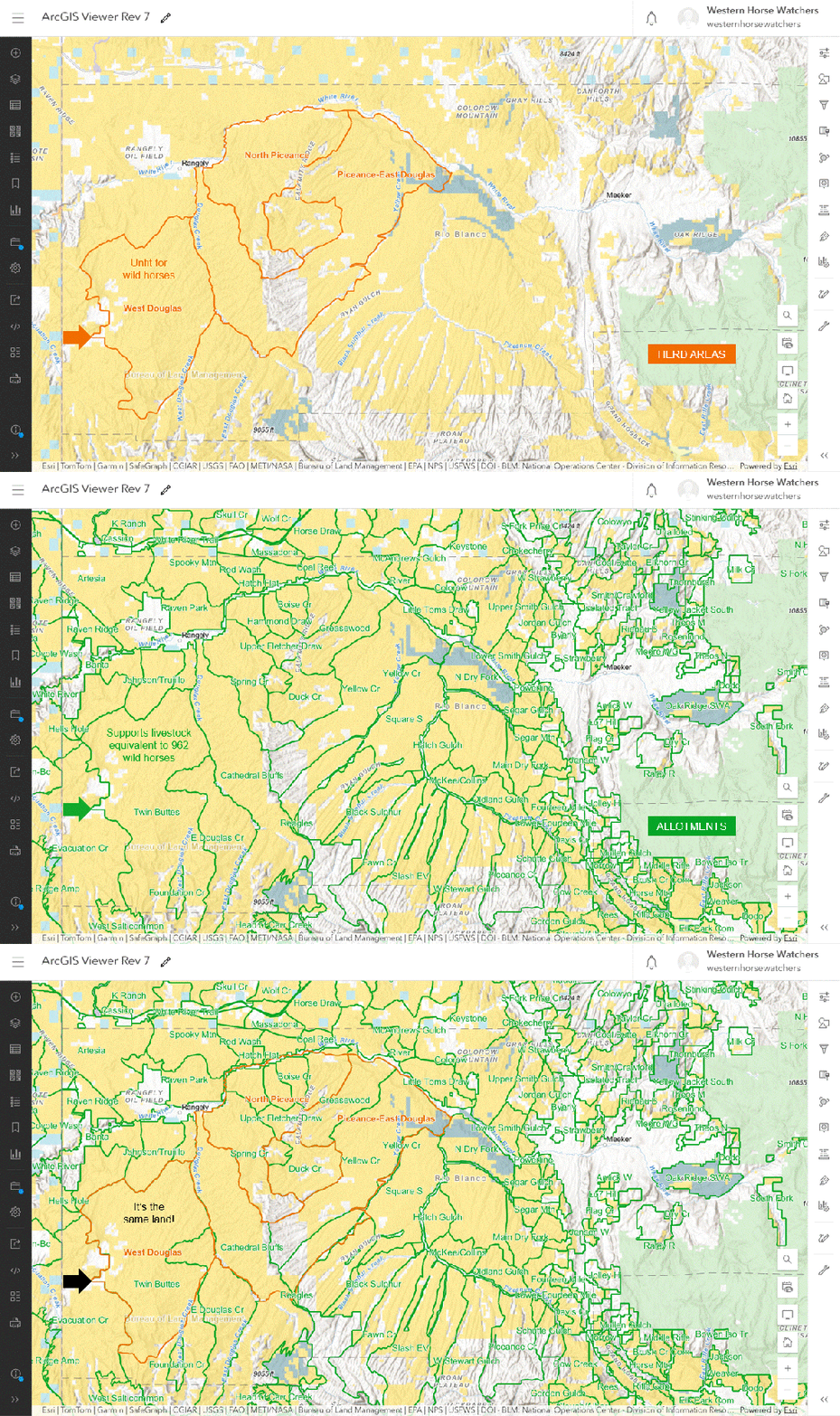
They couldn’t convert an AML to AUMs if their lives depended on it, much less compute a forage allocation for livestock in an area identified for wild horses.
But they know how much adjuvant to add to the PZP and how long to mix them.
The opponents of motorized removal want to pummel the mares with pesticide-laced darts, which inevitably leads to permanent infertility and herd collapse.
The total preference, a little over 90,000 AUMs, is equivalent to 7,500 wild horses.
Taxpayers will receive $121,500 per year for the resource at the current grazing fee, while they spend $6 per day per head, or $16.4 million per year, to care for 7,500 wild horses in off-range holding.
Nobody in the private sector would do that.
But a government agency co-opted by a special interest would, especially when it’s aided and abetted by a cadre of frauds who claim to be voices for the horses.
The herd reduction program will continue for at least two more months according to a report by the Payson Roundup.
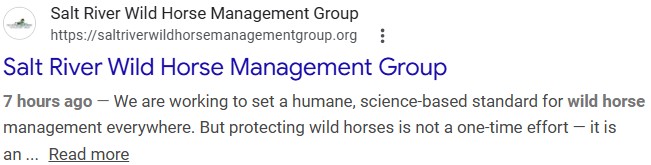
The ringleader of the Salt River Wild Horse Darting Group, a forward base for the Campaign Against America’s Wild Horses, told her followers that “the only thing that’s certain is that the future for the Salt River Horses is extremely uncertain.”
This is nonsense. The herd has no future because SRWHDG ruined the mares with PZP.
The long-term effects of the pesticide were known from the beginning by everyone involved but swept under the rug to win public assent.
Breeding, not mass sterilization, assures long-term viability.
A new contract, if one is needed, would provide for documentation and mopping up as the herd fades to extinction.
A secondary task would be to bring the liars and frauds to justice.
Those who claim that wild horses are a nonnative species and don’t belong on public lands rank among the greatest supporters of nonnative species on public lands.
The first criterion corresponds to one wild horse per thousand acres (25,600 animals on 25.6 million acres according to the last page of the 2025 population dataset).
These two figures suggest that public lands in the western U.S. can support many more wild horses than the government admits.
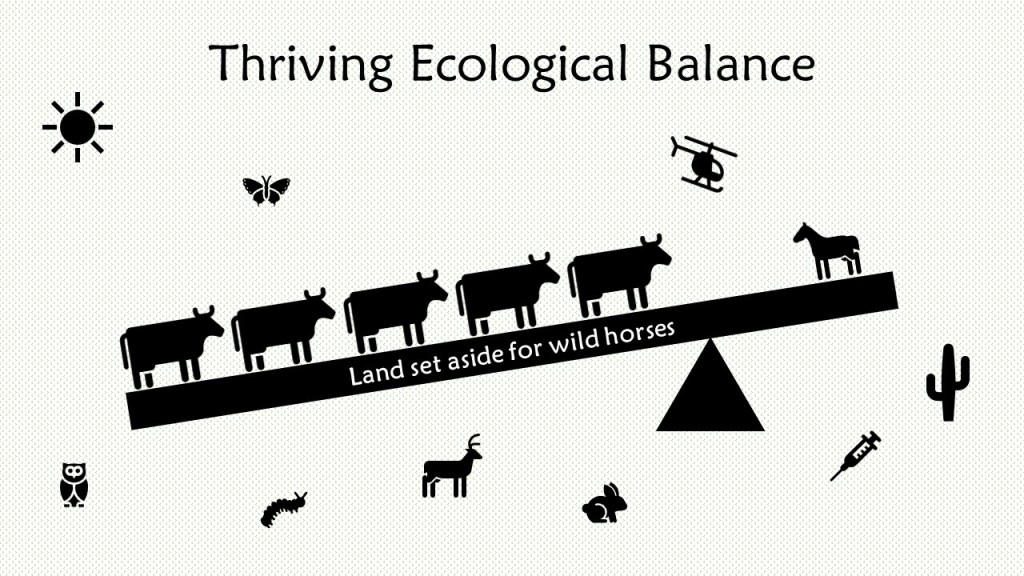
The advocates, long on zeal but short on truth, want you to focus on #1, an arbitrary value that feeds the overpopulation narrative and maximizes rancher prosperity while supplying a rationale for their darting programs.
If the goal was rangeland health, most acreage grazed by livestock, which includes areas identified for wild horses, would be in the Maintain category.
A report by the Congressional Research Service puts the cost of short-term holding at $6.00 per day and the cost of long-term holding at $2.35 per day.
For every AUM assigned to livestock in the lawful homes of wild horses, the government collects $1.35 from the permittee while it spends $70 to $180 to care for the horse displaced thereby.
Nobody in the private sector would do that.
If they really cared about costs, Congress would direct the government to put the horses back on the range and relieve the ranchers of their grazing permits, while making the necessary changes to the statutes.
The third edition of the National Pesticide Applicator Certification Manual should be available for sale this week—giving you plenty of time to order one for Valentine’s Day.
It’s a no-brainer. What advocate isn’t striving to become a certified applicator of restricted-use pesticides?
Unfortunately, the publisher does not donate a percentage of the selling price to Rifles for WretchesTM or similar charity that equips the advocates with the tools of their trade.
The manual is intended as a study guide for those planning to take the Pesticide Applicator Certification Core Exam.
The 2014 edition states on page 51 that restricted-use pesticides (such as PZP) demand special attention because there is reason to believe they could harm humans, livestock, wildlife or the environment even when used according to label directions.
Such as permanent infertility in mares.
Unlawful use of pesticides is discussed on page 39.
Failure to use the product as directed on the label.
The advocates want you to think of PZP as a medication, always referring to the product as a vaccine.
As stated in its Year Two Report, the Colorado Wild Horse Working Group believes that strategic darting should be the cornerstone of wild horse management.
It’s an indication that the stakeholders are willing to play the long game in support of their goals and a major win for the advocates.
Not mentioned in the discussion are the long-term effects of the fertility control pesticides and the eventual disappearance of the herds.
The fertility control program was launched in Magoffin County early last year according to a story by WHAS News.
The report refers to PZP as a contraceptive vaccine, not a restricted-use pesticide.
Contrary to another statement in the article, the product is not reversible if applied for more than five years.
The group expects the population to stabilize in three years.
The story did not indicate if the partner organizations would become obsessed with pesticides as they have out west and if the effort would morph into a mass sterilization program across the nine-county region where the horses are found.
The hypergeometric function in Excel lets you compute the probabilities of matching one to five numbers in the first part of the Powerball drawing.
Suppose your favorite number is seven. What is the probability that it appears in the sample of five taken at random from a field of 69, as it did on November 15?
Using Excel’s nomenclature, the number of successes in the sample would be one, the sample size would be five, the number of successes in the population would be one, the population size would be 69 and the cumulative argument would be set to false.
The result is approximately .072, about 7.2%. The probability that seven does not appear would be 1 – .072 = .928 or 92.8%.
What is the probability of matching all five numbers? Change the number of successes in the sample to five and the number of successes in the population to five.
The result is almost zero, .000000089, or 1 in 11,238,513.
Unfortunately, Excel does not have a function for computing the probability of the advocates telling the truth about PZP in 2026, that you can’t use the pesticide for “humane population reduction” without sterilizing the mares.