Triple B Roundup, Day 17

The incident started on November 2.  Results through November 18:

  • Scope: Triple B Complex
  • Target: Wild horses
  • AML: 889
  • Pre-gather population: 3,335
  • True AML: 4,551
  • Type: Planned
  • Method: Helicopter
  • Category: Cruel and costly (according to advocates)
  • Better way: Sterilize mares with PZP (according to advocates)
  • Capture goal: 2,255
  • Removal goal: 2,155
  • Captured: 1,351, up from 1,086 on Day 15
  • Shipped: 1,150, up from 904 on Day 15
  • Released: 20, no change from Day 15
  • Deaths: 13, up from 11 on Day 15
  • Average daily take: 79.5
  • Unaccounted-for animals: 168
  • Snippet from statute: It is the policy of Congress that wild free-roaming horses and burros shall be protected from capture, branding, harassment, or death
  • Snippet from manual: To protect wild horses and burros from unauthorized capture, branding, harassment or death

The figures above are based on the daily reports.

The sidebar says 1,153 shipped.

Two stallions were dispatched on Day 16.  The death rate is 1.0%.

The capture total includes 530 stallions, 519 mares and 302 foals.

Youngsters represented 22.4% of the animals gathered, consistent with a herd growth rate of 17% per year.

Of the adults, 50.5% were male and 49.5% were female, no indication of an abnormal sex ratio.

Body condition scores were not given.

The location of the trap site was not disclosed.

The name of the contractor was not provided.

Three HMAs are affected.

Twelve mares have been treated with GonaCon EquineThe plan calls for up to 50 to receive the pesticide and be returned to the range with up to 50 stallions.

The roundup supports three tenets of rangeland management.

Resources liberated to date:

  • Forage: 15,972 AUMs per year
  • Water: 13,310 gallons per day

RELATED: Triple B Roundup, Day 15.

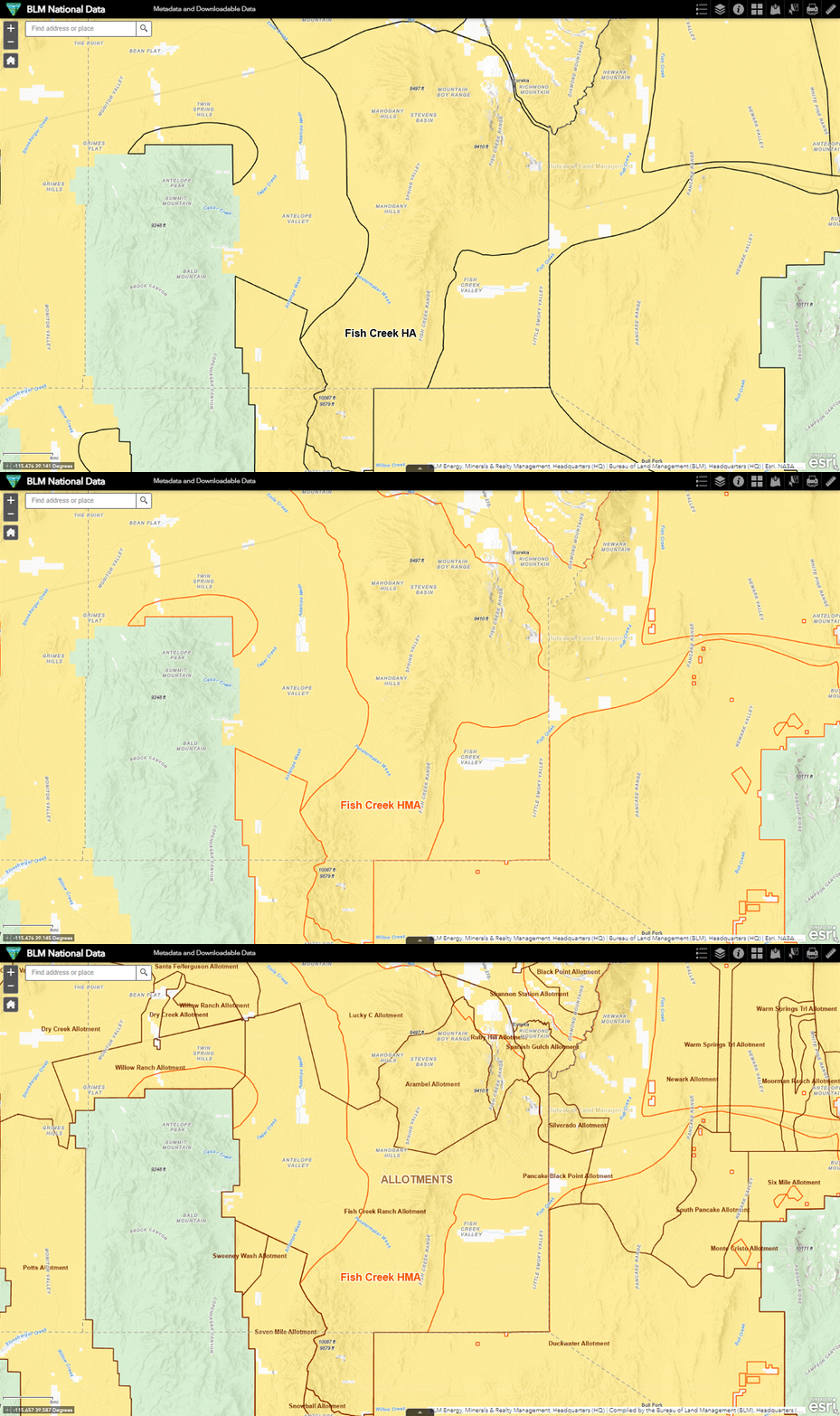
Triple B Complex with Allotments 11-04-24

NDA Installing Fence Around Washoe Lake?

Located at the southwest corner of the Virginia Range, the barrier will increase public safety and protect wild horses from harmful human interactions according to a report by KOLO News but the advocates say it will separate them from a key water source.

Details about the project have been kept under wraps.

NDA shared a map with the reporter and the advocates but not with the public.

Western Horse Watchers was unable to find an announcement at the NDA news page.

The article said the plan will be discussed on December 6, probably at the next regular meeting of the Nevada Board of Agriculture, but as of today no agenda has been posted.

The third quarter meeting was cancelled.

The dispute over the fence marks the latest chapter in the lover’s quarrel between NDA and the Campaign Against America’s Wild Horses, the NGO “hired” by NDA to sterilize the Virginia Range mares.

RELATED: Goicoechea’s Focus on Virginia Range Not About Public Safety.

Washoe Lake 11-19-24

Buffalo Hills Roundup, Day 3

The incident started on November 15.  Results through November 17:

  • Scope: Buffalo Hills HMA
  • Target: Wild horses and burros
  • AML: 314 horses, no burros
  • Pre-gather population: 314 horses, 33 burros
  • True AML: 408 horses
  • Type: Planned
  • Method: Helicopter
  • Category: Cruel and costly (according to advocates)
  • Better way: Sterilize mares with PZP (according to advocates)
  • Capture goal: 235 horses, 33 burros
  • Removal goal: 32 horses, 33 burros
  • Horses captured: 66, up from zero on Day 1
  • Burros captured: 33, no change from Day 1
  • Horses shipped: None
  • Burros shipped: 33, no change from Day 1
  • Horses released: None
  • Burros released: None
  • Horse deaths: 1, up from zero on Day 1
  • Burro deaths: None
  • Average daily take: 22.0 horses
  • Unaccounted-for animals: 65 horses, zero burros
  • Snippet from statute: It is the policy of Congress that wild free-roaming horses and burros shall be protected from capture, branding, harassment, or death
  • Snippet from manual: To protect wild horses and burros from unauthorized capture, branding, harassment or death

The figures above are based on the daily reports.

Burros

The capture goal has been reached.

All animals have been shipped.

There were no deaths.

The capture total includes 5 jacks, 21 jennies and 7 foals.

Horses

A death was reported on Day 3, presumably a horse.  No details were given.

The death rate is 1.5%.

The capture total includes 29 stallions, 28 mares and 9 foals.

Youngsters represented 13.6% of the animals gathered.

Of the adults, 50.9% were male and 49.1% were female.

Body condition scores were not given.

The location of the trap site was not disclosed.

The name of the contractor was not provided.

Up to 100 mares will be treated with GonaCon Equine and released back to the range with up to 103 stallions.

The roundup supports three tenets of rangeland management.

Resources liberated to date (based on horses and burros):

  • Forage: 990 AUMs per year
  • Water: 825 gallons per day

RELATED: Buffalo Hills Roundup Begins.

Buffalo Hills HMA with Allotments 10-02-24

How Many Wild Horses Can the Buffalo Hills HMA Support?

The HMA lies within the Buffalo Hills Allotment, overlapping 27.6% of the parcel according to Table 5 of the Final EA for pest control and resource enforcement in the Smoke Creek Complex.

The 314 horses allowed by plan require 3,768 AUMs per year.

The allotment offers 4,114 active AUMs on 440,982 public acres.

If the resource is evenly distributed across the allotment, livestock inside the HMA, the lawful home of wild horses, receive an estimated .276 × 4,114 = 1,135 AUMs per year, enough to support 94 wild horses.

Therefore, the True AML would be 314 + 94 = 408, to be achieved by confining the ranchers to their base properties in a year-round off season.

The HMA covers 125,207 public acres so the stocking rate at the new AML would be 408 ÷ 125,207 × 1,000 = 3.3 wild horses per thousand public acres.

This brings more embarrassment to the bureaucrats and ranchers, who claim that public lands in the western U.S. can only sustain one wild horse per thousand public acres (27,000 animals on 27 million acres).

RELATED: Buffalo Hills Wild Horses Better Off Than Permittees.

Buffalo Hills HMA with Allotments 10-02-24

DOGE Seeks Cost-Cutting Ideas, Hiring High-IQ Individuals

Musk and Ramaswamy will review the top 1% of applicants according to a November 17 story in The Hill.

Consider one AUM, the amount of forage necessary to keep one wild horse or one cow/calf pair on the range for one month.

If the bureaucrats assign it to a rancher, he’ll pay $1.35 to the government while it spends $150 to care for the horse displaced thereby.  This is current practice.

If the bureaucrats assign it to a horse, the government saves $150 in holding costs while forfeiting $1.35 in grazing fees.

You don’t need a high IQ to realize that best option is the latter, to be achieved by confining the ranchers to their base properties in a year-round off season.

The advocates, not known for superior intelligence, claim that the problem can be solved by shooting the mares with pesticide-laced darts.

RELATED: What Are Musk and Ramaswamy Being Told About Wild Horses?

Triple B Roundup, Day 15

The incident started on November 2.  Results through November 16:

  • Scope: Triple B Complex
  • Target: Wild horses
  • AML: 889
  • Pre-gather population: 3,335
  • True AML: 4,551
  • Type: Planned
  • Method: Helicopter
  • Category: Cruel and costly (according to advocates)
  • Better way: Sterilize mares with PZP (according to advocates)
  • Capture goal: 2,255
  • Removal goal: 2,155
  • Captured: 1,086, up from 937 on Day 13
  • Shipped: 904, no change from Day 13
  • Released: 20, no change from Day 13
  • Deaths: 11, up from 10 on Day 13
  • Average daily take: 72.4
  • Unaccounted-for animals: 151
  • Snippet from statute: It is the policy of Congress that wild free-roaming horses and burros shall be protected from capture, branding, harassment, or death
  • Snippet from manual: To protect wild horses and burros from unauthorized capture, branding, harassment or death

The figures above are based on the daily reports.

The sidebar says 907 shipped.

No activity was reported on Day 14.

A stallion died of a fractured neck on Day 15.  The death rate is 1.0%.

The capture total includes 424 stallions, 418 mares and 244 foals.

Youngsters represented 22.5% of the animals gathered, consistent with a herd growth rate of 17% per year.

Of the adults, 50.4% were male and 49.6% were female, no indication of an abnormal sex ratio.

Body condition scores were not given.

The location of the trap site was not disclosed.

The name of the contractor was not provided.

Three HMAs are affected.

Twelve mares were treated with GonaCon Equine and released on Day 9.  The number of doses is not known.

In 2017 the EPA set the interval between treatments at 90 days but the BLM wants it changed to 7 days.  A search for an updated registration yielded no new results.

The plan calls for up to 50 mares to receive the pesticide and be returned to the range with up to 50 stallions.

The roundup supports three tenets of rangeland management.

Resources liberated to date:

  • Forage: 12,792 AUMs per year
  • Water: 10,660 gallons per day

RELATED: Triple B Roundup, Day 13.

Triple B Complex with Allotments 11-04-24

How to Help the Clan Alpine and Desatoya Permittees

The simplest way is to give money to the advocates.

They oppose principal use and management at the minimum feasible level.

They’re always talking about wild horse removal.

They want the ranchers to win.

Better Way 10-25-23

There is another option that requires more effort on your part but the pass-through cost is zero.

Go cut a Christmas tree in one of the HMAs.

You’ll need a permit as explained in this announcement.

Only pinyon pines and junipers may be taken.

The Pine Nut Mountains and Virginia Range are off limits.

These trees are subject to hand thinning, mastication, chaining and “lop and scatter” because they crowd out forage preferred by livestock.

The projects are usually peddled as sagebrush restoration and fuels reduction, as in this example by the Ely District Office.

Junipers would not make very good Christmas trees in this writer’s opinion but pinyon pines would make a nice addition to your holiday decor.

Better yet buy some land in Nevada and you can decorate them in place year after year.

RELATED: Who Benefits from Cheatgrass Mitigation Projects?

Clan Alpine and Desatoya Christmas Trees 11-16-24

Who Benefits from Cheatgrass Mitigation Projects?

On November 8, the Moab Field Office announced it would spray approximately 13,000 acres of cheatgrass near the Utah-Colorado border in the desert adjacent to I-70.

BLM staff will wait two growing seasons before applying native seed to the treated area.

The project was billed as fuels reduction.

No map was given.

A link to the NEPA analysis was not provided.

Why would you remove one type of vegetation and replace it with another if you’re trying to prevent wildfires?

The National Data Viewer shows the area is covered with grazing allotments.

Moab Cheatgrass Mitigation 11-16-24

Forest Service Starts Work on Prineville Adoption Center

A nonprofit specializing in the restoration of historic structures on public lands is converting the former headquarters of the Crooked River National Grasslands into a facility that places Big Summit wild horses into private care.

Renovations should be complete next year, according to a report by The Bulletin of Bend, OR, clearing the way for a roundup.

RELATED: Big Summit Roundup Delayed as Forest Service Builds New Corrals.

Triple B Roundup, Day 13

The incident started on November 2.  Results through November 14:

  • Scope: Triple B Complex
  • Target: Wild horses
  • AML: 889
  • Pre-gather population: 3,335
  • True AML: 4,551
  • Type: Planned
  • Method: Helicopter
  • Category: Cruel and costly (according to advocates)
  • Better way: Sterilize mares with PZP (according to advocates)
  • Capture goal: 2,255
  • Removal goal: 2,155
  • Captured: 937, up from 883 on Day 11
  • Shipped: 904, up from 659 on Day 11
  • Released: 20, up from 18 on Day 11
  • Deaths: 10, no change from Day 11
  • Average daily take: 72.1
  • Unaccounted-for animals: 3
  • Snippet from statute: It is the policy of Congress that wild free-roaming horses and burros shall be protected from capture, branding, harassment, or death
  • Snippet from manual: To protect wild horses and burros from unauthorized capture, branding, harassment or death

The figures above are based on the daily reports.

The sidebar says 907 shipped.  If that figure is used, there would be no unaccounted-for animals, suggesting that operations have moved to another area.

No horses were taken on Day 13.  Two stallions were released.

The death rate is 1.1%.

The capture total includes 358 stallions, 366 mares and 213 foals.

Youngsters represented 22.7% of the animals gathered, consistent with a herd growth rate of 17% per year.

Of the adults, 49.4% were male and 50.6% were female, no indication of an abnormal sex ratio.

Body condition scores were not given.

The location of the trap site was not disclosed.

The name of the contractor was not provided.

Three HMAs are affected.

Up to 50 mares will be treated with GonaCon Equine and returned to the range with up to 50 stallions.

The number of doses and the interval between treatments were not specified, leaving open the possibility that the Complex becomes the next GonaCon crime scene.

The roundup supports three tenets of rangeland management.

Resources liberated to date:

  • Forage: 11,004 AUMs per year
  • Water: 9,170 gallons per day

RELATED: Triple B Roundup, Day 11.

Triple B Complex with Allotments 11-04-24

Foal-Free Friday, Catching Them Red-Handed Edition

Field audits are a good way to ensnare the advocates in their own destructive activity.

A pesticide label (PZP | Gonacon) tells you how the product can be used.

The first requirement is that the field workers have it with them.  Ask to see it.

GonaCon Violation of Federal Law 08-05-23

Are they wearing the proper PPE?

Are they following the specified interval between doses?

Are they adhering to the approved uses of the pesticide?  For example, PZP can only be used on female horses and burros capable of doing environmental damage.

The Salt River advocates say the horses are good for the environment but they’re using the product to shrink the herd.

Not only do they contradict themselves but thinning overpopulated herds is not an approved use of the pesticide.

Using it to control herds that interfere or could interfere with animal agriculture is not an approved use.  Same for herds that pose safety hazards to motorists.

Referring to pesticides as vaccines may constitute misbranding, another unlawful act.

The EPA offers several options for reporting illegal use:

RELATED: Foal-Free Friday, Army of Nitwits Edition.

Pesticide Patrol 08-16-23

What Are Musk and Ramaswamy Being Told About Wild Horses?

President-elect Donald Trump announced on November 12 that Elon Musk and Vivek Ramaswamy will lead a new task force on government efficiency according to a report by AP News.

The Department of Government Efficiency will work outside the bureaucracy to drive large-scale structural reform and create an entrepreneurial approach to government.

You can be sure the farm bureaus, stock grower’s associations and public lands councils, already circling their wagons, will point to the wild horse and burro program as wasteful government spending, when most of its costs are incurred because of them.

The same is true for wildfire restoration, fuels reduction, cheatgrass mitigation, predator control and pinyon-juniper management on America’s public lands.

Hundreds of millions of dollars spent every year on affluent ranchers who pocket the profits and pay almost nothing for the services, as nearly 70,000 wild animals rot in government holding.

If Musk and Ramaswamy understood the waste and sleaze, and they had the authority, they’d kill this boondoggle Monday morning and put those animals back on the range.

BLM Acknowledges Onaqui Wild Horse Shooting

The agency has offered a $5,000 reward for information leading to the arrest and conviction of the person(s) responsible according to today’s news release.

In an effort to trick you into thinking they care about wild horses, the pesticide pushers and ranching sympathizers have pledged $14,000, bringing the total to $19,000.

They know they won’t have to make good on their promises.

RELATED: Onaqui Stallion Found Dead.

Triple B Roundup, Day 11

The incident started on November 2.  Results through November 12:

  • Scope: Triple B Complex
  • Target: Wild horses
  • AML: 889
  • Pre-gather population: 3,335
  • True AML: 4,551
  • Type: Planned
  • Method: Helicopter
  • Category: Cruel and costly (according to advocates)
  • Better way: Sterilize mares with PZP (according to advocates)
  • Capture goal: 2,255
  • Removal goal: 2,155
  • Captured: 883, up from 723 on Day 9
  • Shipped: 659, up from 615 on Day 9
  • Released: 18, no change from Day 9
  • Deaths: 10, up from 8 Day 9
  • Average daily take: 80.3
  • Unaccounted-for animals: 196
  • Snippet from statute: It is the policy of Congress that wild free-roaming horses and burros shall be protected from capture, branding, harassment, or death
  • Snippet from manual: To protect wild horses and burros from unauthorized capture, branding, harassment or death

The figures above are based on the daily reports.

The Day 3 report still shows 122 horses shipped but the breakdown yields 120.

No horses were taken on Day 10.  Capture activity may have moved to another area or weather conditions were unfavorable.

A stallion was dispatched on Day 10 because of club feet and another for tooth loss.

The death rate is 1.1%.

The capture total includes 342 stallions, 344 mares and 197 foals.

Youngsters represented 22.3% of the animals gathered, consistent with a herd growth rate of 17% per year.

Of the adults, 49.9% were male and 50.1% were female, no indication of an abnormal sex ratio.

Body condition scores were not given.

The location of the trap site was not disclosed.

The name of the contractor was not provided.

Three HMAs are affected.

Up to 50 mares will be treated with GonaCon Equine and returned to the range with up to 50 stallions.

The number of doses and the interval between treatments were not specified, leaving open the possibility that the Complex becomes the next GonaCon crime scene.

The roundup supports three tenets of rangeland management.

RELATED: Triple B Roundup, Day 9.

Triple B Complex with Allotments 11-04-24

Cumberland Island Horses Safe for Now

A federal judge has dismissed the case seeking their removal from the barrier island off the coast of Georgia, according to a report by The Atlanta Journal-Constitution.

The original article was placed behind a paywall but was reprinted in full by the Union-Bulletin of Walla Walla WA.

The writer said the court ruled against them because the do-gooders in the coalition named them as plaintiffs.

RELATED: Coalition Seeks Removal of Cumberland Island Horses.

BLM Earmarks $25 Million for Wild Horse Outplacement

Five new public-private partnerships could place an additional 11,000 wild horses and burros into private care over the next five years in exchange for $25 million in funding, according to today’s news release.

That’s on top of the existing adoption program.

Leading the way is Forever Branded, a Texas nonprofit that will receive over $16 million.

Western Horse Watchers believes that these programs will not reduce expenditures for off-range holding but will accelerate turnover so more wild horses can be removed from their lawful homes.

The off-range corrals could be emptied several times over by confining the ranchers to their base properties in a year-round off season.

The agency spends tens of millions of dollars every year stockpiling wild horses so it can collect a few million dollars in grazing fees from the ranchers.

Nobody in the private sector would do that.

Onaqui Stallion Found Dead

He was found in the HMA on November 10 according to a report by KSL News, killed by gunfire.

Your host was unable to find a statement from the BLM at their news site.

The HMA is subject to permitted grazing.

Advocates with the Wild Horses of America Foundation are poisoning the Onaqui mares with PZP and Gonacon Equine.

They should be investigated for unlawful use of pesticides.

RELATED: Reward Offered as Two Onaqui Stallions Found Dead.