Murderer’s Creek Roundup, Day 73

The incident started on November 29.  Results through February 9:

  • Scope: Murderer’s Creek HMA, WHT
  • Target: Wild horses
  • AML: 140
  • Pre-gather population: 650
  • True AML: TBD
  • Type: Emergency
  • Method: Bait
  • Capture goal: 350 – 400
  • Removal goal: 350 – 400
  • Captured: 373, up from 350 on Day 66
  • Shipped: 340, no change from Day 66
  • Released: None
  • Deaths: 6, up from 5 on Day 66
  • Average daily take: 5.1
  • Unaccounted-for animals: 27
  • Snippet from statute: It is the policy of Congress that wild free-roaming horses and burros shall be protected from capture, branding, harassment, or death
  • Snippet from manual: To protect wild horses and burros from unauthorized capture, branding, harassment or death

Results for Days 68, 71, 72 and 73 were posted today.  No reports were given for Days 67, 69 and 70.

The low end of the capture goal has been reached.

A stallion died of colic on Day 68, lifting the death rate to 1.6%.

The capture total includes 135 stallions, 148 mares and 90 foals.  The gather page says 135/153/85.

Youngsters represented 24.1% of the animals gathered, consistent with a herd growth rate of 19% per year.  The Rule of 72 says the herd size would double in 3.8 years.

Of the adults, 47.7% were male and 52.3% were female, no indication of an abnormal sex ratio in the population at large.

Body condition scores were not given.

The location of the trap site was not disclosed.

The name of the contractor was not provided.

There are no plans to treat any of the mares with fertility control pesticides and return them to the range.

No decisions have made regarding the long-term disposition of horses, which means they could be treated or altered in off range holding, including the stallions.

The status of livestock grazing in the burned area is not known.

RELATED: Murderer’s Creek Roundup, Day 66.

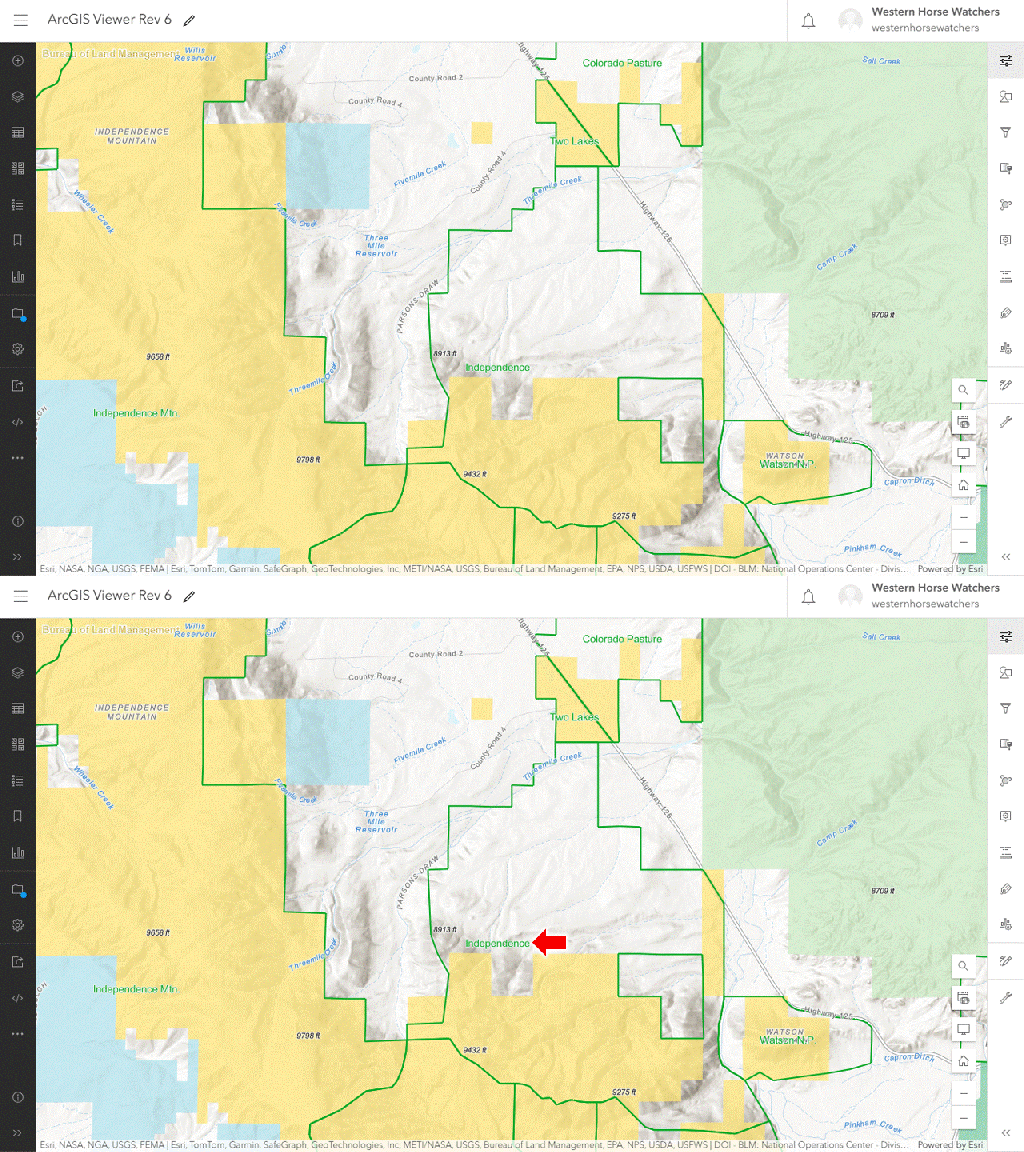
Murderers Creek HMA with Allotments 10-24-24

When Will Elko County Endorse the Virginia Range Advocates?

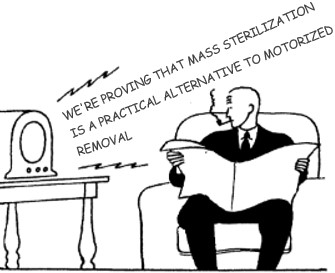
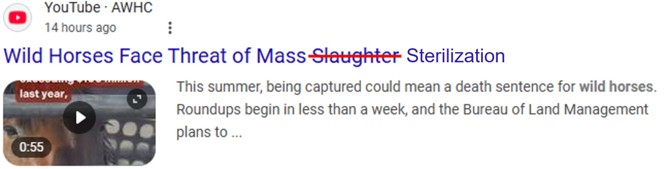
They’re obliterating one of the largest wild horse herds in the American west, proving that mass sterilization is more effective in the long run than motorized removal.

They’re pioneering a two-part management philosophy:

  • Ruining the mares with PZP
  • Praying for the older horses to die

Added benefits include:

  • Tiny breeding populations
  • Loss of genetic diversity
  • Abnormal sex ratios
  • Selection for faulty immune systems

They sell this scam as wild horse conservation and many have fallen for it.

RELATED: Modus Operandi of the Wild Horse Advocates.

Pesticide Pushers 07-17-23

If Wild Horses Had Principal Use of K Ranch

Organizers of the Wild Horse Summit said they’d arm with you with knowledge to effectively advocate so let’s put that theory to the test.

The allotment, on the north side of I-40 near Dinosaur, CO, offers 3,664 active AUMs on 43,242 public acres according to the allotment master report.

The forage assigned to horses is zero.

How many could live there?

The forage assigned to livestock is equivalent to 305 wild horses, or 7.1 animals per thousand public acres.

Why is this important?

Your faithful public servants claim that public lands in the western U.S. can only support one wild horse per thousand acres (27,000 animals on 27 million acres).

The advocates bolster the narrative with their darting programs.

If the allotment was an HMA, the AML would be 43 and 262 horses would be consigned to off-range holding because of permitted grazing.

What’s that?  You didn’t learn any of this at the summit?

You can’t get blood from a stone and you won’t get the required knowledge from conferences organized by ranching sympathizers.

BLM allotments in Colorado support livestock equivalent to 49,546 wild horses on 7,448,367 public acres, or 6.7 wild horses per thousand public acres.

Wild horses can be placed on public lands not identified for their use by acquiring base properties associated with grazing allotments and flipping the preference to horses.

RELATED: The Allotments Tell the Story: They’re Lying, All of Them.

K Ranch Allotment 02-08-25

Committee Approves SCR 4006

A motion to pass carried 7-0 in the Senate Energy and Natural Resources Committee on February 7.

Refer to video of the discussion and vote.

The resolution asks Congress to establish federal protections for the wild horse herd at Theodore Roosevelt National Park.

If it agreed, would it impose the multiple-use mandate, which the bureaucrats interpret as four to six cow-calf pairs for every wild horse?

RELATED: Committee Rejects SB 2331.

Modus Operandi of the Wild Horse Advocates

Next to their love of wild horses, the advocates lie most about fertility control, selling mass sterilization as wild horse conservation.

In this snippet from her testimony on February 7 regarding SB 2331, Castle McLaughlin speculates about the management philosophy at TRNP.

She’s talking about the Park Service but her remarks apply to the advocacy groups, especially the Campaign Against America’s Wild Horses and its affiliates.

Dinosaur Base Property Available for $11.9 Million

K Ranch covers 14,367 deeded acres on the north side of I-40 near Dinosaur, CO, with access to 45,140 BLM acres and 3,200 state acres according to the agent’s listing.

The National Data Viewer shows the arrangement.  Click on image to open in new tab.

The Allotment Master Report puts it in the Improve category, with 3,664 active AUMs on 43,242 public acres, equivalent to 305 wild horses or 7.1 wild horses per thousand public acres.

Your faithful public servants claim that public lands in the western U.S. can only support one wild horse per thousand acres (27,000 on 27 million acres).

The land ratio is, using the agent’s data, is 3.1 public acres for every deeded acre.

The ranch does not overlap any areas identified for wild horses.

The legislature expects the Colorado Wild Horse Working Group to identify and pursue long-term solutions for wild horses removed from federal horse management areas or held in federal facilities, the best of which is to put them back on public lands at the expense of privately owned livestock.

This can be accomplished by acquiring base properties such as this one and flipping the grazing preference to horses.

K Ranch Scorecard 02-08-25

The investment ratio would be $39,016 per rescued horse if the ranch was operated in self-sustaining mode.

On-site hay production would increase capacity, driving the investment ratio down.

The listing says the ranch supports a year-round cattle operation of approximately 530 cows, plus 75 yearling heifers and 15 bulls, equivalent to roughly 600 wild horses.

RELATED: Starting a Nonprofit That Actually Helps Wild Horses.

K Ranch Allotment 02-08-25

Breeding Population More Important Than Herd Size

In this snippet from his testimony on February 7 regarding SB 2331, Eric Molvar explains that the breeding population is a function of herd size minus the number of mares that have been treated with fertility control.

Section 4.4.6.3 of the WHB Management Handbook calls for a herd size of 150 to 200 animals to achieve a breeding population of at least 50 but does not mention the fertility control deduction.

The advocates won’t talk about this because they’re driving the breeding populations to zero in their quest to prove that mass sterilization is a practical alternative to motorized removal.

RELATED: What’s the Minimum Herd Size for Genetic Viability?

Should SB 2331 Include Support for Kuntz Ranch?

The ranch operates as a refuge for wild horses rescued from the park.

Thought to be descendants of Sitting Bull’s ponies, they have historical significance.

The herd you see today was put there by the Park Service as an exhibit.

There is too much fuss about the current herd and not enough interest in preserving the original bloodlines.

North Dakota lawmakers should consider this issue as they refine the bill.

RELATED: SB 2331 Testimony List Growing.

Foal-Free Friday, Science-Based Conservation Edition

There’s only one foal in the following report about SB 2331 by KX News, a sign of long-term problems for the herd.

The advocates claim that a working group would unite state officials, advocates, experts, and interested parties to ensure collaborative, humane, science-based conservation of the Theodore Roosevelt National Park wild horses.

Those are codewords for mass sterilization.  The science is flawed, it’s not humane and collaboration is really collusion among those who want the horses gone.

RELATED: Foal-Free Friday, Bringing Them Up on Charges Edition.

Del Norte Base Property Available for $45 Million

L Cross Ranch covers 6,581 deeded acres in southern Colorado, with access to 11,460 BLM acres, 26,140 Forest Service acres and 15,844 state acres, according to the agent’s listing.

The National Data Viewer identifies the BLM allotments as East Carnero Creek, South Carnero, Rio Grande Canal and Hellgate.

The Allotment Master Report gives management status, public acres and active AUMs.

The Western Watersheds map identifies the Forest Service allotments as Pasture and Cave.

The land ratio, neglecting state acreage, is 5.7 public acres per deeded acre.

The ranch does not overlap any areas identified for wild horses.

The legislature expects the Colorado Wild Horse Working Group to identify and pursue long-term solutions for wild horses that are removed from federal horse management areas or held in federal facilities, the best of which is to put them back on public lands at the expense of privately owned livestock.

This can be accomplished by acquiring base properties such as this one and flipping the grazing preference to horses.

L Cross Ranch Scorecard 02-06-25

The BLM acreage offers 706 active AUMs, equivalent to 59 wild horses, which is not great for the required investment.

On-site hay production will increase that number.  The listing says the ranch supports 850 to 900 head year around.

The authorized forage in the Forest Service and state lands is not known.

L Cross Ranch 02-06-25

CAAWH Mobilizing Drones in Favor of SB 2331?

As of this evening, the testimony list has 81 entries, mostly in favor of the bill.

One of the submittals is a form letter from the Campaign Against America’s Wild Horses, claiming that a wild horse working group would unite state officials, advocates, experts and interested parties to ensure collaborative, humane, science-based conservation of the Theodore Roosevelt National Park wild horses, prevent removals, and provide long-term oversight.

These do-gooders have no idea what they’re talking about.  Those are codewords for nonmotorized removal—mass sterilization with pesticide-laced darts.

A working group would provide a forward base from which the advocates can wage war on the TRNP wild horses, as it has in Colorado.

You only need to look at Assateague Island to see how it will turn out.

RELATED: SB 2331 Hearing This Week.

Scoping Begins for Jackson Mountains HMAP

A scoping statement and management evaluation have been copied to the project folder.

Comments will be accepted through March 4 according to the news release.

The HMAP will affirm the current AML and forage allocations, and authorize methods such as forcible removal, fertility control pesticides and sex ratio skewing to achieve them on a long-term basis.

RELATED: New HMAP for Jackson Mountains HMA?

Jackson Mountain HMA with Allotments 01-31-25