As usual, the news release does not include a map of the project area or link to the NEPA analysis.
Permit holders, among others, were urged to be aware of treatment operations.
Ironically, the agency that routinely ignored the 2017 labeling amendment for GonaCon Equine, which extended the interval between primer and booster from 30 days to 90 days, said in the announcement that “Strict adherence to the pesticide label restrictions and instructions is followed as required by law.”
A link to the offending material was not provided so you can’t be sure what they’re whining about.
But you get the impression that the federal government will be selling off vast amounts of public lands with few if any limitations if an amendment to the budget reconciliation bill drafted by the Senate Energy and Natural Resources Committee becomes law.
The story may be related to a section in a bill titled “MANDATORY DISPOSAL OF BUREAU OF LAND MANAGEMENT LAND AND NATIONAL FOREST SYSTEM LAND FOR HOUSING,” which starts on page 30.
The measure calls for the disposal of not less than 0.50 percent and not more than 0.75 percent of Bureau of Land Management land and not less than 0.50 percent and not more than 0.75 percent of National Forest System land.
Said lands are to be suitable for residential housing, have access to existing infrastructure and are adjacent to developed areas.
Large parcels in remote areas, such as the Fifteenmile HA and overlapping allotments, would not be nominated for sale.
Small islands of public lands that can’t be accessed without crossing private property are likely candidates.
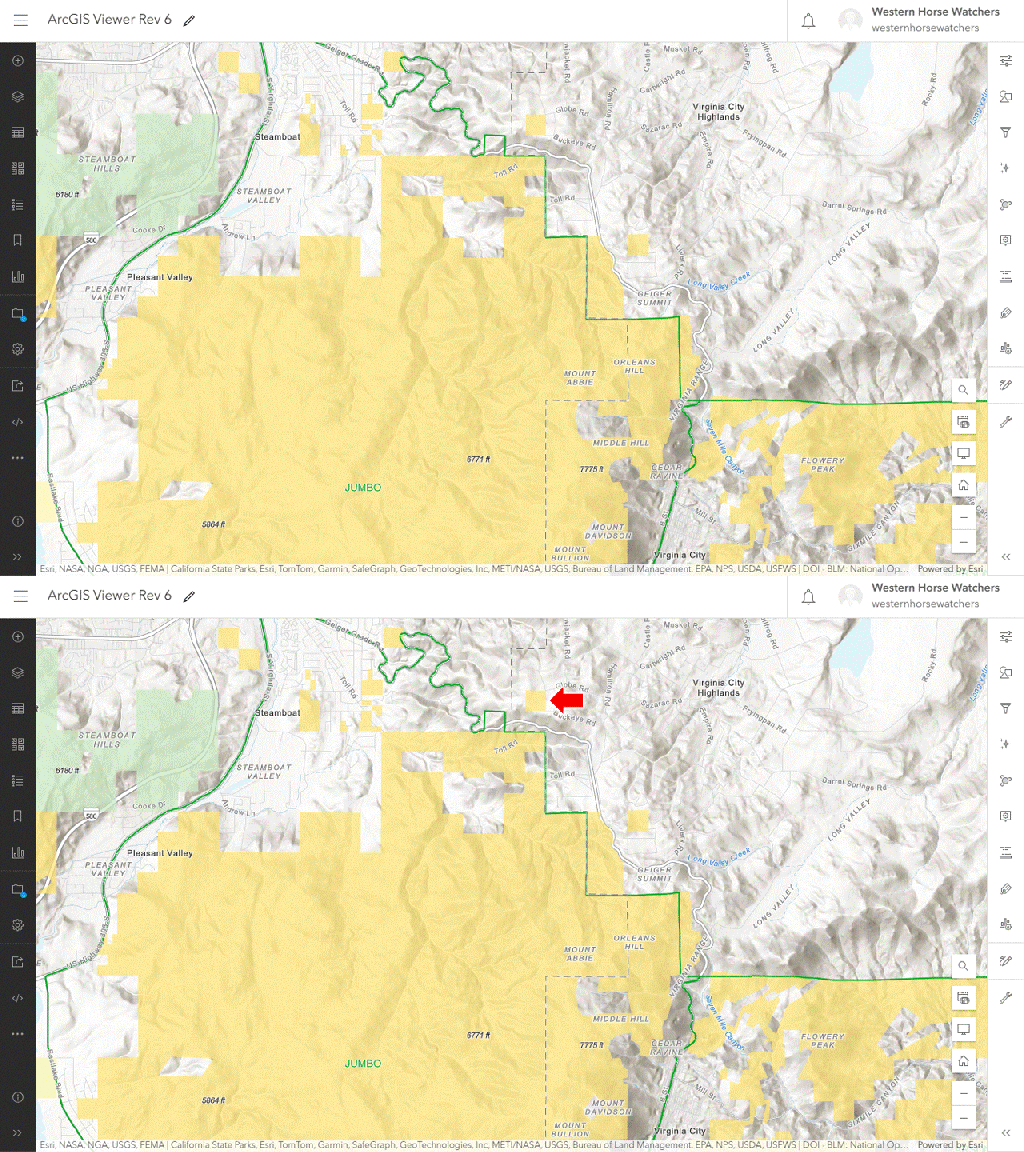
For example, APN 004-251-06, just inside the Storey County line and slightly north of the Jumbo Allotment, is in a developed area on the Virginia Range.
It’s designated as a single-family residence but owned by the BLM.
The 40-acre parcel has a seasonal pond, is mostly level, and power lines are about a half mile away.
Would probably fetch around $200,000.
Federally protected lands are not eligible for sale.
Unfortunately, the list of protected lands on page 31 does not include areas identified for wild horses and burros.
He’s one of the greatest proponents of the herd according to a story posted yesterday by the Powell Tribune.
The 2025 population dataset put the size at 149 and he’s already darted 45, which may be close to 100% of the breeding-age mares. Any left for the advocates?
His efforts are not mentioned at their darting page.
The HMA is a curated horse exhibit. There’s nothing natural about it.
Sterilized mares
Tiny breeding population
Lack of genetic diversity
Abnormal sex ratio
Massive human involvement
Habitat fragmented by allotments
Selection for faulty immune systems
All of this to prop up a failed industry, referred to in the article as the folks with stock.
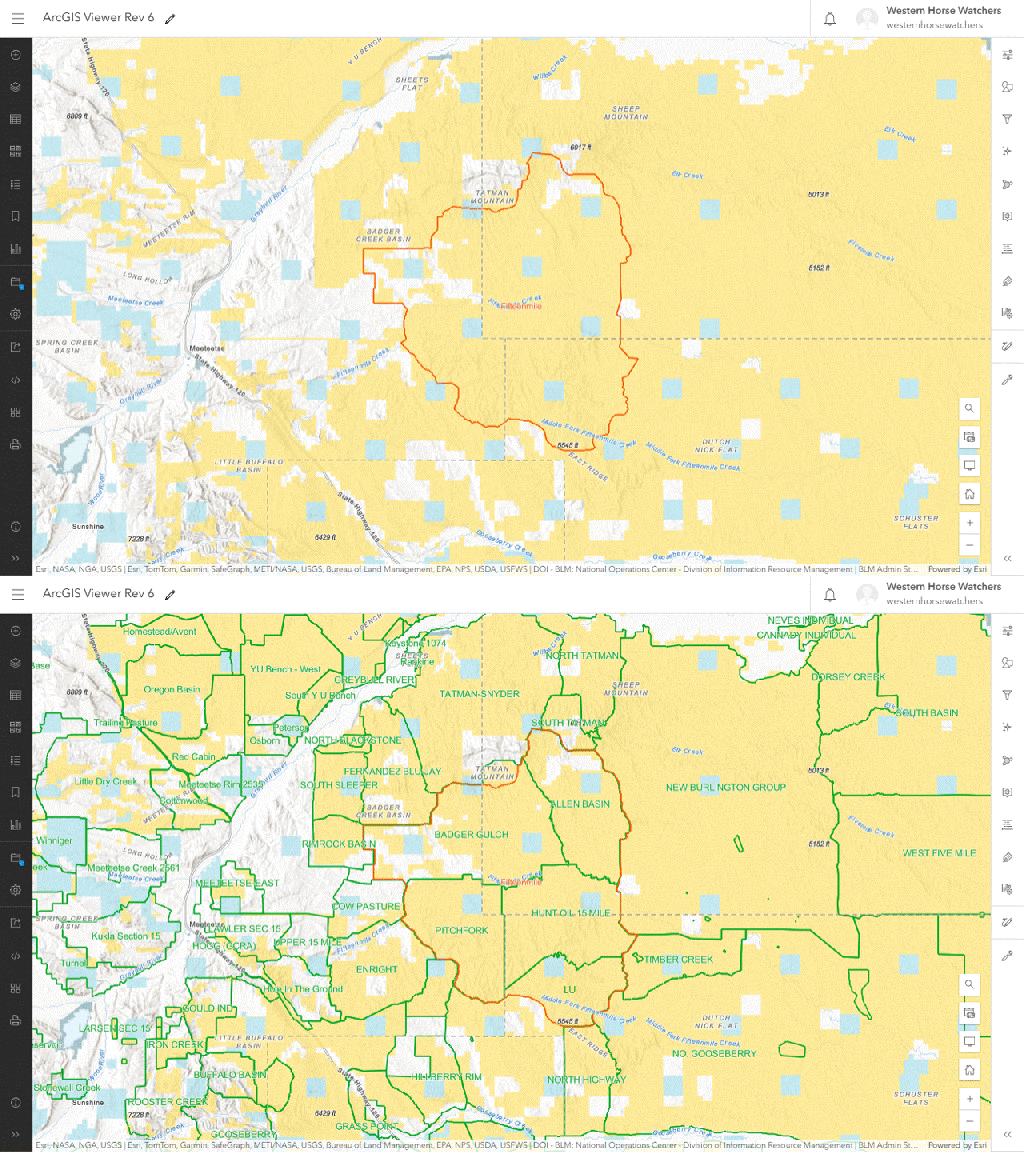
The allotment lies mostly within the Fifteenmile HA but outside the HMA, as shown in the ArcGIS Viewer.
The Allotment Master Report puts it in the Improve category, another indication that your stewards of the public lands have not been taking their responsibilities seriously.
The permittees receive 6,207 active AUMs on 94,000 public acres.
If the area was designated for wild horses, how many could live there?
The forage assigned to livestock is equivalent to 517 wild horses, or 5.5 wild horses per thousand public acres.
Your faithful public servants claim that public lands in the western U.S. can only support one wild horse per thousand acres (25,500 animals on 25.6 million acres).
The advocates, defeated a long time ago, reinforce the narrative with their darting programs.
If the allotment was an HMA, the AML would be 94 and 423 wild horses would be consigned to off-range holding because of permitted grazing.
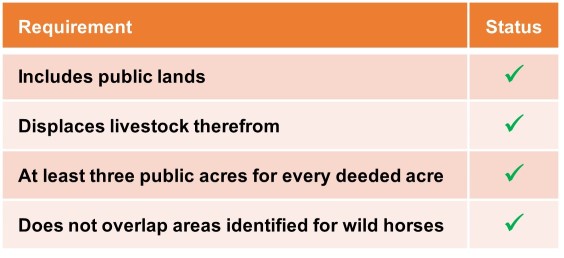
Wild horses can be placed on public lands not identified for their use by acquiring base properties associated with grazing allotments and flipping the preference to horses.
An article by The Colorado Sun points to a long-term challenge in the management of the state’s wild horses: Many of the advocates are growing older and there is not much interest among young people in taking over.
Given that wild horse management generally equates to beating the numbers down with ovary-killing pesticides, that’s a good thing.
The Draft DNA asserts that a 2019 EA fully covers the removal of wild horses later this year and constitutes BLM’s compliance with the requirements of the NEPA.
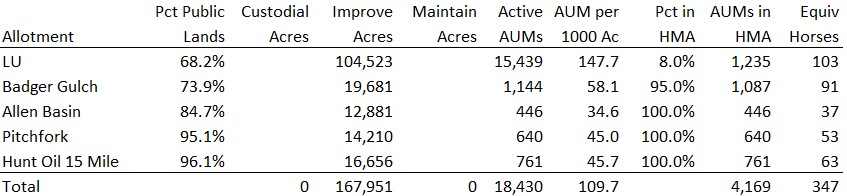
The EA indicates on page 21 (page 24 in the pdf) that five allotments overlap the HMA.
The Allotment Master Report gives management status, acreage and active AUMs.
The EA does not give the percentage of public lands inside the HMA but those numbers can be estimated from the ArcGIS Viewer.
The allotments offer a weighted average 109.7 AUMs per thousand public acres, equivalent to 9.1 wild horses per thousand public acres.
Your faithful public servants claim that public lands in the western U.S. can only support one wild horse per thousand acres (25,500 animals on 25.6 million acres).
The HMA covers 68,607 public acres and has an AML of 230 according to the 2025 population dataset.
The HMA supports livestock equivalent to 347 wild horses, so the True AML would be 230 + 347 = 577.
The stocking rate would be 8.4 wild horses per thousand public acres.
Simone Netherlands of the Salt River Wild Horse Darting Group and Suzanne Roy of the Campaign Against America’s Wild Horses should be ordered to appear before the Board—if there is one—and put under oath to discuss the condition of the herd.
The title should say “How should Utah fix the mismanagement of resources in the lawful homes of wild horses and burros?” not “How should Utah rein in the wild horse and burro problem?”
The writer noted that wild horse and burro numbers in the state far exceed appropriate management levels and that animals are straying outside of federal management areas.
The first report, appearing last week, was for June 12.
Results for June 13 say June 12.
The totals at the gather page say 169 animals gathered and 91 shipped but the daily reports, June 9 through June 16, yield 225 animals captured and 128 shipped.
An NPS outfitter leading a horse tour at the Ozark National Scenic Riverways found the youngster with its mom, unable to move its hind legs according to a story by KY3 News.
He was killed on impact and the driver was arrested for DWI according to a report by The Outer Banks Voice.
The incident follows the loss of a colt earlier this month, putting more pressure on a herd that’s struggling to survive, not because of careless drivers but because of heartless women who ruined the mares with PZP.
Those who sound the alarm about wild horses and burros are often among their worst enemies.
Take for example the Campaign Against America’s Wild Horses, a leader in humane disposal and faithful servant of the bureaucrats and ranchers.
Who’s the greater threat to wild horses, a President whose budget will be tempered by Congress or a nonprofit that’s wiping out herds with mass sterilization?
Do these people not understand that the Campaign Against America’s Wild Horses, a leader in nonmotorized removal and servant of the public-lands ranchers, is sterilizing the Virginia Range mares with PZP, a restricted-use pesticide that tricks the immune system into attacking their ovaries?
How stupid do you have to be to support an organization like that?





 Western Horse Watchers Association