In some circles it’s known as Giving Tuesday but think of it as an opportunity to give the advocates the boot.

Western Horse Watchers Association
Exposing the Hypocrisy, Lies and Incompetence of the Wild Horse Advocates
In some circles it’s known as Giving Tuesday but think of it as an opportunity to give the advocates the boot.
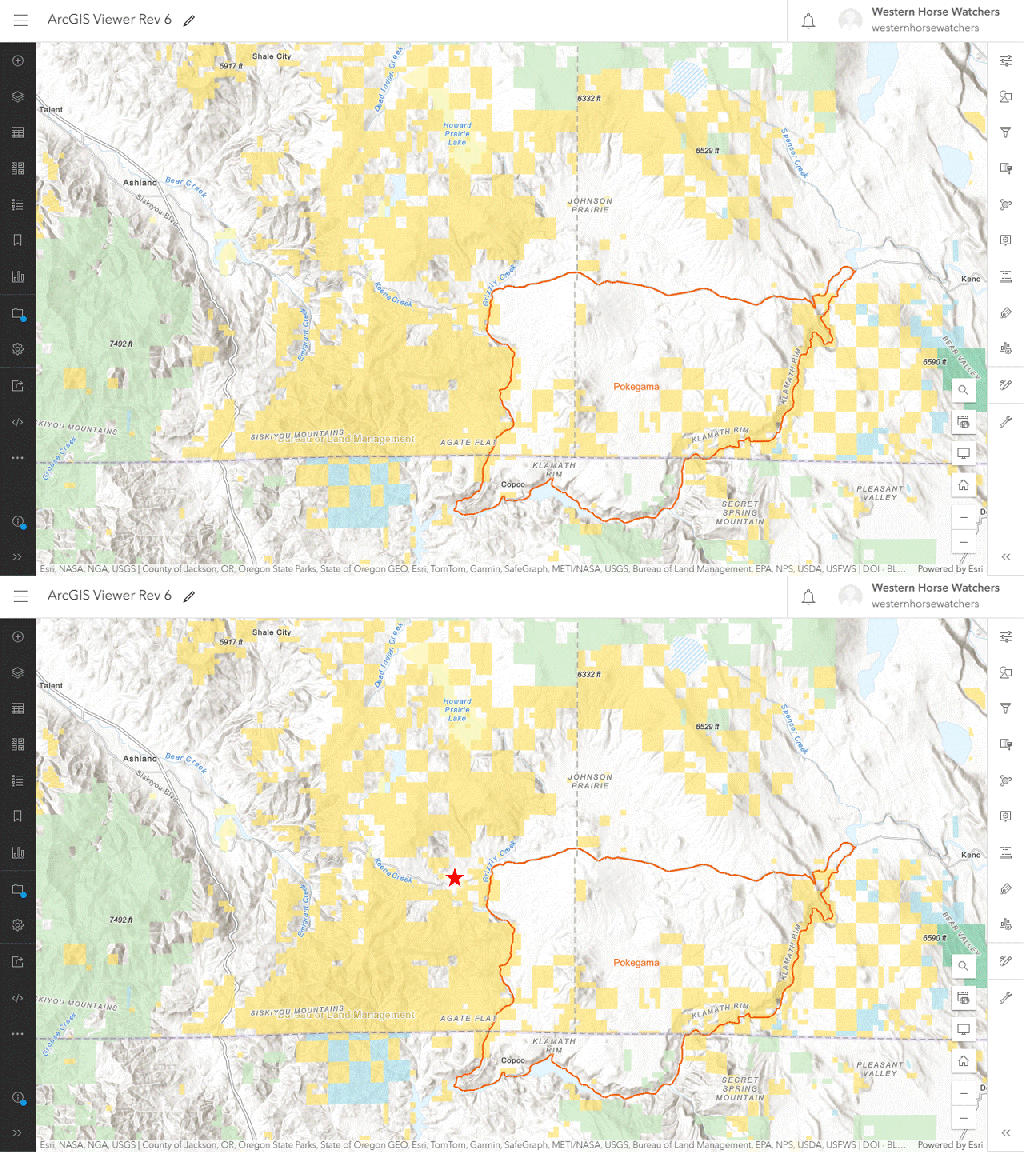
The Decision Record authorizes the Proposed Action, discussed in Section B of the Categorical Exclusion, clearing the way for bait-trap removal of six wild horses that have strayed from the Pokegema HMA onto school property.
A map of the project area was not provided but the incident would probably take place near Highway 66 on the west side of the HMA based on the school address.
The news release did not indicate if Oregon was a fence-out state and if the barrier around the school meets the requirements of a legal fence.
Funding for the operation would come from ______________________.
RELATED: No FY26 Budget, No FY26 Roundup Schedule.
Bidders paid $1,051,726 for 14,116 AUMs, or $74.50 per AUM according to today’s news release, suggesting that the American people are not receiving a fair price for grazing on term permits, which is currently set at $1.35 per AUM.
RELATED: BLM Announces McGregor Grazing Auction.
The incident will begin on October 4.
The removal goal is 270 but the actual number of horses and burros is flexible.
A helicopter will push the animals into the traps.
Operations will not be open to public observation.
There are no plans to treat any of the females with fertility control pesticides and return them to the range.
Captured animals will be taken to the off-range corrals at Ridgecrest.
The HMA overlaps the northern half of the naval air weapons station at China Lake.
The news release did not indicate if the animals were confined to the area by fencing or if the advocates had offered to sterilize the mares and jennies with PZP.
BLM land adjacent to the facility is subject to permitted grazing.
Funding for the roundup will come from __________________________.
RELATED: No FY26 Budget, No FY26 Roundup Schedule.

At the Green Mountain HMA with Wyoming PBS.
The proposal would withdraw approximately 5,000 public acres from settlement, sale, location and entry under the general land laws, subject to existing rights, and reserve the area for military purposes.
The BLM news release does not include a map or link to a NEPA project but a notice in the Federal Register gives the townships, ranges and sections which can be found in the PLSS layer of the ArcGIS Viewer.
Most of the project area is in the Coyote Lake HMA, or, if you prefer, the Coyote Lake Allotment, with a small portion in 15-Mile Community.
The Air Force would place two transmitters in Christmas Valley according to an article by Oregon Public Broadcasting. The facility on BLM land, about 150 miles to the southeast, would contain two receivers.
The project area covers 16 sections, for a total of 10,240 acres, so the withdrawn lands would be somewhere inside the blue box in the following map.
Comments will be accepted through December 29.

The House passed a continuing resolution that would fund the government through November 21 but it failed in the Senate.
Republicans need at least eight Democrat votes in that chamber to get it across the finish line according to a report by The Hill.
Any amendments would send it back to the House, which is not in session.
Another option is a partial government shutdown.
As of today, a FY26 schedule has not been posted to the BLM gather page.
The advocates will not receive any new funding for their PZP sterilization programs until FY26 appropriations bills have been signed into law and maybe then, given the desire to cut federal spending, not at all.
The new fiscal year begins on October 1.

The off-range corrals will close at the end of November according to a report by The Grand Junction Daily Sentinel.
The decision was financially driven.
Animals currently at the facility will be transferred to corrals in Wyoming and Utah.
UPDATE: The CDOC news release says that approximately 100 horses taken from Colorado HMAs will be placed into private care within the state.
The incident started on August 27.
The documented capture total through September 25 is 209, including 92 stallions, 98 mares and 19 foals.
Youngsters accounted for 9.1% of the sample.
Of the adults, 48.4% were male and 51.6% were female.
The average daily take is 7.0.
A horse died on Day 30 for unspecified reasons, bringing the total deceased to 7.
The death rate is 3.3%.
The Forest Service does not include deceased animals in the daily breakdowns.
Body condition scores were not given.
The number of animals shipped is not known.
The operation has liberated 2,508 AUMs per year.
The WHT is subject to permitted grazing.
The legacy contractors use helicopters to take wild horses off the range.
Other suppliers use baited traps.
The advocates prefer ovary-killing pesticides.
Although their methods differ, they are united by a shared goal.
RELATED: Foal-Free Friday, Searching for Integrity Edition.

Now they’re billing it as education and awareness.
The Campaign Against America’s Wild Horses will serve cookies and hot cider on October 23 as they try to convince you that mass sterilization is a humane alternative to motorized removal.
How stupid do you have to be to believe anything from these phonies?
RELATED: An Evening of Education and Advocacy for Wild Horses?

John Mack has left the group over disagreements with founder Jacquelyn Hughes as to how many horses should be removed from the Salt River herd according to a report by Phoenix New Times.
That shifts management responsibilities to Hughes for five years if AZDA was to select her proposal, which is not her style.
As a wild horse removal contractor, she wants to get in, get the job done and move on to the next opportunity.
By contrast, the Salt River advocates have stayed the course, which is necessary to sterilize the mares.
The agency published a signed decision on August 7 for temporary water hauls in the Stone Cabin and Willow Creek allotments, which contain the HMA.
A DNA worksheet was also copied to the project folder.
The decision document says on page three that water is the most effective tool for distributing cattle on arid lands and that the animals are unlikely to venture more than two miles from a water source, linking permitted grazing to riparian deterioration.
In response to a comment from the Nevada Department of Animal Agriculture, the BLM indicated that it may consider removal of wild horses if conditions persist. Refer to item 1 in Exhibit 3.
The Drought Monitor puts the project area in category D2, severe drought.
Persons who participated in the planning process have until September 30 to dispute the plan.
RELATED: Clifford Spring Exclosure Won’t Isolate Stone Cabin Horses.

The incident started on August 27.
The documented capture total through September 20 is 177, including 74 stallions, 86 mares and 17 foals.
Youngsters represented 9.6% of the sample.
Of the adults, 46.3% were male and 53.8% were female.
The average daily take is 7.1.
A horse was dispatched on Day 18 for unspecified reasons, followed by another on Day 21, bringing the total deceased to 6.
The death rate is 3.4%.
Body condition scores were not given.
The number of animals shipped is not known.
The operation has liberated 2,124 AUMs per year.
The WHT is subject to permitted grazing.
At the southwest corner of the Virginia Range with Jeff Martinez. Check out the darting injury at 2:09. The advocates are trying to convince the bureaucrats and ranchers that they can be as ruthless as the helicopter pilots and wranglers.
The advocates asserted in the Nevada Current op-ed that “America’s wild horses have faced competition from livestock, unfair resource allocation, and shrinking habitat for generations,” which is a fair statement, but their solution is completely unrelated and can only make the problem worse.
Makes perfect sense once you realize they’re in the tank for the ranchers.
Bobby Khan, a candidate for the seat currently held by a co-founder of the pesticide caucus and author of the “Ground a Helicopter, Sterilize a Mare” Act, has proposed a five-step plan for resolving the issues.
1. End the Roundups. “Halt helicopter roundups and stop funneling horses into holding facilities or auctions.” The goal is to end the removals not the roundups. Bait trapping and fertility control are alternate methods of removal.
2. Return Horses to the Wild. “Reintroduce horses and burros to their designated lands where they legally belong.” Not if they’re managed principally for livestock.
3. Herd Management Solutions. This one wrecks the whole program: “Work with experts, ranchers and advocates to implement responsible herd management practices that protect horses and respect ranching interests.” Resource management is a zero-sum game. What you give to the ranchers must be taken from the horses. This is why there so many in off-range holding. Not compatible with item 2.
4. Cut Costs and Save Taxpayer Money. “Replace costly confinement programs with humane, natural management that saves taxpayers hundreds of millions of dollars annually.” Probably a reference to fertility control, straight out of the advocates’ playbook.
5. Build Coalitions for Change. “Partner with leaders, advocates, and public voices…to bring national attention and action to the issue.” Enlarging the committee will not produce the required knowledge.
RELATED: Palomino Valley Horse Rally Won’t Break Any New Ground.

The event, organized by the Campaign Against America’s Wild Horses, is set for October 23 in Virginia City.
The topic is wild horse management on the Virginia Range.
They’ll sell the program as humane population reduction or wild horse conservation, but it’s really mass sterilization.
There’s nothing natural about it and it’s all based on myths propagated by bureaucrats, hunters and ranchers.

From the solutions page at Bobby Khan for Congress:
“He’ll fight to ban helicopter roundups, demand full transparency from the Bureau of Land Management, and push for humane, science-based herd management solutions. That includes fertility control, strategic rewilding, and support for sanctuaries and tribal partnerships doing the real work on the ground.”
Sounds just like the advocates.
RELATED: Political Rally at Palomino Valley Off-Range Corrals?
Stakeholders said it created regulatory uncertainty, reduced access to public lands and undermined the multiple-use mandate established by Congress according to the news release.
A 60-day comment period began with publication of a notice in the Federal Register.
Wild horses fall under “historical values” in the definition of multiple use in FLPMA.
RELATED: Public Lands Rule Published.
 Western Horse Watchers Association