McCullough Roundup, Day 47

The incident started on January 22.  Results through March 8:

  • Scope: McCullough Peaks HMA
  • Target: Horses
  • Method: Bait
  • Type: Planned
  • Goals: Gather 80, remove 35
  • Captured: 90, no change from Day 46
  • Shipped: 24, no change from Day 46
  • Released: 51, up from 41 on Day 46
  • Deaths: 1, no change from Day 46
  • Average daily take: 1.9
  • Unaccounted-for animals: 14

The Day 47 report said trapping was complete.

The capture goal has been exceeded by 12.5%.

The 14 horses in temporary holding will likely be shipped, bringing the total removed to 39 and beating the goal by 11%.

The number of mares treated with fertility control pesticides is unknown.

The death rate is 1.1%.

The location of the trap site was not disclosed.

Body condition scores were not provided.

The HMA is subject to permitted grazing.

  • Forage liberated to date: 468 AUMs per year
  • Water liberated to date: 390 gallons per day

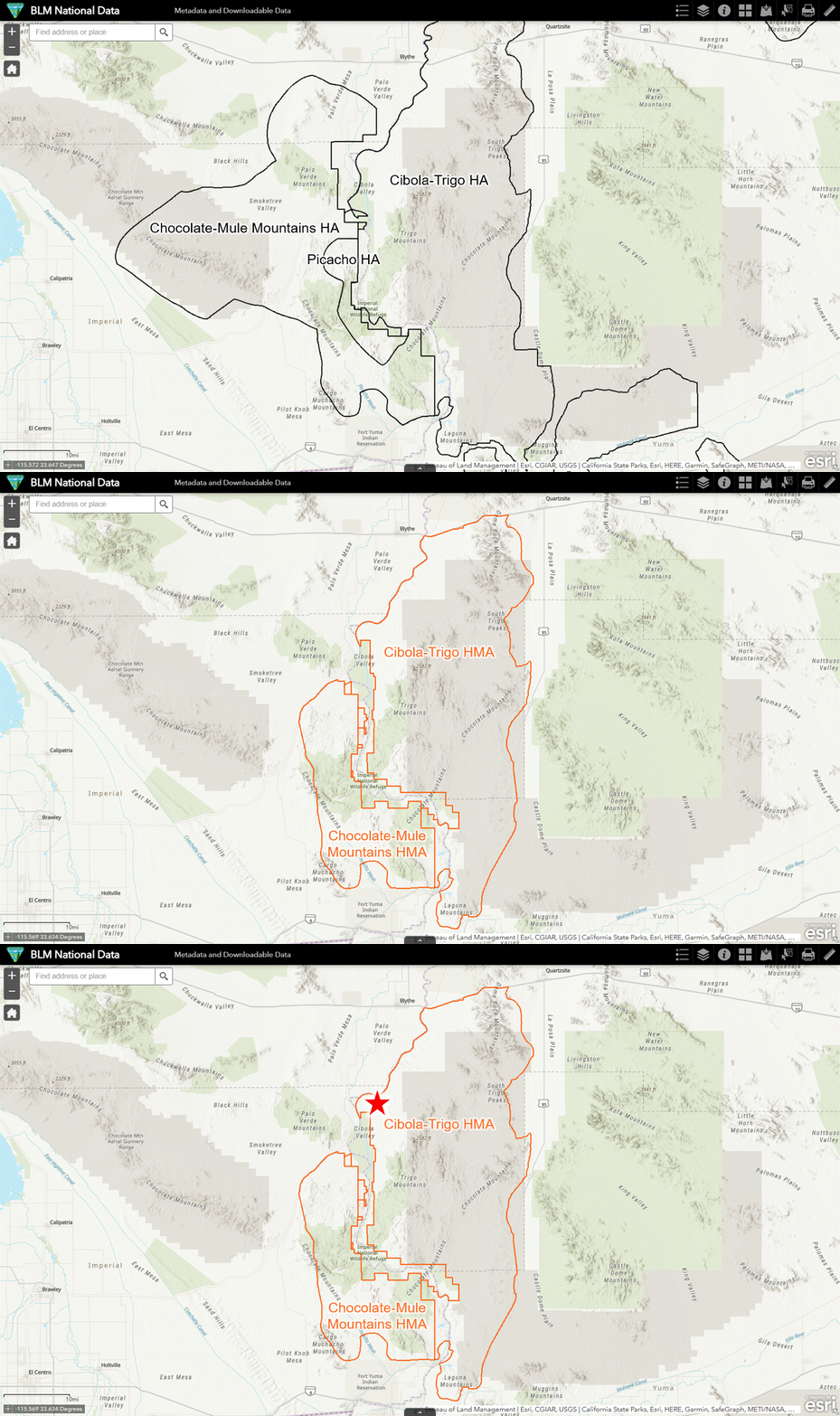
The National Data Viewer shows habitat loss and overlapping allotments.  Click on map to open in new tab.

An estimated 535 wild horses have been displaced from their lawful home by permitted grazing, making the True AML almost five times higher than the current AML.

The roundup supports three tenets of rangeland management.

RELATED: McCullough Roundup, Day 46.

McCullough Peaks HMA with Allotments 07-14-23

Congress Trims WHB Budget by Four Percent in FY24

The explanatory statement for Interior, Environment, and Related Agencies, one of six spending bills approved by the Senate yesterday and signed into law today, provides $141,972,000 for the program in FY24, down from $147,888,000 in FY23.

Go to the table on page 179.

With a growing number of animals in off-range holding, thanks to aggressive efforts this year to force them from their lawful homes, the reduction may necessitate some changes to the FY24 roundup schedule.

The statement indicates that up to $11,000,000 can be spent on the use of ovary-killing pesticides such as PZP, which it describes as “a robust and humane fertility control strategy of reversible immunocontraceptive vaccines.”

Pesticide Patrol 08-16-23

Senate Orders Park Service to Keep Wild Horses at TRNP?

A report by KFGO News says Congress passed legislation directing the Park Service to keep horses in Theodore Roosevelt National Park.

A report by WZFG News says the bill directs the National Park Service to maintain “the historic scene commensurate with the historic herds during the period when President Theodore Roosevelt was a rancher in the area.”

A search of Congress.gov for “historic scene commensurate” yielded only one result, a report accompanying a FY24 spending bill for the Department of the Interior.

The language appears on page 40 of the pdf.

RELATED: Hard Truths about TRNP Horses

UPDATE: A story by The Hill indicates the Senate passed a $460 billion spending package yesterday, after the House approved it on Wednesday, providing funding for the departments of Veterans Affairs, Agriculture, Interior, Transportation, Housing and Urban Development, Justice, Commerce and Energy, among others.  A link to the legislation was not included.

UPDATE: A news release by the White House indicates it’s HR 4366.

Railroad Valley Base Property Offered for $6.5 Million

The Jones Boys Ranch covers 435 deeded acres near Lockes, NV, a ghost town on U.S. Highway 6.

There are two houses on the property: The main home has three beds and two baths, the bunk house has 2/2.

A spring produces over 200 gpm according to the listing.

The deeded acreage is surrounded by the Butterfield Allotment, on which the property has grazing preference.

The allotment overlaps a small portion of the Quinn and White River HAs.

The National Data Viewer shows the arrangement.  Click on image to open in new tab.

The parcel offers 4,776 active AUMs on 122,080 public acres, according to the Allotment Master Report, enough to support 398 wild horses.

The stocking rate would be 3.3 wild horses per thousand public acres.

This brings more distress to the bureaucrats and ranchers, who insist that public lands in the western U.S. can only support one wild horse per thousand acres (27,000 animals on 27 million acres).

The allotment is in the Custodial category with condition unknown.  This is unusual for a parcel of this size.  Buyers should discuss with the Tonopah Field Office.

As with other base properties, the new owner could petition the BLM for a change in livestock type and season of use so horses could roam the area, as American Prairie did for bison in Montana.

Butterfield Allotment with HAs 03-08-24

McCullough Roundup, Day 46

The incident started on January 22.  Results through March 7:

  • Scope: McCullough Peaks HMA
  • Target: Horses
  • Method: Bait
  • Type: Planned
  • Goals: Gather 80, remove 35
  • Captured: 90, up from 68 on Day 44
  • Shipped: 24, up from 14 on Day 44
  • Released: 41, up from 40 on Day 44
  • Deaths: 1, no change from Day 44
  • Average daily take: 2.0
  • Unaccounted-for animals: 24

The figures above are based on the daily reports.

No horses were shipped on Day 45 due to poor road conditions.

The capture goal has been exceeded by 12.5%.

Roughly half of the horses in temporary holding would need to be shipped to achieve the removal goal.

Retained mares might be treated with fertility control pesticides before release.

The churn rate has decreased sharply in the last three days, suggesting that the Cody Field Office has switched from a fishing expedition to Git-R-Done.

The death rate is 1.1%.

The location of the trap site was not disclosed.

Body condition scores were not provided.

The HMA is subject to permitted grazing.

  • Forage liberated to date: 588 AUMs per year (will go down if horses returned)
  • Water liberated to date: 490 gallons per day (ditto)

The National Data Viewer shows habitat loss and overlapping allotments.  Click on map to open in new tab.

An estimated 535 wild horses have been displaced from their lawful home by permitted grazing, making the True AML almost five times higher than the current AML.

The roundup supports three tenets of rangeland management.

RELATED: McCullough Roundup, Day 44.

McCullough Peaks HMA with Allotments 07-14-23

Foal-Free Friday, Dancing Like Marionettes Edition

This result appeared yesterday in a Google search for “wild horses.”

Reality of Roundups 03-07-24

If the advocates actually believed this, they wouldn’t be so eager to get rid of the horses.

It’s theater.  They want the ranchers to win.

They go through the motions to win your support but in reality their hearts are very far from the horses.

VR Darting Injury 09-15-21

RELATED: Foal-Free Friday, Scribes and Pharisees Edition.

McCullough Roundup, Day 44

The incident started on January 22.  Results through March 5:

  • Scope: McCullough Peaks HMA
  • Target: Horses
  • Method: Bait
  • Type: Planned
  • Goals: Gather 80, remove 35
  • Captured: 68, up from 52 on Day 41
  • Shipped: 14, no change from Day 41
  • Released: 40, up from 37 on Day 41
  • Deaths: 1, no change from Day 41
  • Average daily take: 1.5
  • Unaccounted-for animals: 13

The figures above are based on the daily reports.

The Day 44 report said 16 horses were caught and three were released.  The status of the other 13 is not known.

The roundup continues to have a high churn rate.  If the 13 horses are shipped, the capture-to-remove ratio would drop to 2.4:1, in line with the target of 2.3:1.

Some horses may have been caught more than once.

The death rate is 1.5%.

The location of the trap site was not disclosed.

Body condition scores were not given.

The HMA is subject to permitted grazing.

  • Forage liberated to date: 336 AUMs per year (assuming 28 horses removed)
  • Water liberated to date: 280 gallons per day

The National Data Viewer shows habitat loss and overlapping allotments.  Click on map to open in new tab.

An estimated 535 wild horses have been displaced from their lawful home by permitted grazing, making the True AML almost five times higher than the current AML.

The roundup supports three tenets of rangeland management.

RELATED: McCullough Roundup, Day 41.

McCullough Peaks HMA with Allotments 07-14-23

Shackleford Herd Shrinks by Seven in 2023

At the end of 2023 there were 117 horses on Shackleford Banks, according to an undated report by NPS, down from 124 at the end of 2022.

Five foals were born in 2023, for a birth rate of four percent.

Twelve horses died.

The herd consisted of 62% females and 38% males at the end of December.

The low birth rate and unusual sex ratio are likely due to the safe, proven and reversible fertility control program.

Nine mares who had recent foals were treated in 2023.

The report did not indicate the pesticide of choice, but it is probably PZP.

Shackleford Banks is at the southern end of the Cape Lookout National Seashore.

RELATED: Shackleford Herd Grew Slightly in 2022.

CAAWH Spends $3.6 Million on Fish Springs Land Grab

Records at the Douglas County assessor’s office indicate the sale consisted of three transactions covering 21 APNs.

The project is dedicated to wild horse and burro habitat conservation according to a March 2 announcement distributed by Lucky Three Ranch.

Half of the parcels are designated for single family residences.

1. Document 2023-995176, Grant, Bargain, Sale Deed, $963,000.

2. Document 2023-995160, Grant, Bargain, Sale Deed, $2,067,100.

3. Document 2023-995179, Grant, Bargain, Sale Deed, $552,000.

  • 1321-00-001-021, 640 acres, agricultural qualified
  • Subtotal: 640 acres, average price $862.50 per acre

Grand total: $3,582,100 for 3,269.44 acres, average price $1,095.63 per acre.

This was the justification for the rebranding.

CAAWH Rebranding 02-29-24

In another example of conservation just a few miles north in Storey County, volunteers with the Campaign Against America’s Wild Horses have been pummeling the Virginia Range mares with pesticide-laced darts since 2019.

RELATED: CAAWH Seeks More Land in Pine Nut Mountains?

Pesticide Pushers 07-17-23

What Do the Darting Programs Have in Common?

Besides the hypocrisy, lies and collusion, no accountability to the public.

For example, the reports issued by the Campaign Against America’s Wild Horses for nonmotorized removal on the Virginia Range do not discuss the

  • Long-term population goal
  • Number of viable mares
  • Size of the breeding population
  • Loss of genetic diversity
  • Changes in death rate and sex ratio
  • Unlawful use of pesticides

The population of over 3,000 wild horses has produced only three foals this year.

That’s great news to the bureaucrats and ranchers, whom CAAWH serves, but it’s frightening to the rest of us.

How close is the herd to the tipping point, where it implodes because most of the mares are sterile?

You have a right to know but they’re not talking.

RELATED: Virginia Range Darting Update for February 2024.

Pesticides R Us Better Way 11-07-23

McCullough Roundup, Day 41

The incident started on January 22.  Results through March 2:

  • Scope: McCullough Peaks HMA
  • Target: Horses
  • Method: Bait
  • Type: Planned
  • Goals: Gather 80, remove 35
  • Captured: 52, up from 48 on Day 37
  • Shipped: 14, up from 9 on Day 37
  • Released: 37, up from 35 on Day 37
  • Deaths: 1, no change from Day 37
  • Average daily take: 1.3
  • Unaccounted-for animals: None

The figures above are based on the daily reports.

The Day 41 report said two more horses were removed, bringing the total to 15.

To check this value, subtract the horses released from the horses captured:

Removed = CapturedReleased = 52 – 37 = 15

The roundup continues to have a high churn rate.  The capture-to-remove ratio is 3.5:1, compared to a target of 2.3:1.

Some animals may have been caught more than once.

The death rate is 1.9%.

The location of the trap site was not disclosed.

The HMA is subject to permitted grazing.

  • Forage liberated to date: 180 AUMs per year
  • Water liberated to date: 150 gallons per day

The National Data Viewer shows habitat loss and overlapping allotments.  Click on map to open in new tab.

An estimated 535 wild horses have been displaced from their lawful home by permitted grazing, making the True AML almost five times higher than the current AML.

The roundup supports three tenets of rangeland management.

RELATED: McCullough Roundup, Day 37.

McCullough Peaks HMA with Allotments 07-14-23

Virginia Range Darting Update for February 2024

The Campaign Against America’s Wild Horses, a leader in nonmotorized removal, reported today that 161 mares received 161 doses of PZP during the month, 22 given as a primer and 139 as a booster.

Over the life of the program, which began in 2019, the advocates have pumped 8,770 doses of the pesticide into 1,998 mares.

Three foals have been born year-to-date.  One died of unspecified causes.

The current population is thought to be 3,444 with 338 horses listed as missing, compared to 3,465 with 342 horses listed as missing in January.

The population was 3,471 with 336 listed as missing in December.

The goal for March: “Continue to maximize booster treatments to mares across the Virginia Range before spring breeding season to prevent pregnancies, and continuing to allow for humane population decrease.”

Protecting Them From Removal 12-03-23

Not discussed in the report:

  • Long-term population goal
  • Number of viable mares
  • Size of breeding population
  • Loss of genetic diversity
  • Changes in death rate and sex ratio
  • Unlawful use of pesticides

PZP tricks the immune system into attacking the ovaries, resulting in sterility after five years of treatment.

The report will be submitted to the Nevada Department of Agriculture.

RELATED: Virginia Range Darting Update for January 2024.

Adjectives for Pests 12-01-23

Coalition Asks Wildlife Board to Support Anti-Horse Agenda

The Douglas County Advisory Board to Manage Wildlife took no action at its February 27 meeting regarding a letter prepared by the Coalition for Healthy Nevada Lands, Wildlife and Free-Roaming Horses, according to a story dated March 1 by The Record-Courier of Minden, NV.

A copy of the letter, seeking a reduction of wild horses on public lands. was not included in the report.

Advocates attending the meeting came not as spokesmen for the horses but as defenders of humane management.

They noted that the Coalition pushes for the removal of wild horses to the point they would no longer be genetically viable, yet that’s exactly what they’ve done with their ruinous darting program.

Although there are around 80 wild horses in the Fish Springs herd, Western Horse Watchers suspects the breeding population is now in the single digits.

The sex ratio is likely skewed in favor of females.

The number of viable mares is unknown.

The Pine Nut advocates receive material support from the Campaign Against America’s Wild Horses, leader of the blind and recognized expert in nonmotorized removal.

Advocates Bawling About Removal of McCullough Filly

They say she’s too young to be separated from her mom, according to a story dated March 2 by Cowboy State Daily.

Are they upset because the government is getting rid of the horses and not them?

Getting Rid of Wild Horses Is Our Job 10-14-23

The article said the youngster was taken on February 22 but the report for that day shows no foals captured or removed.

Most folks in the horse world would not refer to a six-month-old female as a mare.

RELATED: Advocates Bawling About Loss of McCullough Filly?

The Allotments Tell the Story: They’re Lying, All of Them

Public lands in the western U.S. can only support one wild horse per thousand acres according to the bureaucrats, ranchers and advocates (27,000 animals on 27 million acres).

A corollary is that public lands in the western U.S. can only produce 12 AUMs per year per thousand acres.

But in case after case, the latest being the base properties offered by Harry Ranch, the data show otherwise.

The allotments tied to those parcels produce enough forage to sustain from five to seven times as many wild horses.

This is the dirty little secret of rangeland management.

The roundups, darting programs and outplacement services are not necessary.

They were contrived to protect the ranchers.

Consider the undated infographic for the WHB program in FY23, especially the list of new partners at the bottom of page one.

They are defeatists, pesticide pushers and ranching sympathizers.

How do you oppose the juggernaut?

Use their own data against them.

That means having a basic understanding of the National Data Viewer, the Allotment Master Report and some simple arithmetic.

The other option is to throw in with the Love Triangle and kiss the herds goodbye.

RELATED: The Three Tenets of Rangeland Management.

Working Together for a Horse-Free Future 12-21-22

Voices of Defeat

This result appeared today in a Google search for “wild mustangs.”

Voices of Defeat 03-01-24

Are you surprised that it was posted to a site controlled by the Campaign Against America’s Wild Horses?

The underlying assumption is that wild horses and burros need to be removed from their lawful homes (in favor of privately owned livestock).

This is the sound of defeat, a defining characteristic of wild horse advocacy.

Western Horse Watchers would rather see the WHB Act restored to its original form, the ranchers confined to their base properties and the advocates banned from areas identified for wild horses and burros.

RELATED: Capitulation, Surrender, Defeat.