Challenge to SOWH Conferees

Get out of the classroom and see how many barren mares you can find on the Virginia Range.

Should be easy.

Last week the Campaign Against America’s Wild Horses, a leader in nonmotorized removal, reported that only eleven foals have been born this year to a population of nearly 3,500, thanks to them.

The herd is reaching the tipping point.

Although publicly CAAWH denies that PZP is a sterilant (refer to following video), its own literature states otherwise.

CAAWH Self Boosting Mares 04-07-24

Refer to the Advocatespeak Decoder for the meaning of “self-boost.”

The conference provides an opportunity for organizers and attendees to denounce the sterilization effort, which will spread to other areas once the bureaucrats and ranchers realize its finality.

Condemnation forthcoming?  Don’t bet on it.

RELATED: Backdrop for Saving Wild Horses Conference: Mass Sterilization.

Codewords for Ranching Superiority (on Public Lands)

Like the advocates, the bureaucrats use deceptive language to mislead the public about their true intentions and loyalties.

In 1971, Congress declared that wild horses and burros were to be protected from capture, branding, harassment and death.

Areas where they were found were to be managed principally for them.

Today, the wild horse and burro program operates as a grazing program ancillary, supporting three tenets of rangeland management.

This process is sold to the American people as

  • Achieving and maintaining AMLs,
  • Healthy horses on healthy rangelands, and
  • Restoring a thriving ecological balance and multiple-use relationship,

Meaning that livestock operators receive most of the authorized forage in the lawful homes of wild horses.

But inverting the priorities is not enough.

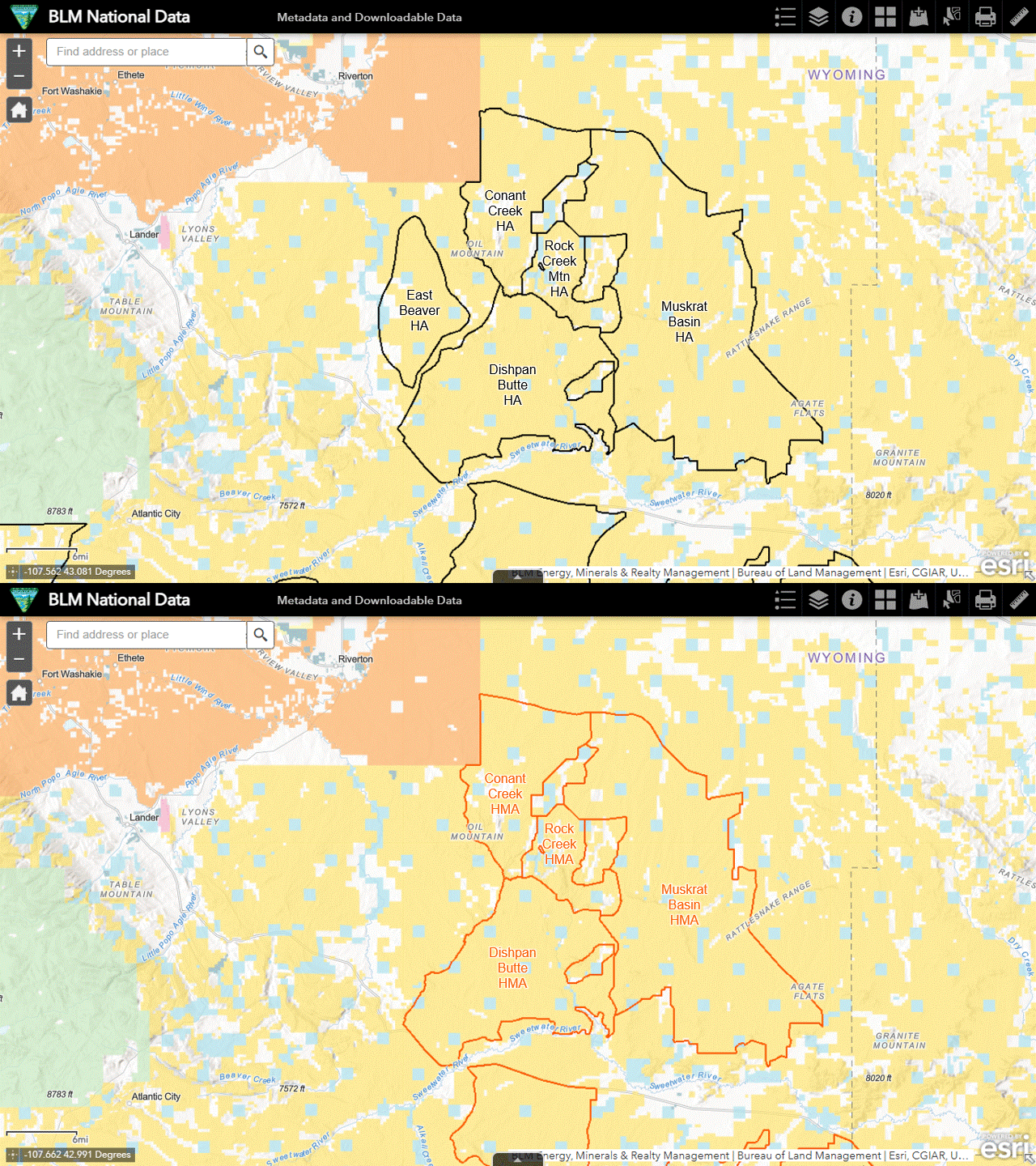
Congress is unlikely to repeal in the statute so the bureaucrats have opted for long-term nullification through the planning process, one HMA at a time.

The Caliente Complex is a perfect example.

The advocates condone the effort through their darting programs.

RELATED: Codewords for Nonmotorized Removal (of Wild Horses).

Thriving Ecological Balance-3

Foal-Free Friday, Shooting the Messenger Edition

Your host is not a villain, he tells you about the villains.

  • Western Horse Watchers is not pursuing a hidden agenda, the advocates are

We Want the Ranchers to Win 04-04-24

  • Western Horse Watchers is not poisoning the mares with ovary-killing pesticides, the advocates are
  • Western Horse Watchers is not selling eradication as conservation, the advocates are

Better Way 10-25-23

  • Western Horse Watchers is not driving the breeding populations into the single digits, the advocates are
  • Western Horse Watchers is not skewing the sex ratios in favor of females, the advocates are
  • Western Horse Watchers is not inflicting injuries and infections, the advocates are

VR Darting Injury 09-15-21

  • Western Horse Watchers is not praying for the older horses to die, the advocates are
  • Western Horse Watchers is not blowing smoke up your butt about HMAPs, the advocates are
  • Western Horse Watchers is not telling you that PZP is reversible, the advocates are
  • Western Horse Watchers is not promoting the overpopulation narrative, the advocates are
  • Western Horse Watchers is not trying to hide the mismanagement of resources in areas identified for wild horses, the advocates are

Changing the Way Herds are Managed 11-04-23

  • Western Horse Watchers is not desperate for a seat at the table, the advocates are
  • Western Horse Watchers is not fighting for ranching superiority in the lawful homes of wild horses, sometimes referred to as achieving and maintaining AMLs, the advocates are

Why don’t you hear about this?  It’s illegal for the government to stifle free speech so today’s messengers are silenced by its big-tech minions.

RELATED: Foal-Free Friday, Arithmetic for Advocates Edition.

Virginia Range Darting Update for March 2024

The Campaign Against America’s Wild Horses, a leader in nonsurgical sterilization, reported today that 165 mares received 165 doses of PZP during the month, 31 given as a primer and 134 as a booster.

Over the life of the program, which began in 2019, the advocates have pumped 8,927 doses of the pesticide into 2,007 mares.

Eleven foals have been born year-to-date.  One died of unspecified causes.

The current population is thought to be 3,480 with 353 horses listed as missing, compared to 3,444 with 338 horses listed as missing in February.

The population was 3,465 with 342 horses listed as missing in January and 3,471 with 336 listed as missing in December.

The goal for April: “Continue to maximize booster treatments to mares across the Virginia Range as we move through spring breeding season to prevent pregnancies, and continuing to allow for humane population decrease.”

Let Us Fix Your Wild Horse Problem 02-18-23

Not discussed in the report:

  • Long-term population goal
  • Number of viable mares
  • Size of breeding population
  • Loss of genetic diversity
  • Changes in death rate and sex ratio
  • Unlawful use of pesticides

PZP tricks the immune system into attacking the ovaries, resulting in sterility after five years of treatment.

The report will be submitted to the Nevada Department of Agriculture.

RELATED: Virginia Range Darting Update for February 2024.

Adjectives for Pests 12-01-23

Any Wild Horses to See 2024 Total Solar Eclipse?

Not on the east coast and not out west but horses in the Ozark National Scenic Riverways will.

An article by the Park Service puts the town of Eminence in the zone of totality and with it most of the park.

The Pulltite Campground is on the western edge.  Click on image to open in new tab.

An interactive map by NASA shows the track across the U.S.  The event occurs April 8.

Ozark National Scenic Riverways 04-04-24

If Sourdough Was Managed Principally for Wild Horses

The AML would be 545 and the stocking rate would be 7.9 animals per thousand public acres.

The allotment, located southeast of Harper, OR, offers 6,538 active AUMs on 68,844 public acres, according to the Allotment Master Report.

The bureaucrats and ranchers tell us that public lands in the western U.S. can only support one wild horse per thousand acres (27,000 animals on 27 million acres).

The advocates give credence to the story with their darting programs.

If it was an HMA, the AML would be 70 and 475 horses would be consigned to off-range holding because of permitted grazing.

RELATED: The Allotments Tell the Story: They’re Lying, All of Them.

Sourdough Allotment 04-01-24

Lake Pleasant Roundup, Day 51

The incident started on February 5.  Results through March 26:

  • Scope: Lake Pleasant HMA
  • Target: Burros
  • Type: Planned
  • Method: Bait
  • Goals: Gather 400, remove 400
  • Captured: 183, up from 144 on Day 22
  • Shipped: 180, up from 93 on Day 22
  • Released: None
  • Deaths: 3, no change from Day 22
  • Average daily take: 3.6
  • Unaccounted-for animals: 0

The figures above are based on the daily reports.

No activity was reported between February 28 and March 25.

The death rate is 1.6%.

The capture total includes 78 jacks, 80 jennies and 25 foals.

Youngsters represented 13.7% of the animals gathered.

Of the adults, 49.4% were male and 50.6% were female.

The HA and HMA are the same size.  The area is subject to permitted grazing.

  • Forage liberated to date: 1,098 AUMs per year
  • Water liberated to date: 915 gallons per day

There are no plans to treat any of the jennies with fertility control pesticides and return them to the range.

The roundup targets animals that are damaging private property and creating a public safety hazard, purposes for which PZP was not authorized.

The incident supports three tenets of rangeland management.

RELATED: Lake Pleasant Roundup, Day 22.

Lake Pleasant HMA with Allotments 02-06-23

If Keeney Creek Was Managed Principally for Wild Horses

The AML would be 598 and the stocking rate would be 10.1 animals per thousand public acres.

The allotment, located south of Harper, OR, offers 7,180 active AUMs on 59,439 public acres, according to the Allotment Master Report.

The bureaucrats and ranchers tell us that public lands in the western U.S. can only support one wild horse per thousand acres (27,000 animals on 27 million acres).

The advocates reinforce the narrative with their darting programs.

If it was an HMA, the AML would be 60 and 538 horses would be consigned to off-range holding because of permitted grazing.

RELATED: The Allotments Tell the Story: They’re Lying, All of Them.

Keeney Creek Allotment 03-31-24

BLM Doesn’t Need to Spend a Dime on Wild Horse Sterilization

The advocates will do it for free.

With the Assateague and Currituck herds imploding because of too many nonviable mares, a fact they will never acknowledge, the advocates can point to their darting programs at the Salt River and Virginia Range as examples of mass sterilization supported by the public.

Except they won’t call it that.  They’ll say it’s in-the-wild management.

Some observers claim that the FY24 budget cut will push the agency toward permanent solutions such as surgical sterilization.

RELATED: Mass Sterilization OK if Done with PZP.

Pesticide Pushers 07-17-23

Side Trips While in Reno for SOWH Conference

The event runs from April 17 to 19 at the Grand Sierra Resort as explained in a March 29 news release.

If you’re tired of being propagandized about HMAPs, fertility control and the wonders of public-lands ranching, not necessarily by the presenters but by other conferees and hangers-on, here are some options for quick getaways:

Velma’s Burial Site – Mountain View Cemetery, along I-80 west of hotel.  Refer to the map in this video.

Virginia City – Go south on 580, take exit 25B and turn left onto State Route 341 about a mile ahead.  When you get to the top you’ll hit a straightaway known as Five Mile Flat, where you may see wild horses.  For a scenic detour through the residential area and a better chance to see some Virginia Range mustangs, turn left onto Cartwright then right onto Lousetown at the fire station.  Lousetown will take you back to 341 and Virginia City.  The best time to see wild horses in this area is May and June.

Tahoe Reno Industrial Center – Go north on 580 from the hotel, then east on I-80 to State Route 439, USA Parkway.  You may see wild horses in this area but few if any foals thanks to the advocates.  Highway 439 runs south to Highway 50, where you can go west to Carson City then north back to the hotel on 580.  As you go west on 50, horses on the right are probably Virginia Range and horses on the left are Pine Nut Mountains but there is some intermixing.  The Pine Nut HMA also features barren mares, courtesy of the advocates.

RELATED: Tough Choices: SOWH&W Conference Overlaps FREES.

Velmas Grave Marker 03-30-24

Pancake Ruling Helps Advocates, Not Wild Horses

Undoubtedly, the decision will keep their base fired up and the donations rolling in, a top priority for nonprofits, but areas identified for wild horses will still be managed primarily for livestock.

BEFORE HMAPs

  • Management goal: Ranching superiority
  • Forage allocations: 20% to horses, 80% to livestock
  • Result: For every wild horse allowed on public lands, four have been consigned to off-range holding
  • Who foots the bill: Taxpayers

AFTER HMAPs

  • Management goal: Ranching superiority
  • Forage allocations: 20% to horses, 80% to livestock
  • Result: For every wild horse allowed on public lands, four have been consigned to off-range holding
  • Who foots the bill: Taxpayers

Conclusion: HMAPs don’t make the needed changes, they maintain the status quo.

As for the burden on taxpayers, the advocates have an answer for that too.

End Wild Horse Reproduction 03-30-24

RELATED: Court Sends Pancake EA Back to BLM for Further Analysis.

Court Sends Pancake EA Back to BLM for Further Analysis

The case centered around the absence of a Herd Management Area Plan (HMAP) for the Complex, which would summarize the management goals for the area and the actions required to achieve them.

The judge stated that “Engaging in the decision-making of an HMAP without actually preparing an HMAP could therefore deprive interested parties of the administrative review processes to which they are entitled,” according to a news release on EIN.

What is the overarching goal of rangeland management in areas identified for wild horses and burros?  Ranching superiority, with few exceptions.

HMAPs cannot change that.  Management priorities and resource allocations are documented in the land-use plans which are beyond the scope of the order.

RELATED: Reading the Pancake Tea Leaves.

Foal-Free Friday, Arithmetic for Advocates Edition

The BLM allows 11,987 wild horses and 824 wild burros on 14,032,947 public acres in Nevada, according to the statistics released earlier this week.

The current population is thought to be 28,314 wild horses and 3,804 wild burros.

The Nevada WHR and Marietta WBR are not subject to permitted grazing so let’s deduct their acreage, AMLs and current populations from the totals.

  • Nevada WHR – AML is 500 wild horses, no BLM acreage (land controlled by DoD), current population is 337 horses
  • Marietta WBR – AML is 104 wild burros, 64,466 BLM acres, current population is 38 horses and 556 burros

The management plans for Nevada HMAs allow 11,487 wild horses and 720 wild burros on 13,968,481 public acres, compared to a current population of 27,939 horses and 3,248 burros.

That’s equivalent to 11,487 + (720 ÷ 2) = 11,847 horses allowed by plan on 13,968,481 public acres, compared to a current population of 27,939 + (3,248 ÷ 2) = 29,563.

The stocking rate allowed by plan is 11,847 ÷ 13,968,481 × 1.000 = 0.8 wild horses per thousand public acres.

The bureaucrats and ranchers tell us that public lands in the western U.S. can only support one wild horse per thousand acres (27,000 animals on 27 million acres), so Nevada comes up on the short side of the target.

The current stocking rate is 29,563 ÷ 13,968,481 × 1,000 = 2.1 wild horses per thousand public acres.

We know from previous discussion that BLM allotments in Nevada can support 4.3 wild horses per thousand public acres, for an estimated carrying capacity of 0.8 + 4.3 = 5.1 wild horses per thousand public acres, which surpasses the current stocking rate by a factor of 2.4.

You don’t have a wild horse problem, you have a resource management problem.

For every horse allowed on Nevada public lands, five have been consigned to off-range holding because of permitted grazing.

The HMAs in Nevada should be able to support an additional 60,000 wild horses.

The advocates couldn’t care less.  They want to end wild horse reproduction, not public-lands ranching.

Protect Wild Horses from Advocates 08-29-21

To wit, here is the arithmetic they understand and use on a daily basis:

0.5 cc PZP solution + 0.5 cc modified Freund’s Complete Adjuvant = 1 dose of primer

0.5 cc PZP solution + 0.5 cc modified Freund’s Incomplete Adjuvant = 1 dose of booster

Give one primer and five to six boosters until the mares are sterile.

RELATED; Foal-Free Friday, Holier Than Thou Edition.

Pesticides R Us Better Way 11-07-23