New this year is an Adult In-Hand Division and a Mustang Only Horse Show, scheduled for August 22 according to a report by the Steamboat Pilot & Today.
Snippet from statute: It is the policy of Congress that wild free-roaming horses and burros shall be protected from capture, branding, harassment, or death
Snippet from manual: To protect wild horses and burros from unauthorized capture, branding, harassment or death
The figures above are based on the daily reports. More animals have been processed than trapped.
There is a discrepancy in the Day 51 results.
The capture goal has been reached according to the sidebar at the gather page.
One animal was dispatched on Day 51 for pre-existing conditions. The death rate is 0.6%.
The capture total includes 536 jacks, 470 jennies and 87 foals. The sidebar says 541/471/88.
Youngsters represented 8.0% of the animals gathered.
Of the adults, 53.3% were male and 46.7% were female.
The location of the trap site is not known.
The name of the contractor was not provided.
On Day 51, 22 jennies were treated with PZP, bringing the total to 100.
With 1,100 captured, 1,093 shipped and seven dead, according to the gather page, the number of animals available for release is zero. Where are the treated jennies?
The Complex is subject to permitted grazing. Resources liberated to date:
The pony swim guide indicates that roughly 50 adult ponies and their foals live at the southern end of the island while 100 adult ponies and their foals reside a little farther to north, putting the total at 150 adults and 60 to 70 foals born in the spring.
A story by KPNX News does not indicate if the herd would be nonreproducing but the answer is clear, given that the advocates have ruined the mares with PZP.
Snippet from statute: It is the policy of Congress that wild free-roaming horses and burros shall be protected from capture, branding, harassment, or death
Snippet from manual: To protect wild horses and burros from unauthorized capture, branding, harassment or death
The figures above are based on the daily reports. The sidebar at the gather page says 1,519 horses captured (including a mule) and 1,293 shipped.
A foal died of capture shock on Day 14. The death rate is 0.4%.
The capture total includes 543 stallions, 649 mares and 325 foals, not counting the mule.
The sidebar says 545/648/326.
Youngsters represented 21.4% of the animals gathered.
Of the adults, 45.6% were male and 54.4% were female.
The location of the trap site is not known.
The name of the contractor was not given.
There are no plans to treat any of the mares with fertility control pesticides and return them to the range.
The HMA is subject to permitted grazing. Resources liberated to date:
Forage: 18,204 AUMs per year
Water: 15,170 gallons per day
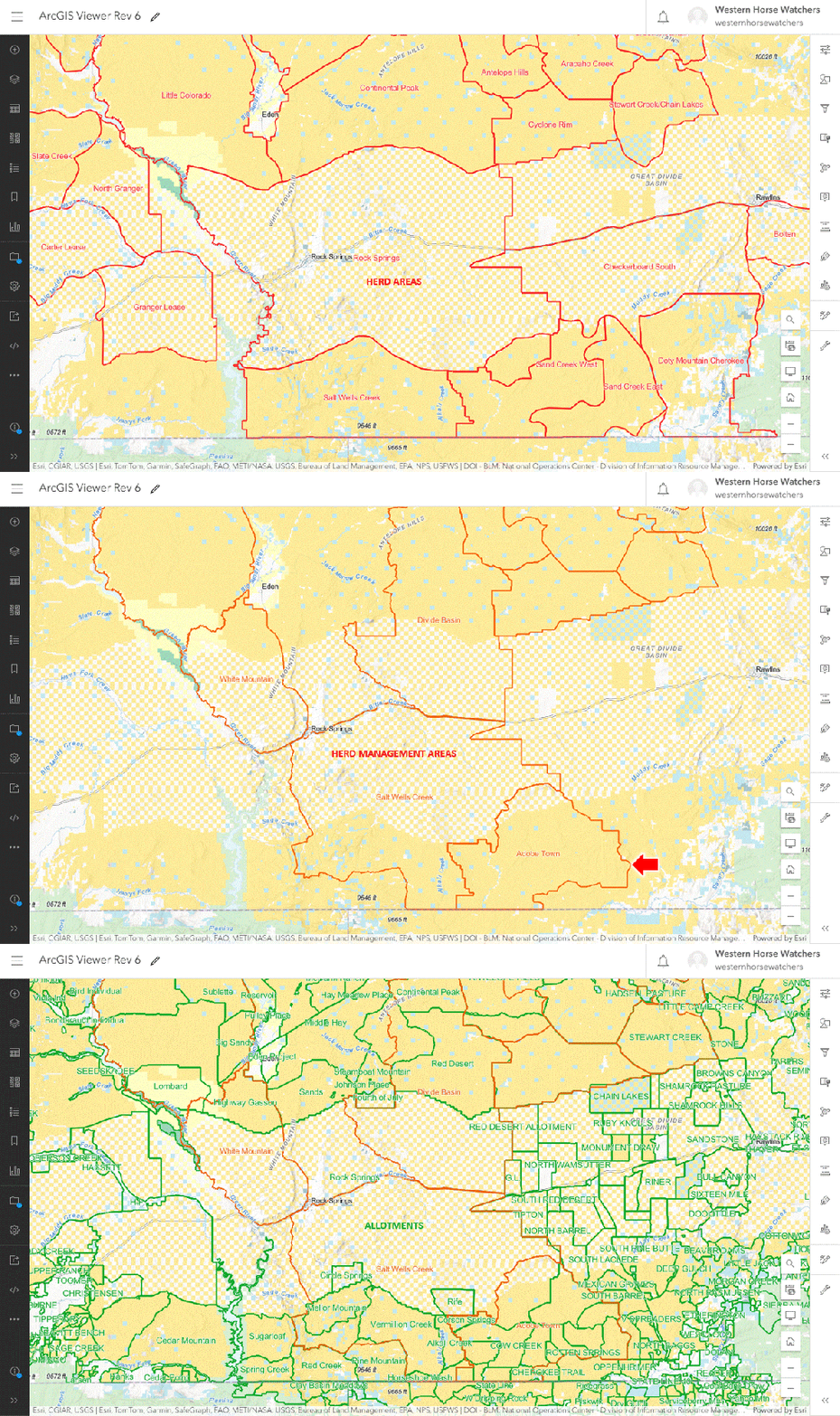
The map shows the Rock Springs HMAs before the RMP amendments, which were halted by an appeals court ruling on July 15. Click to enlarge.
The article says the BLM, in partnership with the Forest Service, planned and installed five virtual fence towers in a jointly managed grazing allotment in the Agua Fria National Monument but did not give the name of the allotment.
Another page describes the Vence virtual fencing system, which matches the description in the BLM article.
Presumably, JH Cattle will benefit from the new equipment, but who paid for it?
The allotment offers 4,572 AUMs on 29,851 public acres, equivalent to 12.8 wild horses per thousand public acres.
Your faithful public servants claim that public lands in the western U.S. can only support one wild horse per thousand acres (25,500 animals on 25.6 million acres).
The Proposed Action would also increase the grazing season by a factor of two.
Table 1 in the Draft EA, developed with no public input, summarizes the changes.
The project folder also contains an aerial image of the allotment.
The topic of increased forage usually appears in planning documents for wild horse roundups.
The customary response is that it can’t be accomplished through a wild horse gather decision and is only possible if the agency first revises the land-use plan to reallocate forage.
Snippet from statute: It is the policy of Congress that wild free-roaming horses and burros shall be protected from capture, branding, harassment, or death
Snippet from manual: To protect wild horses and burros from unauthorized capture, branding, harassment or death
The figures above are based on the daily reports. The sidebar at the gather page says 1,278 horses captured (including a mule) and 1,078 shipped.
A stallion was dispatched on Day 13 for pre-existing conditions. The death rate is 0.4%.
The capture total includes 457 stallions, 544 mares and 275 foals, not counting the mule.
The sidebar says 459/543/276.
Youngsters represented 21.6% of the animals gathered.
Of the adults, 45.7% were male and 54.3% were female.
The location of the trap site is not known.
The name of the contractor was not given.
There are no plans to treat any of the mares with fertility control pesticides and return them to the range.
The HMA is subject to permitted grazing. Resources liberated to date:
Forage: 15,312 AUMs per year
Water: 12,760 gallons per day
The map shows the Rock Springs HMAs before the RMP amendments, which were halted by an appeals court ruling on July 15. Click to enlarge.
Snippet from statute: It is the policy of Congress that wild free-roaming horses and burros shall be protected from capture, branding, harassment, or death
Snippet from manual: To protect wild horses and burros from unauthorized capture, branding, harassment or death
The figures above are based on the daily reports. The gather page says 982 captured.
Two animals were dispatched on Day 44 for pre-existing conditions, boosting the death rate to 0.6%.
The capture total includes 471 jacks, 434 jennies and 74 foals. The sidebar at the gather page says 476/431/75.
Youngsters represented 7.6% of the animals gathered.
Of the adults, 52.0% were male and 48.0% were female.
The location of the trap site is not known.
The name of the contractor was not provided.
No jennies were treated with PZP since the last report, leaving the total at 78.
The July 1 schedule indicates the designated pesticide was GonaCon Equine.
The Complex is subject to permitted grazing. Resources liberated to date:
Forage: 5,874 AUMs per year
Water: 4,895 gallons per day
These numbers will go down if burros are returned to the range.
Snippet from statute: It is the policy of Congress that wild free-roaming horses and burros shall be protected from capture, branding, harassment, or death
Snippet from manual: To protect wild horses and burros from unauthorized capture, branding, harassment or death
The figures above are based on the daily reports.
The death rate is 0.4%.
The capture total includes 377 stallions, 433 mares and 226 foals. A mule caught on Day 7 is not included in the total.
Youngsters represented 21.8% of the animals gathered.
Of the adults, 46.5% were male and 53.5% were female.
The location of the trap site is not known.
The name of the contractor was not given.
There are no plans to treat any of the mares with fertility control pesticides and return them to the range.
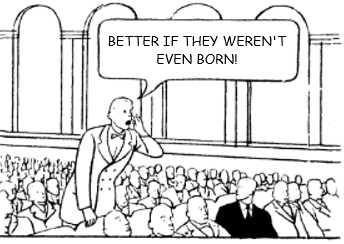
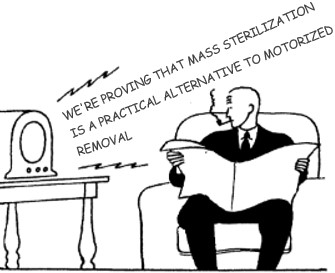
While some folks talk about humane disposal of wild horses, the advocates deliver, referring to the practice as humane management or in-the-wild management.
Those are codewords for mass sterilization with PZP.
The challenger to the Salt River management contract discusses her experiences trapping wild horses in the Apache-Sitgreaves forest in this 65-minute podcast.
Funds from the Forest Service are not unlimited so she receives financial support from “conservation groups” to carry out her work.
If AZDA wants rapid decline in the size of the Salt River herd, she’d be a good option.
Snippet from statute: It is the policy of Congress that wild free-roaming horses and burros shall be protected from capture, branding, harassment, or death
Snippet from manual: To protect wild horses and burros from unauthorized capture, branding, harassment or death
The figures above are based on the daily reports.
The death rate is 0.5%.
The capture total includes 317 stallions, 352 mares and 189 foals. A mule caught on Day 7 is not included in the total.
Youngsters represented 22.0% of the animals gathered.
Of the adults, 47.4% were male and 52.6% were female.
The location of the trap site is not known.
The name of the contractor was not given.
The shipping destination was not disclosed.
There are no plans to treat any of the mares with fertility control pesticides and return them to the range.
The HMA is subject to permitted grazing. Resources liberated to date:
Forage: 10,296 AUMs per year
Water: 8,580 gallons per day
The map shows the Rock Springs HMAs before the RMP amendments, which were halted by an appeals court ruling on July 15. Click to enlarge.
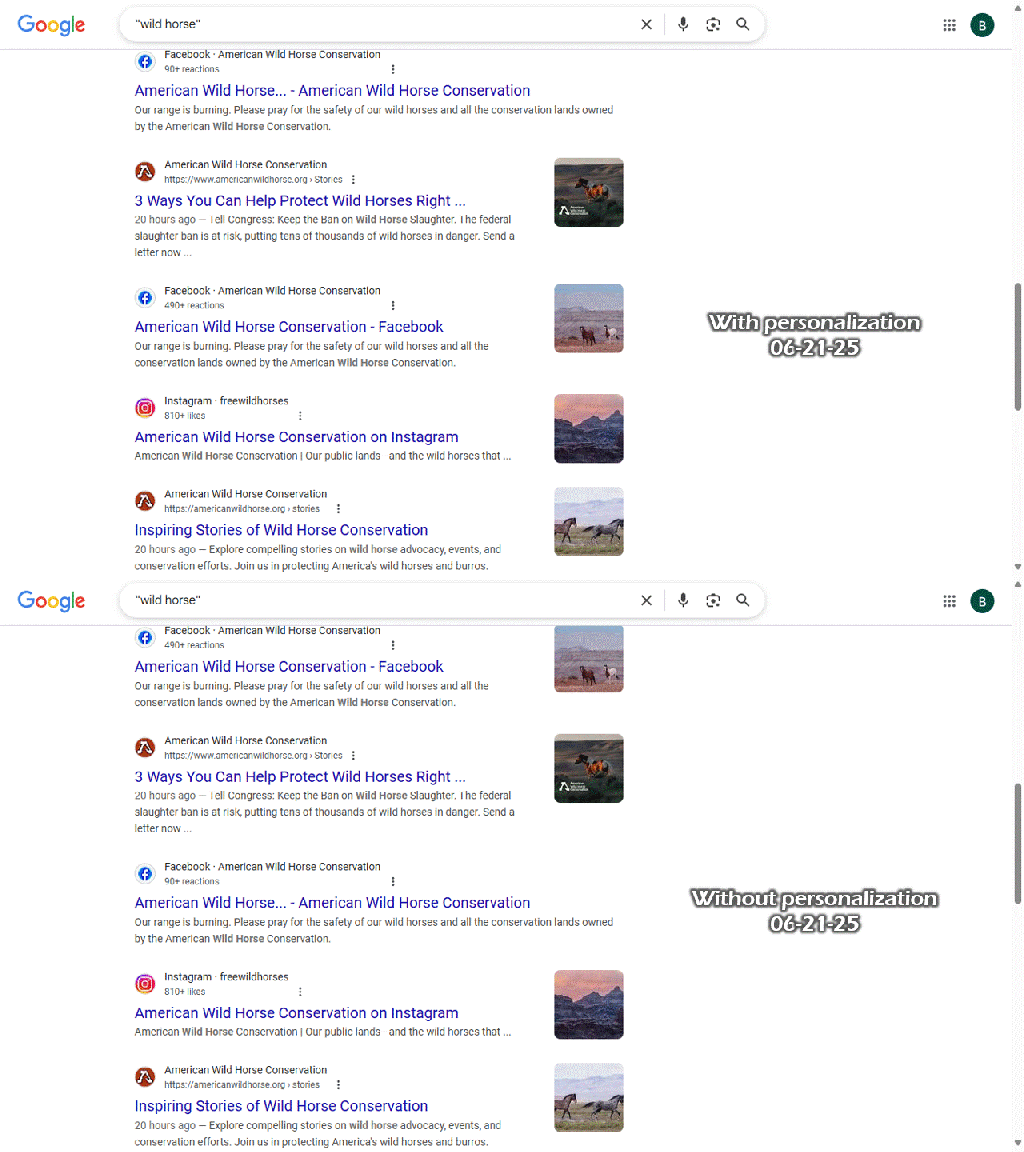
The unspoken word in news circles, apparently, is if you’re doing a story about wild horses, go to the Bureau of Livestock Multiplication and the Campaign Against America’s Wild Horses for comments.
Even Google—an appendage of the Democrat Party—is in on it.
Exhibit #1, a report by KRNV News on the Lahontan Management Plan, featuring the genetic diversity narrative and overpopulation narrative.
The first interview is with Tracy Wilson, defeatist, pesticide pusher and overseer of the largest attempted wild horse eradication in Nevada, who argues that the AML is too small to support genetic diversity and should be at least 150.
Unfortunately, herd size is poor indicator of genetic viability. Breeding population is more important. An AML of 500 would be too small if you’re poisoning the mares with PZP, the raison d’être of CAAWH.
Next, the camera turns to Holley Kline of the BLM who says there are far more wild horses than the land can support, which is misleading.
There are more wild horses than allowed by plan and they’re robbing forage from high net worth individuals who receive generous government benefits with no means testing.
Exhibit #2, a report by KLAS News on FY26 appropriations affecting wild horses, featuring the fertility control narrative.
Suzanne Roy, Wilson’s boss, said the BLM should “make humane management—not removals—the foundation of its program,” implying that fertility control is not removal, even though wild horse numbers go down as the advocates pummel the mares with pesticide-laced darts.
Snippet from statute: It is the policy of Congress that wild free-roaming horses and burros shall be protected from capture, branding, harassment, or death
Snippet from manual: To protect wild horses and burros from unauthorized capture, branding, harassment or death
The figures above are based on the daily reports.
A mare was found dead in a trailer on Day 6. Another mare died in a trailer on Day 7 and a foal died in the trap, lifting the death rate is 0.6%.
The capture total includes 216 stallions, 277 mares and 148 foals. A mule was caught on Day 7, not included in the total.
Youngsters represented 23.1% of the animals gathered.
Of the adults, 43.8% were male and 56.2% were female.
The location of the trap site is not known.
The name of the contractor was not given.
The shipping destination was not disclosed.
There are no plans to treat any of the mares with fertility control pesticides and return them to the range.
The HMA is subject to permitted grazing. Resources liberated to date:







 Western Horse Watchers Association