BLM Biologist Helping Advocates Ruin McCullough Peaks Mares?

He’s one of the greatest proponents of the herd according to a story posted yesterday by the Powell Tribune.

The 2025 population dataset put the size at 149 and he’s already darted 45, which may be close to 100% of the breeding-age mares.  Any left for the advocates?

His efforts are not mentioned at their darting page.

The HMA is a curated horse exhibit.  There’s nothing natural about it.

  • Sterilized mares
  • Tiny breeding population
  • Lack of genetic diversity
  • Abnormal sex ratio
  • Massive human involvement
  • Habitat fragmented by allotments
  • Selection for faulty immune systems

All of this to prop up a failed industry, referred to in the article as the folks with stock.

If Wild Horses Had Principal Use of New Burlington Group

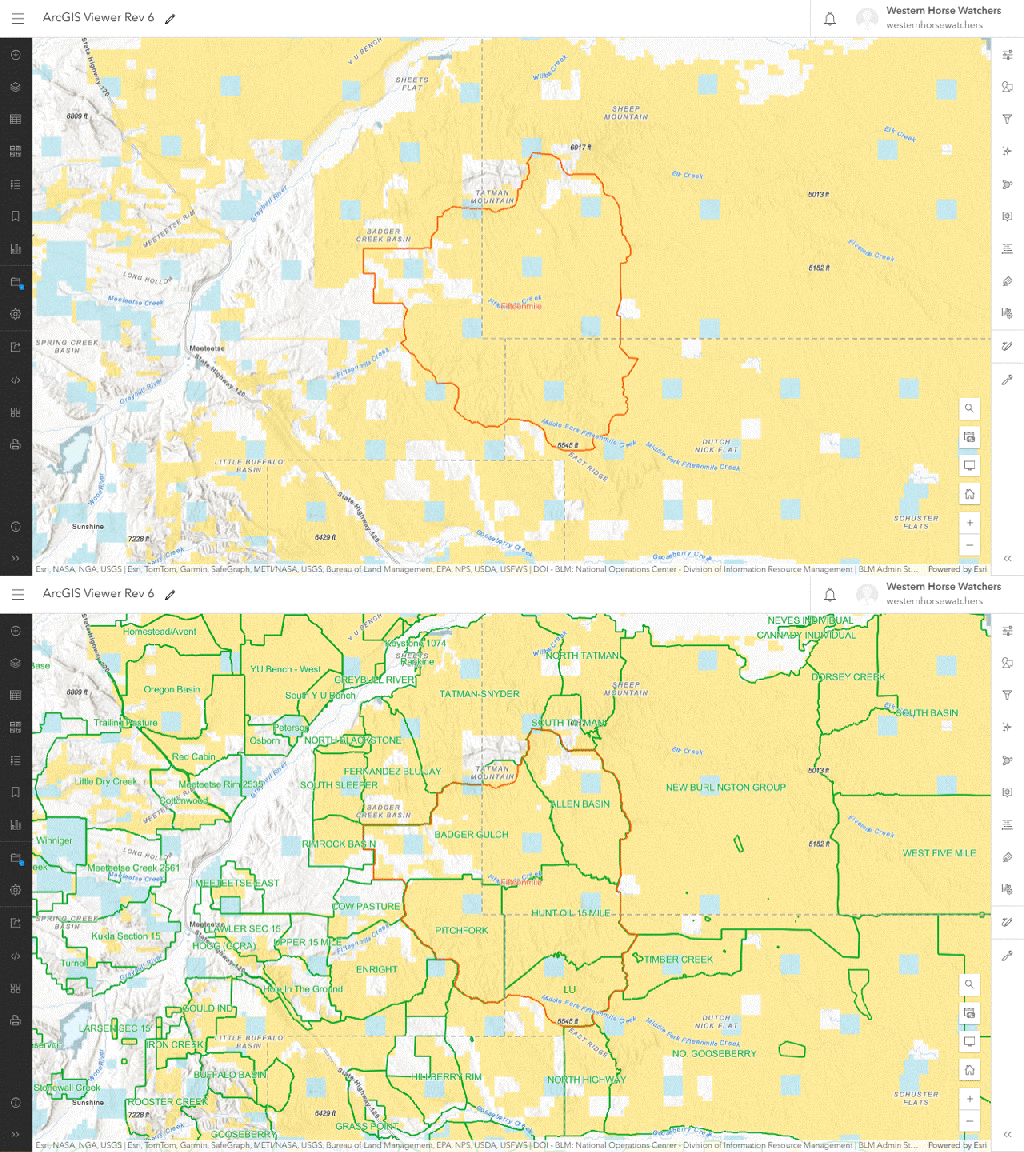
The allotment lies mostly within the Fifteenmile HA but outside the HMA, as shown in the ArcGIS Viewer.

The Allotment Master Report puts it in the Improve category, another indication that your stewards of the public lands have not been taking their responsibilities seriously.

The permittees receive 6,207 active AUMs on 94,000 public acres.

If the area was designated for wild horses, how many could live there?

The forage assigned to livestock is equivalent to 517 wild horses, or 5.5 wild horses per thousand public acres.

Your faithful public servants claim that public lands in the western U.S. can only support one wild horse per thousand acres (25,500 animals on 25.6 million acres).

The advocates, defeated a long time ago, reinforce the narrative with their darting programs.

If the allotment was an HMA, the AML would be 94 and 423 wild horses would be consigned to off-range holding because of permitted grazing.

BLM allotments in Wyoming support livestock equivalent to 158,425 wild horses on 17,312,214 public acres, or 9.2 wild horses per thousand public acres.

Wild horses can be placed on public lands not identified for their use by acquiring base properties associated with grazing allotments and flipping the preference to horses.

RELATED: The Allotments Tell the Story: They’re Lying, All of Them.

Foal-Free Friday, Passing the Torch Edition

An article by The Colorado Sun points to a long-term challenge in the management of the state’s wild horses: Many of the advocates are growing older and there is not much interest among young people in taking over.

Given that wild horse management generally equates to beating the numbers down with ovary-killing pesticides, that’s a good thing.

Don’t let the door smack you on the way out.

RELATED: Foal-Free Friday the 13th, Bad Luck Edition.

How Many Wild Horses Can the Fifteenmile HMA Support?

The Draft DNA asserts that a 2019 EA fully covers the removal of wild horses later this year and constitutes BLM’s compliance with the requirements of the NEPA.

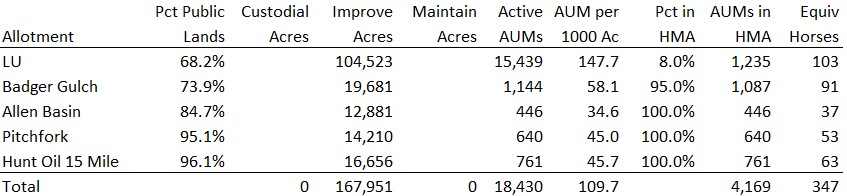
The EA indicates on page 21 (page 24 in the pdf) that five allotments overlap the HMA.

The Allotment Master Report gives management status, acreage and active AUMs.

The EA does not give the percentage of public lands inside the HMA but those numbers can be estimated from the ArcGIS Viewer.

The allotments offer a weighted average 109.7 AUMs per thousand public acres, equivalent to 9.1 wild horses per thousand public acres.

Your faithful public servants claim that public lands in the western U.S. can only support one wild horse per thousand acres (25,500 animals on 25.6 million acres).

The HMA covers 68,607 public acres and has an AML of 230 according to the 2025 population dataset.

The HMA supports livestock equivalent to 347 wild horses, so the True AML would be 230 + 347 = 577.

The stocking rate would be 8.4 wild horses per thousand public acres.

RELATED: Fifteenmile DNA Out for Review, No Announcement.

AZDA Should Hold Pre-Bid Hearing for Salt River Contract

Simone Netherlands of the Salt River Wild Horse Darting Group and Suzanne Roy of the Campaign Against America’s Wild Horses should be ordered to appear before the Board—if there is one—and put under oath to discuss the condition of the herd.

  • Trend chart showing changes in herd size
  • Doses of PZP applied each year
  • Mares treated each year
  • Average doses per mare each year
  • Mares at risk of sterility
  • Current ratio of females to males
  • Mares not responding to treatments
  • Trend chart showing annual death rates
  • Changes in foal survival rates
  • Horses removed from habitat
  • Annual costs of program

The meeting would be open to the public.

Those responding to the RFP are entitled to know how much damage has been done by the advocates before taking responsibility for the herd.

RELATED: Who Would Want to Be Responsible for Salt River Herd?

Deseret Op-Ed Asks Wrong Question About Wild Horses

The article begins with a faulty assumption.

The title should say “How should Utah fix the mismanagement of resources in the lawful homes of wild horses and burros?” not “How should Utah rein in the wild horse and burro problem?”

The writer noted that wild horse and burro numbers in the state far exceed appropriate management levels and that animals are straying outside of federal management areas.

So what?  AMLs don’t indicate carrying capacities.

Those sounding the alarm are usually involved with animal agriculture.

Putting more wild horses in private sanctuaries, identified as a possible solution, is exactly what they want.

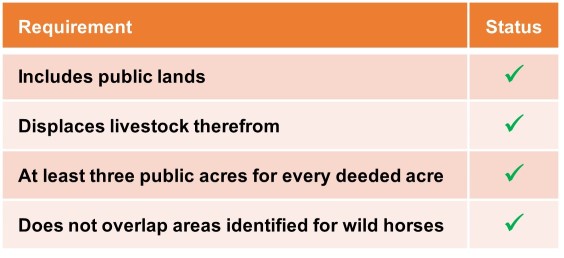
If a proposed facility doesn’t include public lands and doesn’t displace livestock therefrom, it’s not worthy of your support.

Muddy Creek Emergency Roundup Announced

The unplanned event will begin on or about June 24 due to lack of water.

The capture and removal goals are 40 each.

Horses will be drawn into the traps with bait.

Operations will not be open to public observation.

Captured animals will be taken to the Axtell off-range corrals.

A link to the gather page was not given.

The HMA covers 283,474 total acres, including 252,086 public acres, according to the 2025 population dataset.

The AML is 125.

The BLM news release did not give the status of livestock grazing in the overlapping allotments.

PZP Doesn’t Kill Wild Horses, It Kills Wild Herds

Those who sound the alarm about wild horses and burros are often among their worst enemies.

Take for example the Campaign Against America’s Wild Horses, a leader in humane disposal and faithful servant of the bureaucrats and ranchers.

Who’s the greater threat to wild horses, a President whose budget will be tempered by Congress or a nonprofit that’s wiping out herds with mass sterilization?

Is Stupidity a Problem in the Wild Horse World?

Do these people not understand that the Campaign Against America’s Wild Horses, a leader in nonmotorized removal and servant of the public-lands ranchers, is sterilizing the Virginia Range mares with PZP, a restricted-use pesticide that tricks the immune system into attacking their ovaries?

How stupid do you have to be to support an organization like that?

File under: Charlatans.

Errors in Adobe Town DNA?

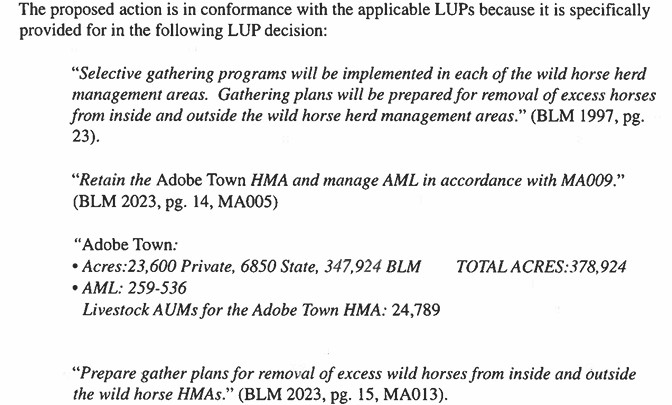
The DNA Worksheet refers to the 2023 Record of Decision and Approved Resource Management Plan Amendment for Wild Horse Management, the “Other Document” listed at the beginning of Section B.

The worksheet says “Retain the Adobe Town HMA and manage AML in accordance with MA009,” followed by a reference to item MA005 in the ROD.

But item MA005 in Table 1 of the ROD states “Retain the White Mountain HMA and manage AML in accordance with MA009.”

In the Rock Springs RMP Amendments, White Mountain was retained in whole but Adobe Town was retained in part.

The figures for acreage in the worksheet don’t match those of item MA009 in the ROD.

The 2025 population dataset gives the acreage as 347,924 BLM, 357,849 total.

The final statement about preparing gather plans matches item MA013 in the ROD.

The worksheet indicates 24,789 AUMs for livestock in the HMA, equivalent to 2,066 wild horses, meaning the AML could go as high as 2,602.

The current AML tells you the HMA is managed primarily for livestock.

The advocates generally don’t challenge forage allocations, arguing that they should be enforced with pesticides, not helicopters.

RELATED: Adobe Town DNA Approved.

Putting the Silver King Theory to the Test

The AML, currently 128, could go as high as 2,658 by removing livestock from the HMA.

Every AUM taken from the ranchers and given back to the horses would save taxpayers at least $150 per year, far offsetting the loss of $1.35 in grazing fees.

Twelve AUMs mean a horse can come out of holding and go back on the range, saving at least $1,800 per year.

Given today’s hay prices, the figure may be closer to $2,500 per year.

Rewilding 1,000 captive horses might save up to $2.5 million per year.

Ranchers would continue to operate on their base properties and/or rented pastures as they do during the off season.

Western Horse Watchers believes the new HMAP will do none of this.

Instead, it will protect the status quo and life will go on as it does today.

RELATED: WHE Still Doesn’t Get It.

Adobe Town DNA Approved

The Decision Record authorizes the Proposed Action, discussed in Section A of the DNA, which will remove 1,675 wild horses from the downsized HMA, achieving the low end of AML.

There are no plans to treat any of the mares with fertility control pesticides and return them to the range.

The DNA asserts that a 2021 EA fully covers the Proposed Action and constitutes BLM’s compliance with the requirements of NEPA.

A summary of comments was posted to the project folder.

RELATED: Adobe Town DNA Out for Public Review.