Advocates, Not Forest Service, Destroying Salt River Herd

As you read this article about the fertility control program, think of Simone Netherlands as a marionette with Suzanne Roy pulling the strings.

The events leading to the current situation are discussed in a 2019 report to the Arizona Department of Agriculture and U.S. Forest Service.

In a nutshell, the Forest Service announced that it would be removing wild horses from the Tonto National Forest and the advocates stepped in and said “Let us do that.”

Let Us Fix Your Wild Horse Problem 02-18-23

Recalling the early days, Netherlands said “At that time, we narrowly escaped removal of the Salt River Wild Horses and offered our way of management to both the state and the federal government.”

What she meant was their way of removal.
Better Way 10-25-23

One of her most outrageous statements involves birth rates and breeding patterns: “If we do want the mare to have a baby, we just don’t dart her that year,” as if conception can be switched on and off like a light bulb—a reference to the sperm-blocking theory.

The longer a mare has been treated with PZP, the longer she takes to regain fertility, about a year per year.

After five years of treatment, she won’t recover.  She’s said to be self-boosting, a codeword for sterile.

Clearly, the horses are not in control of their future.

The management plan allowed ten years for birth control and natural attrition to reduce the herd to 100-200 head, from an initial size of around 400.

Do you think after a decade of nonstop darting the herd will come in for a soft landing, finally in balance with its surroundings?

That’s what they tried at Assateague Island and the herd was still shrinking eight years after the darting program was shut off.

RELATED: Salt River Darting Program by the Numbers.

Foal-Free Friday, Thinking Outside the Box Edition

A 2020 post by the advocates explains habitat loss at the Salt River.

The prescribed course of action, which they were happy to fulfill, was to beat the numbers down with PZP until the population reached an acceptable size—even if it means sterilizing the mares.

How can that be good for the herd?

Why not start a war chest that could be used to buy a base property tied to one of the neighboring allotments and give the horses more space?

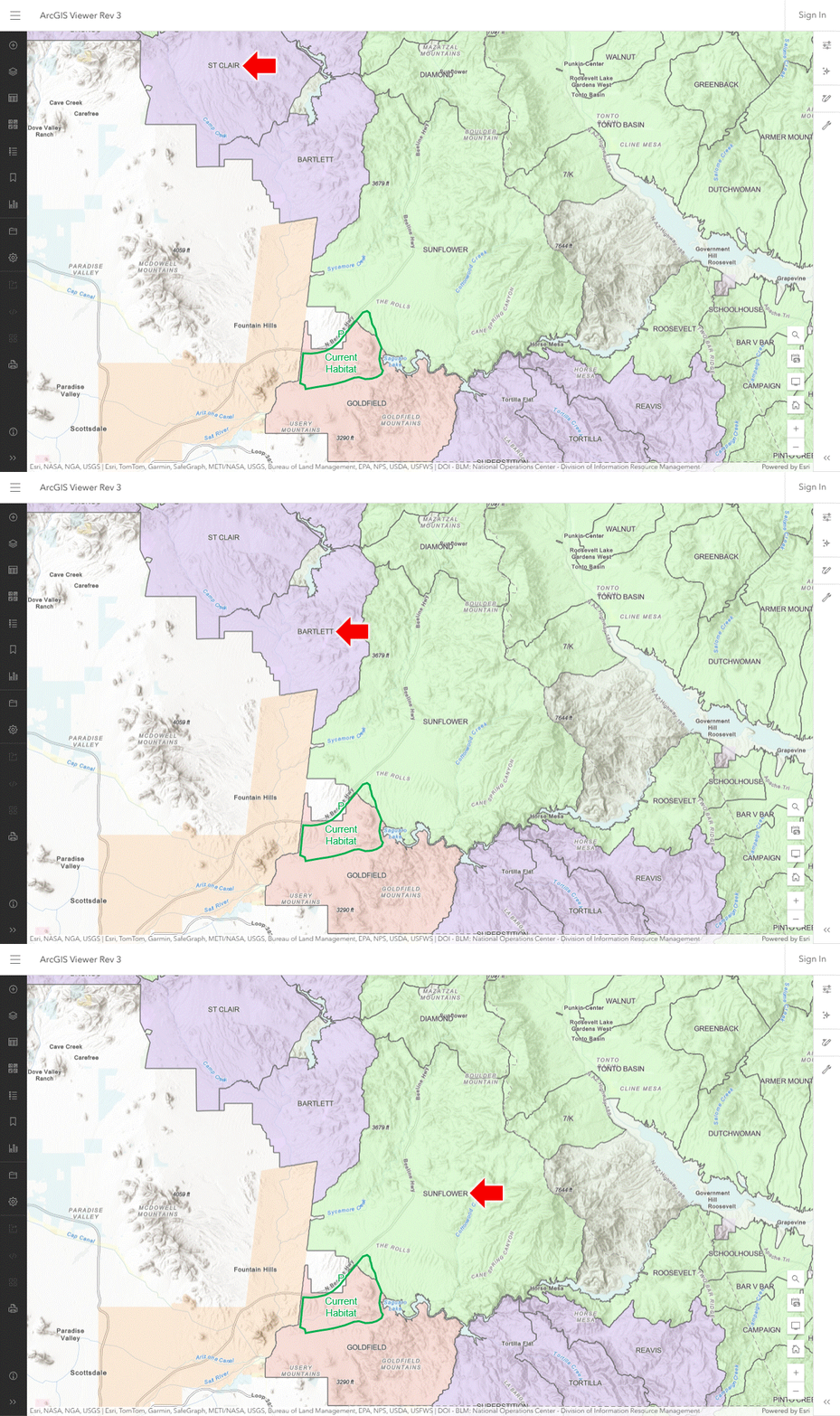
Appendix 5 in a 2018 report on forage availability said the Goldfield, Bartlett, St. Clair and Sunflower allotments were most similar in vegetation, soil and topography to the Salt River horse zone.

The horse zone is mostly in Goldfield, which has been closed to livestock grazing.

Sunflower contains Butcher Jones, one of areas where the horses roamed.

It is active while Bartlett and St. Clair are vacant.

Why don’t the advocates have their eyes on these parcels instead of the scopes of their darting rifles?

RELATED: Foal-Free Friday, Minimally Invasive Edition.

More Space for Salt River Horses 03-20-25

ASU Professor to Speak About Compassionate Conservation

Would you attend a lecture based on lies and propaganda?

Consider this statement, taken from the undated announcement:

Wild horse populations grow at a rate of 15-20% per year and compete with cattle, deer, elk, and bighorn sheep for valuable forage and water resources, which threaten fragile riparian ecosystems through soil compaction and overgrazing.  While most U.S. policies advocate for the removal of these “non-native” horses, horse advocates continue to push for more territory and rights.

Cattle are the nonnative species and on public lands they outnumber wild horses by a huge margin.

Growth rates of 15-20% per year require birth rates of at least 20-25% per year and this is rarely seen in roundup data.

In discussions of wild horses, conservation is a codeword for eradication, make sure ranchers get most of the resources.

BLM allotments in Arizona support livestock equivalent to 53,662 wild horses on 10,090,546 public acres, or 5.3 wild horses per thousand public acres.

Thriving Ecological Balance-3

BLM Releases 2025 Wild Horse and Burro Population Dataset

The current population, as of March 1, is thought to be 53,797 wild horses and 19,333 wild burros, compared to AMLs of 22,637 and 2,919, according to the new report.

The total number of HMAs has dropped to 175 from 177, as a result of the Rock Springs RMP Amendments, now under appeal.

Western Horse Watchers was unable to find an announcement at the BLM news site.

The report was posted to the Program Data page.

The facility report has not been updated since September but, as of today, there are probably more wild horses in off-range holding than on the range.

AMLs represent the number of animals allowed by plan, not the number of animals the land can support.

Court Hears Arguments in Rock Springs Grazing Appeal

Attorneys for the advocacy groups presented their claims to a panel of the Tenth Circuit this morning according to a report by Courthouse News Service.

Although three appeals were filed, the court consolidated them into one.

The panel did not indicate when it would rule.

The case centers around keeping wild horses off private lands, which, in this writer’s opinion, is not the government’s job in a fence-out state.

RELATED: Court Upholds Rock Springs RMP Amendments.

More Options for Salt River Horses?

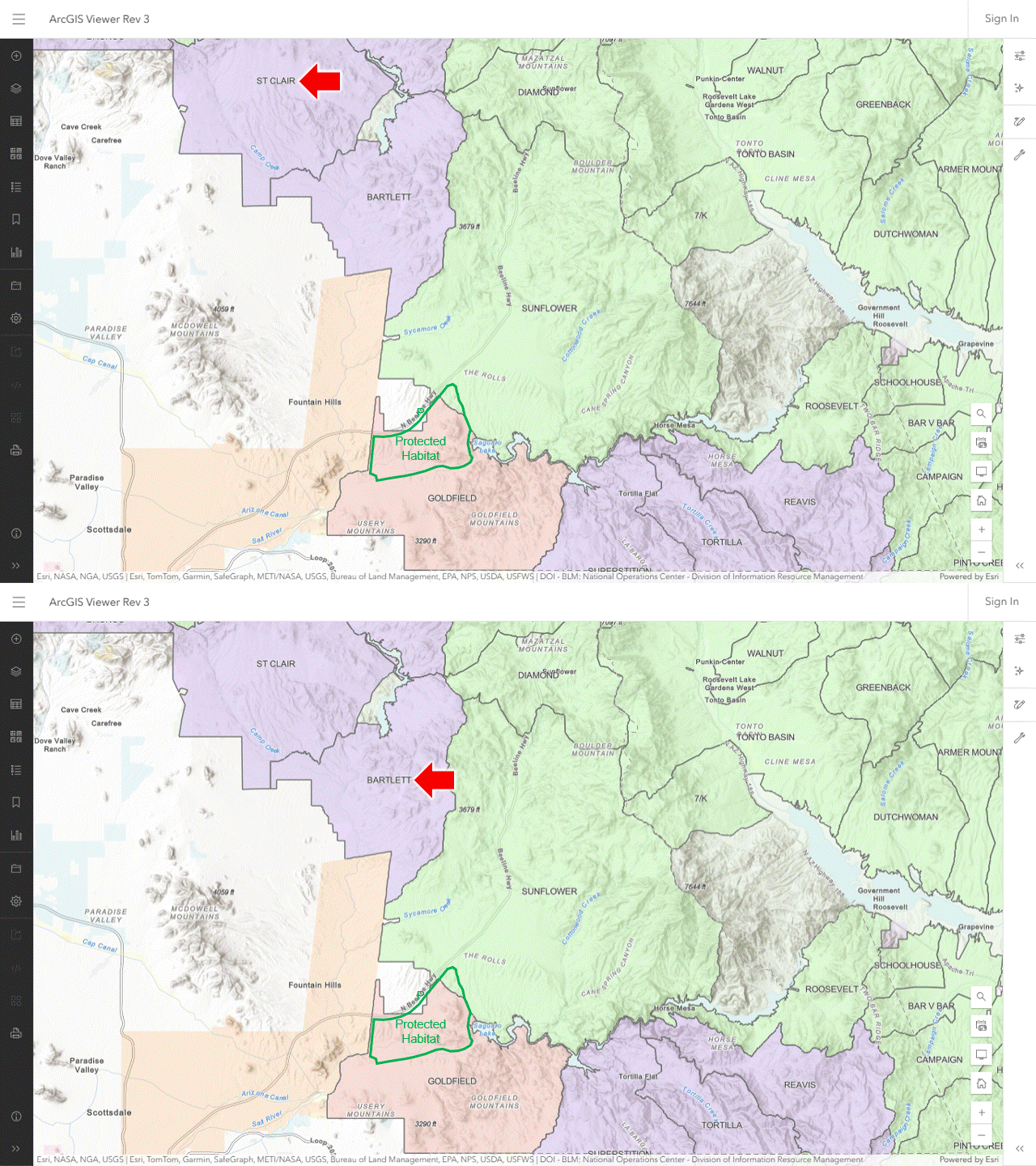
Appendix 5 in the 2018 report on forage availability said the Goldfield, Bartlett, St. Clair and Sunflower allotments are most similar in vegetation, soil and topography to the Salt River horse zone.

Bartlett and St. Clair are vacant according to the ArcGIS Viewer.

Together, they could support 617 wild horses.

Why aren’t the advocates in talks with the Forest Service to access those parcels?

The status of the base properties is unknown.

The protected habitat, described in the 2020 post, lies mostly in the Goldfield allotment but the northern end is in Sunflower.

RELATED: Repurposing Sunflower.

More Options for Salt River Horses 03-18-25

Repurposing Sunflower

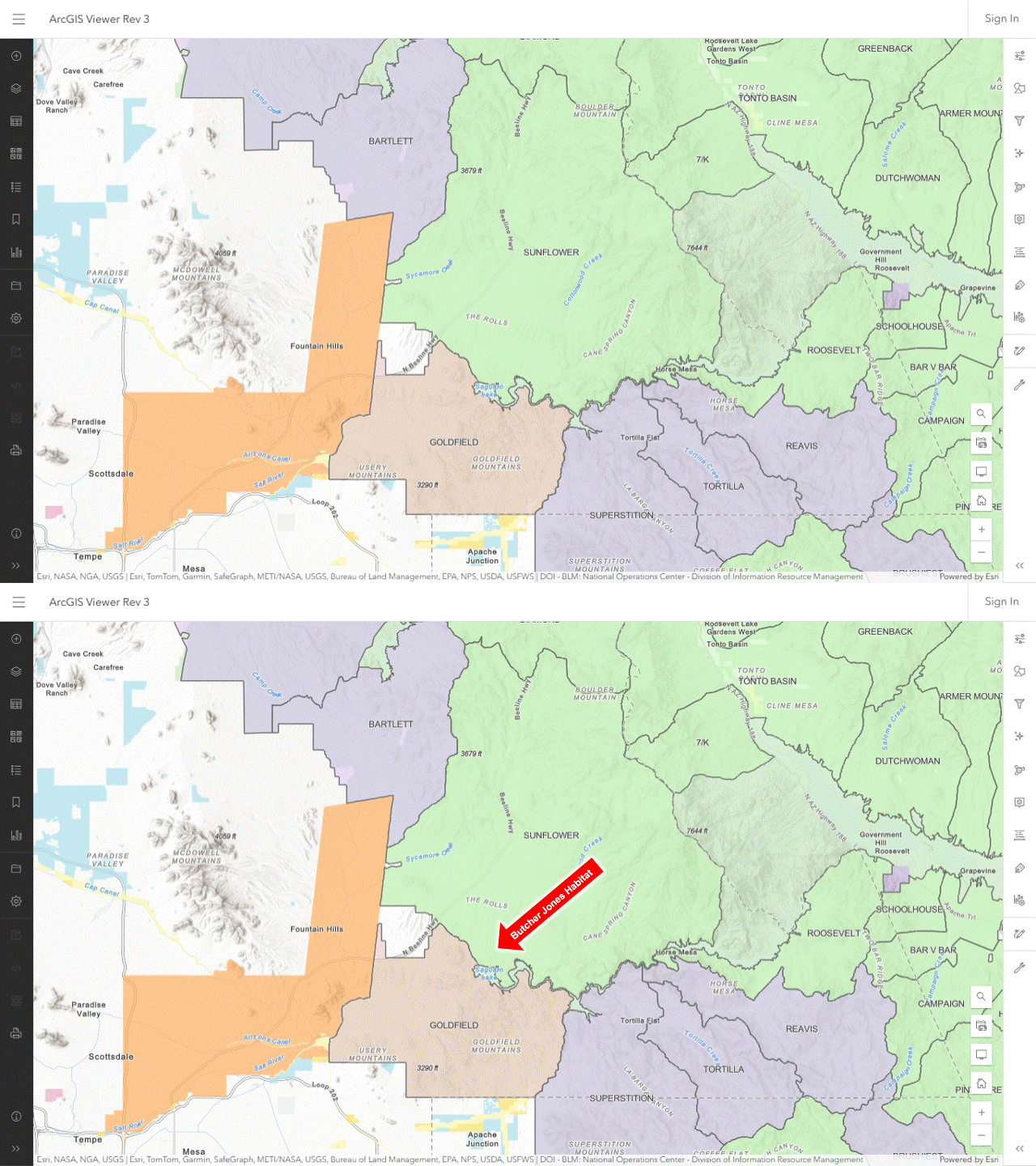
A 2020 post about the Salt River habitat explains why you can’t find any recent videos of wild horses at Butcher Jones: They were moved across the highway to another area.

The map refers to it as the protected habitat, shaded dark green.

The yellow, red and pink areas have been lost, although the yellow area may become accessible again if an overpass is built at Coon Bluff.

An eyeball estimate of the loss is forty to fifty percent of their land.

The pink area is referred to as the Butcher Jones Habitat, which the ArcGIS Viewer reveals as the Sunflower Allotment.

The stated reason for removal was access to water and conflicts with recreational use.

Were there other reasons?

A keyword search of the page yielded no results for Sunflower, allotment, livestock and permitted grazing.

The Forest Service has not posted the AOIs for the Tonto allotments but Table 1 in a 2018 report on forage availability indicated that Sunflower offered 10,020 AUMs on 158,000 acres, equivalent to 835 wild horses or 5.3 wild horses per thousand acres.

Why not start a fundraiser to purchase the base property tied to the allotment or at least the pastures where the horses roamed?

Then ask the Forest Service to change the preference to horses.

RELATED: Butcher Jones and Sunflower.

Butcher Jones Habitat 03-17-25

If Wild Horses Had Principal Use of Shamrock

The allotment, located about 30 miles north of Casper, offers 569 active AUMs on 5,061 public acres according to the allotment master report.

It’s in the Improve category, suggesting that your stewards of the public lands are not taking their responsibilities seriously.

The management plan assigns zero AUMs to wild horses.

How many could live there?

The forage assigned to livestock is equivalent to 47 wild horses, or 9.3 per thousand public acres.

Why is this important?

Your faithful public servants claim that rangelands in the western U.S. can only support one wild horse per thousand acres (27,000 animals on 27 million acres).

The advocates give their assent through their darting programs.

If the allotment was an HMA, the AML would be 5 and 42 wild horses would be consigned to off-range holding because of permitted grazing.

BLM allotments in Wyoming support livestock equivalent to 158,425 wild horses on 17,312,214 public acres, or 9.2 wild horses per thousand public acres.

Wild horses can be placed on public lands not identified for their use by acquiring base properties associated with grazing allotments and flipping the preference to horses.

RELATED: The Allotments Tell the Story: They’re Lying, All of Them.

Shamrock Allotment 03-16-25

Velma’s Life Changed Forever 75 Years Ago

In chapter four of Wild Horse Annie and the Last of the Mustangs, authors David Cruise and Alison Griffiths date her first encounter with the horse runners to a spring morning in 1950, meaning the event which launched modern-day advocacy is now 75 years old.

“What she saw on that truck was beyond anything she’d ever experienced.”

RELATED: Diamond Anniversary of Wild Horse Preservation Movement.

Butcher Jones and Sunflower

Key moments in this video from late 2022:

  • 0:33 – 0:51, Butcher Jones beach with Sunflower allotment in background
  • 1:28 – 1:49, Sunflower allotment and Butcher Jones beach
  • 2:08 – 2:26, Sunflower allotment
    • West end of Saguaro WBT
    • Four Peaks in the distance (eastern side of allotment)
  • 2:27 – 2:52, Looking across the allotment to Four Peaks
  • 4:25 – 4:35, Looking across Saguaro Lake to the Goldfield allotment

Missing from the video are wild horses, who may not be able to access the area anymore.

RELATED: Wild Horses at Butcher Jones.