CAAWH Mobilizing Drones in Favor of SB 2331?

As of this evening, the testimony list has 81 entries, mostly in favor of the bill.

One of the submittals is a form letter from the Campaign Against America’s Wild Horses, claiming that a wild horse working group would unite state officials, advocates, experts and interested parties to ensure collaborative, humane, science-based conservation of the Theodore Roosevelt National Park wild horses, prevent removals, and provide long-term oversight.

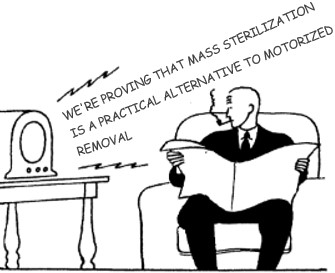
These do-gooders have no idea what they’re talking about.  Those are codewords for nonmotorized removal—mass sterilization with pesticide-laced darts.

A working group would provide a forward base from which the advocates can wage war on the TRNP wild horses, as it has in Colorado.

You only need to look at Assateague Island to see how it will turn out.

RELATED: SB 2331 Hearing This Week.

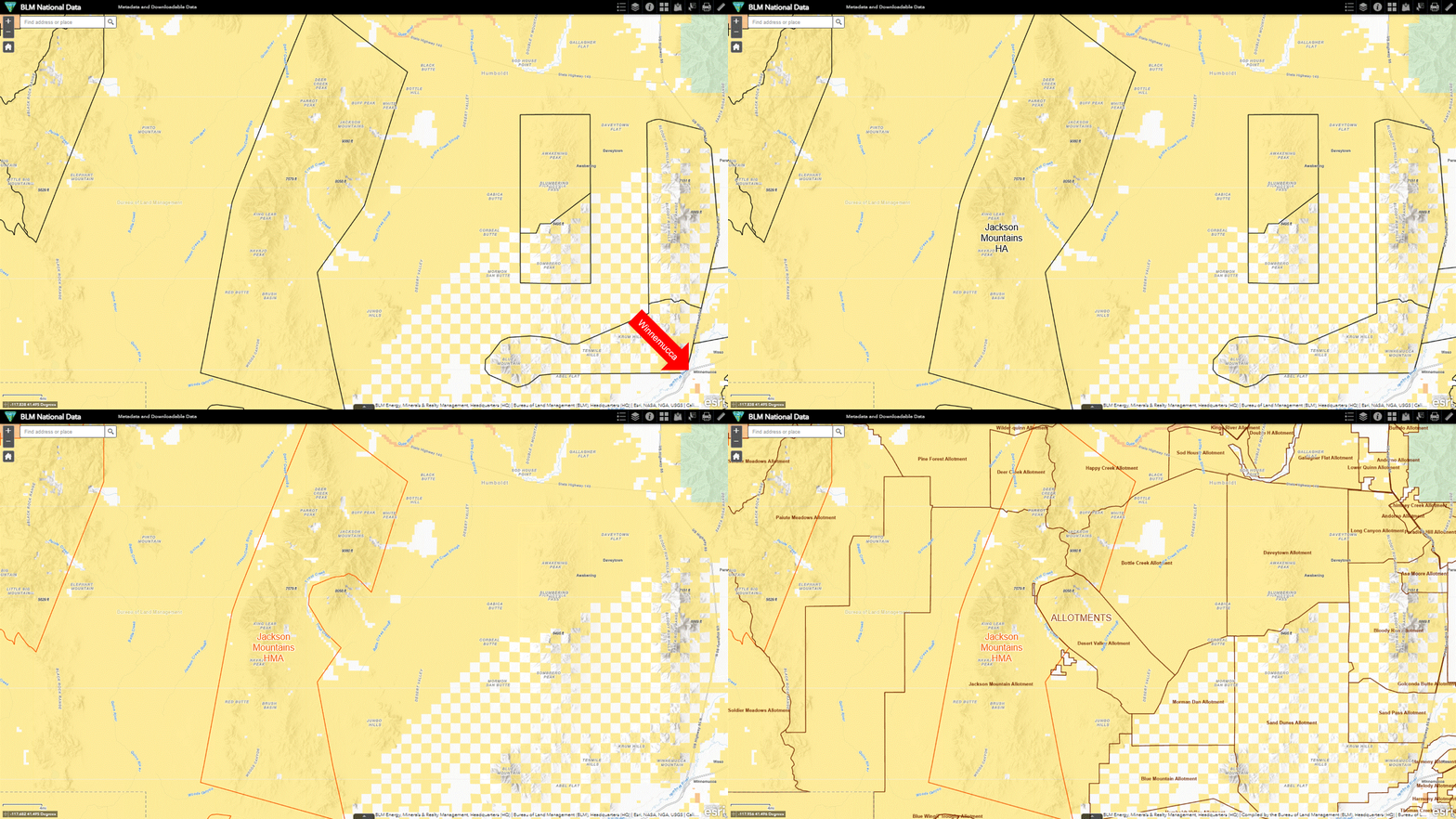
Scoping Begins for Jackson Mountains HMAP

A scoping statement and management evaluation have been copied to the project folder.

Comments will be accepted through March 4 according to the news release.

The HMAP will affirm the current AML and forage allocations, and authorize methods such as forcible removal, fertility control pesticides and sex ratio skewing to achieve them on a long-term basis.

RELATED: New HMAP for Jackson Mountains HMA?

Jackson Mountain HMA with Allotments 01-31-25

SB 2331 Hearing This Week

The Senate Committee on State and Local Government will consider the measure at 9 AM on February 7.  The deadline to submit testimony is 8 AM.

The bill would create a TRNP working group.

The advocates see it as another opportunity to ruin the mares with PZP.

Protect TRNP Wild Horses 02-05-25

Don’t give them a penny.

They’re selling mass sterilization as wild horse conservation.

RELATED: Don’t Be Fooled by SB 2331.

Would You Adopt a Wild Horse If Hay Was 27¢ Per Bale?

Where can you get such a good deal on the cost of feed?

On public lands.  That’s what the ranchers pay, equivalent to $1.35 per AUM.

Why is the government paying $150 or more per AUM to feed wild horses in off-range holding when it could reduce that cost by 99% by keeping them on the range?

Elon Musk, are you listening?

RELATED: No Change to Federal Grazing Fees in 2025.

What Should You Tell Your Legislators About Wild Horses?

One option is suggest that the advocates are working very hard to save the horses from drillers, miners and loggers, but they need more support.

A more accurate assessment would be to explain that the horses have been cheated by the bureaucrats in favor of the ranchers with the cooperation of the advocates.

They receive a tiny fraction of the available resources in their lawful homes.

Forage allocations are enforced by motorized removal, usually carried out by the legacy contractors, and nonmotorized removal, the small but growing domain of the advocates.

Sand Wash Advocate 01-04-25

This is why the off-range corrals are flooded with wild horses and why the costs of the WHB program are spiraling out of control.

The ranchers pay almost nothing for the resources they consume and the services rendered on their behalf by the government.

The advocates want you to think they’re the good guys.

They have nothing to offer America’s wild horses.

They are the old guard, leaders of the blind, irrelevant.

RELATED: New Year, Same State.

Thriving Ecological Balance-3

Murderer’s Creek Roundup, Day 66

The incident started on November 29.  Results through February 2:

  • Scope: Murderer’s Creek HMA, WHT
  • Target: Wild horses
  • AML: 140
  • Pre-gather population: 650
  • True AML: TBD
  • Type: Emergency
  • Method: Bait
  • Capture goal: 350 – 400
  • Removal goal: 350 – 400
  • Captured: 350, up from 322 on Day 60
  • Shipped: 340, up from 274 on Day 60
  • Released: None
  • Deaths: 5, no change from Day 60
  • Average daily take: 5.3
  • Unaccounted-for animals: 5
  • Snippet from statute: It is the policy of Congress that wild free-roaming horses and burros shall be protected from capture, branding, harassment, or death
  • Snippet from manual: To protect wild horses and burros from unauthorized capture, branding, harassment or death

The figures above are based on the daily reports.

The low end of the capture goal has been reached.

The death rate is 1.4%.

The capture total includes 123 stallions, 143 mares and 84 foals.  The gather page says 123/148/79.

Youngsters represented 24.0% of the animals gathered, consistent with a herd growth rate of 19% per year.  The Rule of 72 says the herd size would double in 3.8 years.

Of the adults, 46.2% were male and 53.8% were female, no indication of an abnormal sex ratio in the population at large.

Body condition scores were not given.

The location of the trap site was not disclosed.

The name of the contractor was not provided.

There are no plans to treat any of the mares with fertility control pesticides and return them to the range.

No decisions have made regarding the long-term disposition of horses, which means they could be treated or altered in off range holding, including the stallions.

The status of livestock grazing in the burned area is not known.

RELATED: Murderer’s Creek Roundup, Day 60.

Murderers Creek HMA with Allotments 10-24-24

Don’t Be Fooled by SB 2331

The bill calls for a minimum herd size of 200, a number that will be determined by the Park Service, but the advocates will likely drive the breeding population into the single digits with their projectors and RDDs, as provided in Section 1.3.

This will ruin the mares, increase the risk of inbreeding and spell the long-term demise of the herd, a strategy already in use at the Salt River, Virginia Range and elsewhere.

RELATED: North Dakota Legislature to Create TRNP Working Group?

Advocates are the Predators 11-30-21

North Dakota Legislature to Create TRNP Working Group?

The group would work with NPS to provide recommendations for managing the wild horse population in Theodore Roosevelt National Park according to Section 1.2 of SB 2331.

The minimum herd size would be 200.  The size of the breeding population, which is far more important, was not specified.

The committee would also promote the horses to benefit tourism and assist with educational outreach.

The story was covered by local news outlets but placed behind paywalls.

The measure may be patterned after SB23-275 which created the Colorado Wild Horse Working Group.

Today Is the Nadir of the Wild Horse Summit

A certified PZP darter will discuss the pros and cons of fertility control, as if the decision to ruin the mares must be carefully weighed before acting.

Two shills for the public-lands ranchers will explain their plan to move the horses from their lawful homes to remote wilderness areas to deter wildfires.  The method by which the animals stop lightning is proprietary and not open to public observation.

Refer to the conference home page for dates and times.

RELATED: Notably Absent from Wild Horse Summit.

McKinney Fire 08-08-22

Notably Absent from Wild Horse Summit

A keyword search of the conference home page yielded these results:

The organizers claim to be arming you with knowledge to effectively advocate but they are tiptoeing around the #1 problem for wild horses and not giving you a quantitative basis to make the case.

Worse, they have given airtime to the Wild Horse Fire Brigade, a nonprofit that’s openly hostile to wild horses, opposes the spirit and intent of the original statute, and has the backing of Elko County, a ranching advocacy group.

RELATED: Wild Horse Summit Starts Today?

Support the Advocates 09-22-24