
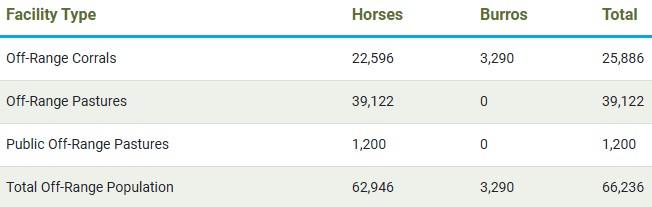
If you want to understand why there are so many wild horses in off-range holding, and why the government needs more corrals, more pastures and more adoptions, look no farther than the Little Colorado HMA.
It’s not in Colorado, but it explains why taxpayers are being asked to shoulder the growing costs of off-range management.
In general, the bureaucrats assign most of the forage in areas identified for wild horses to privately owned livestock.
At Little Colorado, the horses receive just 2.6% of the resource. Table 8 in the 2021 EA for management actions in the Wyoming checkerboard has the data.
To keep the pests in check and ensure the ranchers have principal use of the HMA, the BLM takes them off the range and crams them into public and private feedlots.
None of this is intended to reduce costs.
More animals can be removed if there are more places to places to hold them.
The goal is ranching superiority in the lawful homes of wild horses, sometimes referred to as achieving and maintaining AMLs.
At Little Colorado, the AML ranges from 69 to 100.
Horse #70 is excess, the beginning of overpopulation.
The HMA can’t support more than 100, but it can sustain livestock equivalent to 3,750.
This accounts for six percent of the horses in off-range holding!
If they really wanted to cut costs, they’d put the horses back on the range and confine the ranchers to their base properties in a year-round off season.
RELATED: What Are Musk and Ramaswamy Being Told About Wild Horses?

 Western Horse Watchers Association