Triple B Roundup, Day 7

The incident started on November 2.  Results through November 8:

  • Scope: Triple B Complex
  • Target: Wild horses
  • AML: 889
  • Pre-gather population: 3,335
  • True AML: 4,551
  • Type: Planned
  • Method: Helicopter
  • Category: Cruel and costly (according to advocates)
  • Better way: Sterilize mares with PZP (according to advocates)
  • Capture goal: 2,255
  • Removal goal: 2,155
  • Captured: 614, up from 319 on Day 5
  • Shipped: 371, up from 246 on Day 5
  • Released: None
  • Deaths: 4, up from 3 on Day 5
  • Average daily take: 87.7
  • Unaccounted-for animals: 239
  • Snippet from statute: It is the policy of Congress that wild free-roaming horses and burros shall be protected from capture, branding, harassment, or death
  • Snippet from manual: To protect wild horses and burros from unauthorized capture, branding, harassment or death

The figures above are based on the daily reports.

The Day 3 report still shows 122 horses shipped but the breakdown yields 120.

A stallion was dispatched on Day 6 due to severe swayback.

The death rate is 0.7%.

The capture total includes 240 stallions, 250 mares and 124 foals.

Youngsters represented 20.2% of the animals gathered, consistent with a herd growth rate of 15% per year.

Of the adults, 49.0% were male and 51.0% were female, within the expected range of variation from a random process centered at 50% males / 50% females.

Body condition scores were not given.

The location of the trap site was not disclosed.

The name of the contractor was not provided.

Three HMAs are affected.

Up to 50 mares will be treated with GonaCon Equine and returned to the range with up to 50 stallions.

The number of doses and the interval between treatments were not specified, leaving open the possibility that the Complex becomes the next GonaCon crime scene.

The roundup supports three tenets of rangeland management.

RELATED: Triple B Roundup, Day 5.

Triple B Complex with Allotments 11-04-24

Lakeview EIS, RMP Amendment Almost Complete

The project is now in the protest stage.

Only those who participated in the planning process are eligible to comment according to the news release.

The planning area includes the Paisley Desert and Beatys Butte HMAs, according to the HMA-1 map.

Of interest in Section 3.10.1.1 of Appendix 12 (page 201 in the pdf) are these figures:

  • 127 allotments in the planning area
  • 164,471 active AUMs
  • 2,960,285 public acres

The Lakeview allotments support livestock equivalent to 13,706 wild horses, or 4.6 wild horses per thousand public acres.

Our faithful public servants tell us that public lands in the western U.S. can only support one wild horse per thousand acres (27,000 animals on 27 million acres).

The advocates bolster the narrative with their darting programs.

Thay want the ranchers to win.

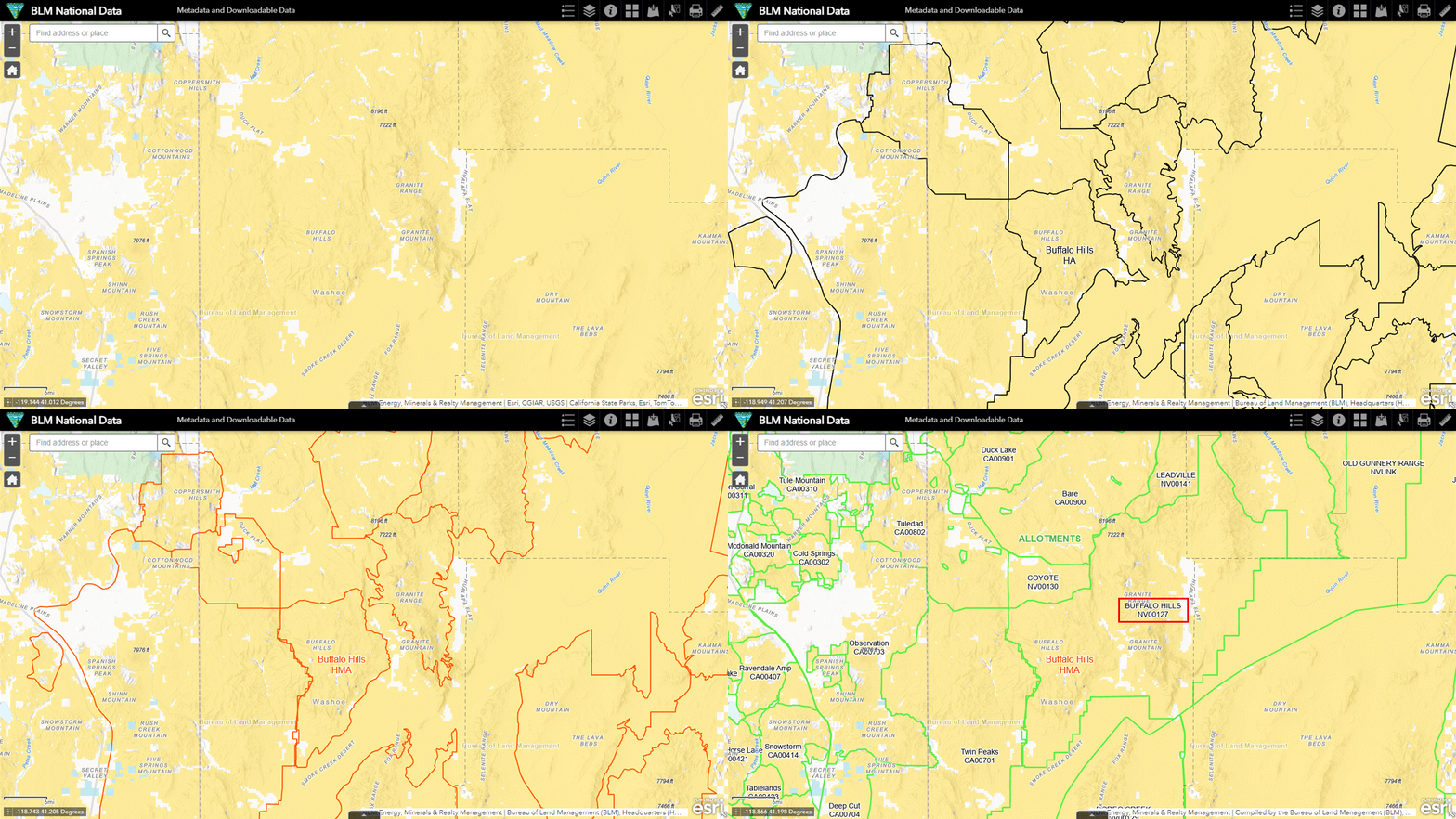
Buffalo Hills Roundup Set for Next Week

The incident, billed as catch-treat-release in the October 31 schedule, will begin on or about November 15 according to today’s news release.

The capture goals are 235 wild horses and 33 wild burros.

The removal goals are 32 wild horses and 33 wild burros.

Up to 100 mares with be treated with GonaCon Equine before being returned to the HMA with up to 103 stallions.

The announcement did not indicate if they would receive two doses and if they’d be given 90 days apart as specified on the label.

The BLM typically gives two doses 30 days apart, which constitutes unlawful use of the pesticide.

A helicopter will push the animals into the trap and operations will be open to public observation.

The pre-gather population is thought to be 314 wild horses and 33 wild burros.

The management plan allows 314 horses and no burros.

Animals identified for removal will be taken to the off-range corrals at Palomino Valley.

The HMA, on the east side of Twin Peaks, lies within the Buffalo Hills Allotment.

RELATED: Buffalo Hills Decision Issued.

Buffalo Hills HMA with Allotments 10-02-24

Foal-Free Friday, Army of Nitwits Edition

The Campaign Against America’s Wild Horses tries to market itself as a leader in wild horse conservation, evident in Google search results.

CAAWH Search Result 1 11-07-24

In reality, its leaders are obsessed with PZP, a restricted-use pesticide that tricks the immune system into attacking the ovaries.

CAAWH Search Result 2 11-07-24

They protect ranchers, not wild horses.

They oppose principal use and management at the minimum feasible level.

They want to replace motorized removal with mass sterilization.

None of this would be possible without a cadre of nefarious leaders and an army of ill-informed donors and volunteers.

RELATED: Foal-Free Friday, Strange But True Edition.

Pesticide Pushers 07-17-23

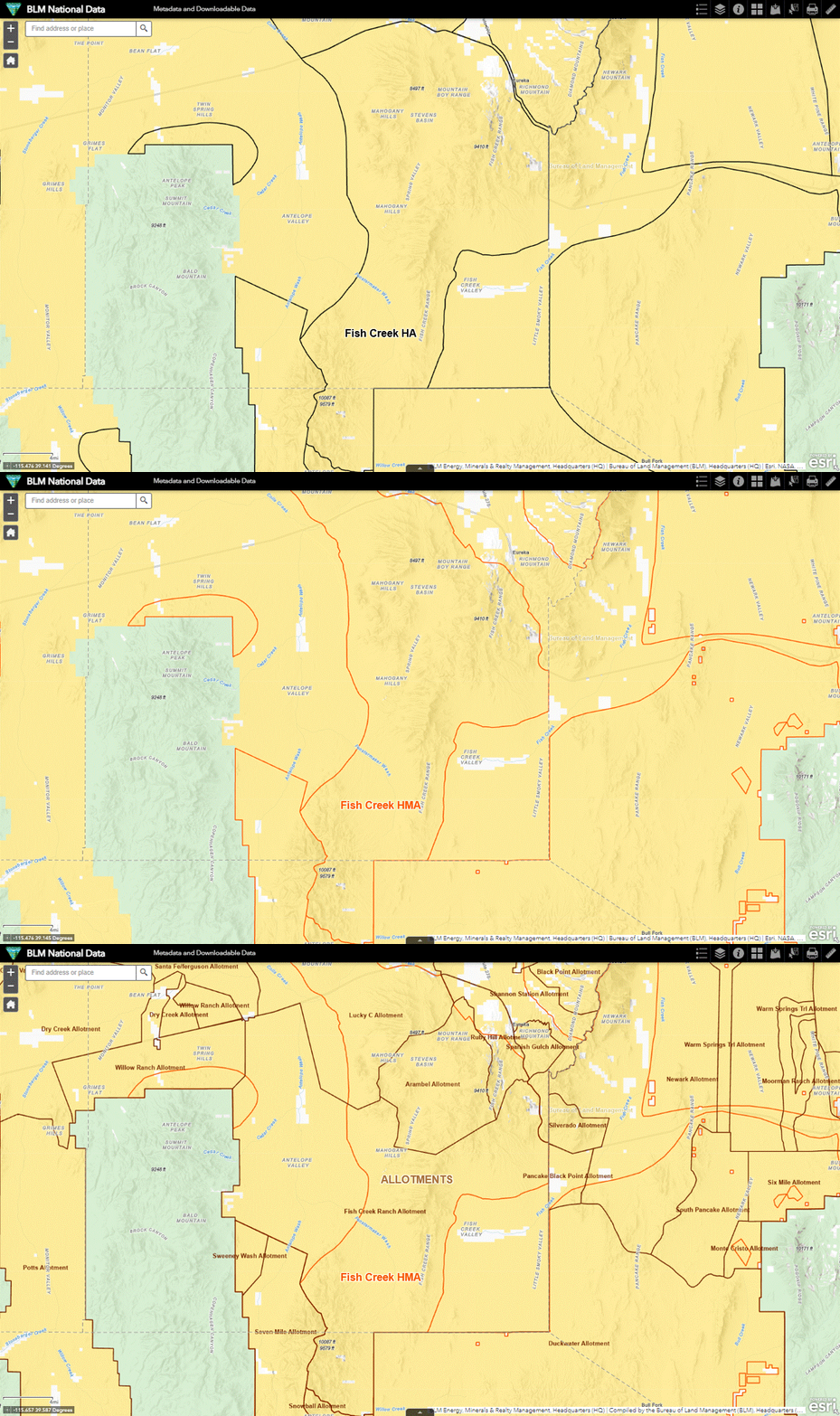
Fish Creek DNA Out for Review

A new project has been opened in ePlanning and the Draft DNA was copied to the documents folder for public review.

Comments will be accepted through December 7 according to today’s news release.

A 2015 Decision Record authorized the Proposed Action discussed in Section 2.2.1 of a 2015 Final EA.

A roundup at the Fish Creek HMA appears on the October 31 schedule with a start date of January 6.  The incident was billed as catch-treat-release and the pesticide of choice is GonaCon Equine.

The DNA asserts that the 2015 analysis fully covers the 2025 roundup and satisfies the requirements of NEPA.

A search of the 2015 EA for “gona” yielded no results, while searches for “zona” and “pzp” yielded numerous results.

Thus, the plan to apply GonaCon in January was not addressed in the original analysis and the assertion in the DNA is not correct.

The HMA, a few miles west of Eureka, NV, is subject to permitted grazing.

Fish Creek HMA with Allotments 11-07-24

Advocates Send Currituck Mule to Beach in the Sky

Some headlines said he died, such as this one by WITN News, but he was killed by the advocates.

Seems like there’s a steady stream of negative results coming from areas where the advocates are involved.

The winner for 2024 will likely be the loss of 24 Virginia Range mustangs in a botched attempt to rescue them from a construction area in south Reno.

RELATED: Advocates Let Currituck Stallion Die Naturally?

Devil’s Garden Roundup, Day 10

The incident started on October 28.  Results through November 6:

  • Location: Devil’s Garden Plateau WHT
  • AML: 402
  • Pre-gather population: Between 651 and 998
  • Target: Horses
  • Type: Planned
  • Method: Helicopter and bait
  • Goals: Capture 500, remove 500
  • Category: Cruel and costly (according to advocates)
  • Better way: Sterilize mares with PZP (according to advocates)
  • Captured: 128, up from 107 on Day 7
  • Shipped: Unknown
  • Released: Unknown
  • Deaths: Unknown
  • Average daily take: 12.8
  • Unaccounted-for animals: Unknown

The death rate cannot be determined.

There is no breakdown of capture total.

The percentage of foals cannot be determined.

The ratio of males to females is unknown.

The location of the trap site was not disclosed.

More information may be available on socialist media.

Body conditions scores have been averaging 4 to 5, an indication that the horses are not starving and the herd has not exceeded the ability of the land to sustain it.

The roundup will achieve a thriving ecological balance and multiple-use relationship on public lands, codewords for ranching superiority in the lawful home of wild horses.

RELATED: Devil’s Garden Roundup, Day 7.

Thriving Ecological Balance-3

Triple B Roundup, Day 5

The incident started on November 2.  Results through November 6:

  • Scope: Triple B Complex
  • Target: Wild horses
  • AML: 889
  • Pre-gather population: 3,335
  • True AML: 4,551
  • Type: Planned
  • Method: Helicopter
  • Category: Cruel and costly (according to advocates)
  • Better way: Sterilize mares with PZP (according to advocates)
  • Capture goal: 2,255
  • Removal goal: 2,155
  • Captured: 319, up from 243 on Day 3
  • Shipped: 246, up from 165 on Day 3
  • Released: None
  • Deaths: 3, up from 1 on Day 3
  • Average daily take: 63.8
  • Unaccounted-for animals: 70
  • Snippet from statute: It is the policy of Congress that wild free-roaming horses and burros shall be protected from capture, branding, harassment, or death
  • Snippet from manual: To protect wild horses and burros from unauthorized capture, branding, harassment or death

The figures above are based on the daily reports.

The Day 3 report still shows 122 horses shipped but the breakdown yields 120.

A stallion and mare were put down on Day 5 due to blindness in one eye, lifting the death rate to 0.9%.

The capture total includes 113 stallions, 137 mares and 69 foals.

Youngsters represented 21.6% of the animals gathered.

Of the adults, 45.2% were male and 54.8% were female.

Body condition scores were not given.

The location of the trap site was not disclosed.

Three HMAs are affected.

Up to 50 mares will be treated with GonaCon Equine and released back to the range with up to 50 stallions.

The number of doses and the interval between treatments were not specified, leaving open the possibility that the Complex becomes another GonaCon crime scene.

The roundup supports three tenets of rangeland management.

RELATED: Triple B Roundup, Day 3.

Triple B Complex with Allotments 11-04-24

Another Amendment to Gonacon Registration in the Works?

The Buffalo Hills DNA indicates the BLM has asked the EPA to revise the label, changing the interval between treatments from 90 days to 7 days.

This means that they know about, and probably knew about, the 2017 update, which increased the interval of the 2013 and 2015 registrations, which they usually cite in their planning documents, from 30 days to 90 days.

Moreover, mares captured in roundups typically receive two doses 30 days apart, which constitutes unlawful use of the pesticide.

GonaCon Violation of Federal Law 08-05-23

When will law enforcement get involved?

And what about the ranching sympathizers at Piceance Mustangs and High Desert Strategies who apply the product with the agency’s blessing?

Western Horse Watchers searched the EPA web site for “Gonacon” and did not find any recent updates for the equine version.

RELATED: An Incomplete History of GonaCon Equine.

Virginia Range Darting Update for October 2024

The Campaign Against America’s Wild Horses, a leader in nonmotorized removal and fierce opponent of principal use, reported today that 107 mares received 108 doses of PZP during the month, 19 given as primers and 89 as boosters.

Over the life of the program, which began in 2019, 2,068 mares have received 9,967 doses of the pesticide, for an average of 4.8 doses per mare.

The results fell 33 doses short of the 10,000-dose milestone predicted for October.

The epicenter of the program is in and around the Tahoe Reno Industrial Center, listed as USA Parkway in the page 3 chart.

Since the beginning of the year, 165 foals have been born and 66 died.

The current population is thought to be 3,465 with 294 horses listed as missing, compared to 3,501 with 299 horses listed as missing in September.

The population was 3,515 with 302 horses listed as missing in August and 3,548 with 311 listed as missing in July.

The Year 6 agreement with NDA has not been posted to the darting resources page.

The Year 5 summary has not been posted to the monthly reports page.

A goal for November is to maximize booster treatments so the herd will continue to shrink and to complete the training of newly certified darters.

Not discussed in the October update:

  • Long-term population goal
  • Number of viable mares
  • Size of breeding population
  • Loss of genetic diversity
  • Changes in death rate and sex ratio
  • Unlawful use of pesticides

The report will be submitted to the Nevada Department of Agriculture.

RELATED: Virginia Range Darting Update for September 2024.

Adjectives for Pests 12-01-23

Buffalo Hills Decision Issued

The BLM has determined that existing NEPA documentation adequately covers the proposed removal of wild horses and burros from rangelands in and around the HMA, according to a November 5 news release.

Operations could begin as early as November 15.

The DNA was copied to the project folder with the DR and comment summary.

Of interest is the last comment at the bottom of page one in the summary regarding the 2017 labeling amendment and increased interval between doses of GonaCon Equine.

The response indicates that the USDA is working with the EPA to change the label to allow a booster as soon as seven days after the initial injection!

If the label is not changed in time for the roundup the agency will follow the current label which means holding the mares for 90 days before applying the booster.

What about all the cases, including EAs currently out for public review, where they refer to the outdated 2013 and 2015 registrations and their 30-day intervals?

They need to be walked back, all of them.

The Buffalo Hills HMA lies within the Buffalo Hills Allotment.

The roundup supports three tenets of rangeland management.

RELATED: Buffalo Hills Comment Period in Progress.

Buffalo Hills HMA with Allotments 10-02-24

Devil’s Garden Roundup, Day 7

The incident started on October 28.  Results through November 3:

  • Location: Devil’s Garden Plateau WHT
  • AML: 402
  • Pre-gather population: Between 651 and 998
  • Target: Horses
  • Type: Planned
  • Method: Helicopter and bait
  • Goals: Capture 500, remove 500
  • Category: Cruel and costly (according to advocates)
  • Better way: Sterilize the mares with PZP (according to advocates)
  • Captured: 107, up from 73 on Day 5
  • Shipped: Unknown
  • Released: Unknown
  • Deaths: Unknown
  • Average daily take: 15.3
  • Unaccounted-for animals: Unknown

Results for Day 6 were not given.

The death rate cannot be determined.

There is no breakdown of capture total.

The percentage of foals cannot be determined.

The ratio of males to females is unknown.

The location of the trap site was not disclosed.

Body conditions scores have been averaging 5, an indication that the horses are not starving and the herd has not exceeded the ability of the land to sustain it.

The roundup will achieve a thriving ecological balance and multiple-use relationship on public lands, codewords for ranching superiority in the lawful home of wild horses.

RELATED: Devil’s Garden Roundup, Day 5.

Thriving Ecological Balance-3

Triple B Roundup, Day 3

The incident started on November 2.  Results through November 4:

  • Scope: Triple B Complex
  • Target: Wild horses
  • AML: 889
  • Pre-gather population: 3,335
  • True AML: 4,551
  • Type: Planned
  • Method: Helicopter
  • Category: Cruel and costly (according to advocates)
  • Better way: Sterilize mares with PZP (according to advocates)
  • Capture goal: 2,255
  • Removal goal: 2,155
  • Captured: 243, up from 81 on Day 1
  • Shipped: 165, up from zero on Day 1
  • Released: None
  • Deaths: 1, no change from Day 1
  • Average daily take: 81.0
  • Unaccounted-for animals: 77
  • Snippet from statute: It is the policy of Congress that wild free-roaming horses and burros shall be protected from capture, branding, harassment, or death
  • Snippet from manual: To protect wild horses and burros from unauthorized capture, branding, harassment or death

The figures above are based on the daily reports.

The Day 3 report indicates 122 horses shipped but the breakdown yields 120.

The death rate is 0.4%.

The capture total includes 83 stallions, 105 mares and 55 foals.

Youngsters represented 22.6% of the animals gathered.

Of the adults, 44.1% were male and 55.9% were female.

Body condition scores were not given.

The location of the trap site was not disclosed.

Three HMAs are affected.

The roundup supports three tenets of rangeland management.

Up to 50 mares will be treated with GonaCon Equine and released back to the range with up to 50 stallions.

The number of doses and the interval between treatments were not specified, leaving open the possibility that the Complex will become another GonaCon crime scene.

RELATED: Triple B Roundup in Progress.

Triple B Complex with Allotments 11-04-24

How Many Wild Horses Can Jakes Wash HA Support?

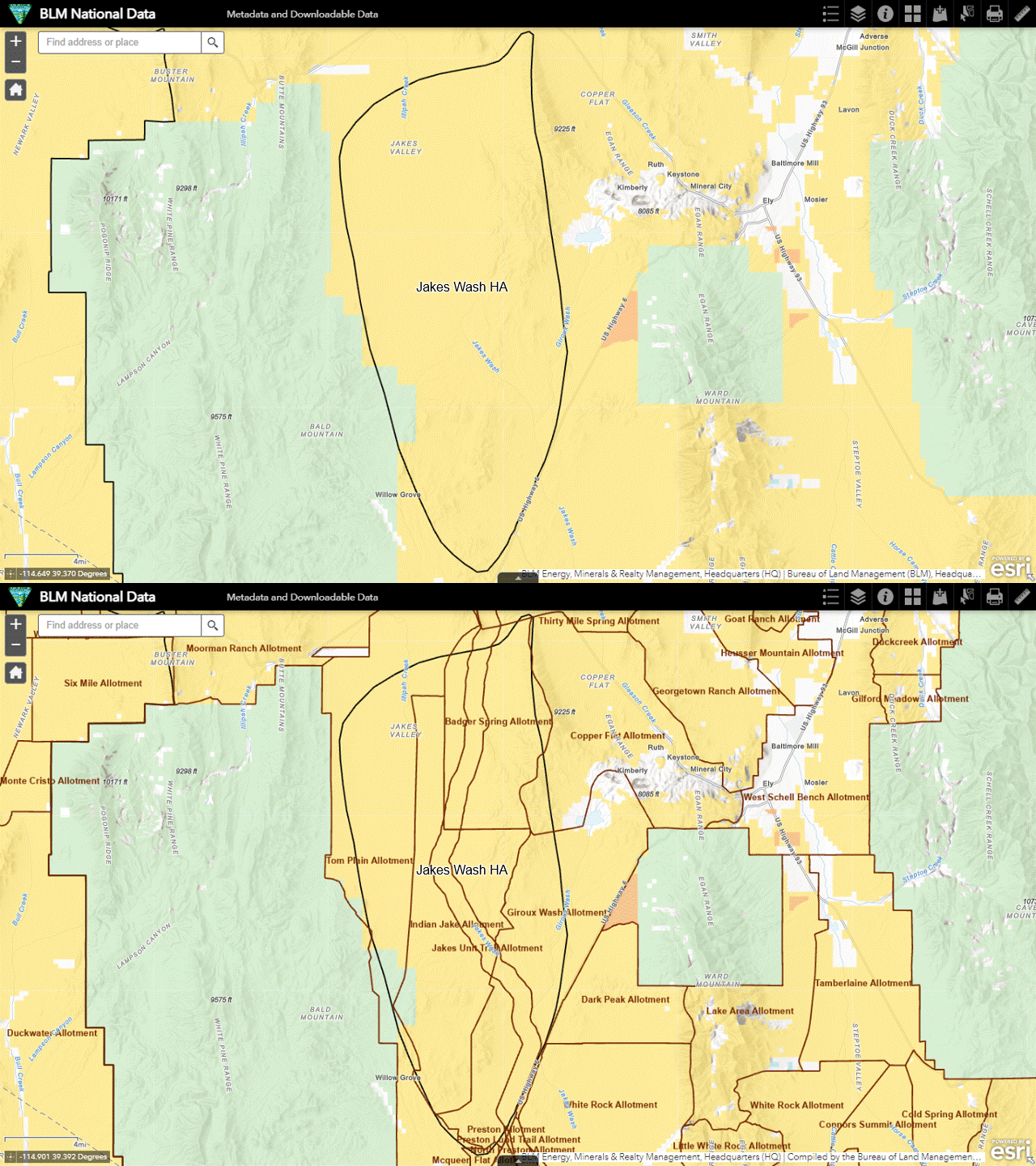
Identified for wild horses but managed principally for livestock, Jakes Wash covers 153,662 public acres 12 miles west of Ely, NV.  It’s part of the Pancake Complex.

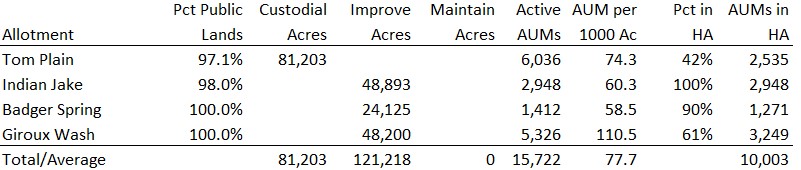
Table 5 in the Draft EA for the new HMAP gives the percentage of four overlapping allotments inside the HA.

The Allotment Master Report provides management status, acreage and active AUMs.

Jakes Wash Forage Calcs 11-05-24

Livestock receive an estimated 10,003 AUMs inside the HA, assuming the resource is evenly distributed across the allotments, enough to sustain 834 wild horses.

The stocking rate would be 5.4 wild horses per thousand public acres.

Our faithful public servants tell us that public lands in the western U.S. can only support one wild horses per thousand public acres.

How many wild horses will be allowed in the HA when the new HMAP is complete?

None.  The AML will still be zero and the land will be managed principally for livestock.

The horses will be viewed as pests and pest control measures will be applied as needed.

The advocates would have you believe that most wild horse problems can be traced to lack of HMAPs.

RELATED: If Wild Horses Had Principal Use of Tom Plain, Indian Jake, et al.

Jakes Wash HA with Allotments 11-04-24

If Wild Horses Had Principal Use of Tom Plain, Indian Jake, et al

The allotments overlap the Jakes Wash HA in eastern Nevada, part of the Pancake Complex.  Refer to Section 3.7 of the Draft EA for the new HMAP.

The forage assigned to horses is zero.

How many wild horses could live there?

The Allotment Master Report provides management status, acreage and active AUMs.

Jakes Wash Allotment Calcs 11-04-24

The Jakes Unit Trail passes through the area according to the National Data Viewer but this has been ignored.

The allotments offer 15,722 active AUMs on 202,421 public acres.

Approximately 60% of the land is in the Improve category.

Using the principle of forage interchangeability, the True AML would be 1,310, the number of horses the land could support if it was managed principally for them as specified in the original statute.

The stocking rate would be 6.5 wild horses per thousand public acres.

Why is this important?

Your faithful public servants claim that public lands in the western U.S. can only support one wild horse per thousand acres (27,000 animals on 27 million acres).

The advocates bolster the narrative with their darting programs.

If the allotments were an HMA, the AML would be 202 and 1,108 horses would be consigned to off-range holding because of permitted grazing.

BLM allotments in Nevada carry livestock equivalent to 173,144 wild horses on 40,194,360 public acres, or 4.3 wild horses per thousand public acres.

Wild horses can be placed on public lands not identified for their use by acquiring base properties associated with grazing allotments and flipping the preference to horses, as American Prairie did for bison in Montana.

RELATED: The Allotments Tell the Story: They’re Lying, All of Them.

Jakes Wash HA with Allotments 11-04-24