
Anything to dispute in this audio segment from KLCC Radio in Eugene, OR?
Month: September 2024
Advocates, Not Project 2025, Greater Threat to Wild Horses
Project 2025 talks about getting rid of wild horses.
The advocates are actually doing it.
The greatest threat is public-lands ranching, which the advocates support.
Do not be deceived.
RELATED: Project 2025 Targets America’s Wild Horses and Burros?

Bullfrog Scoping Begins
A management evaluation has been copied to the project folder for public review.
Comments will be accepted through October 18.
RELATED: New Pest Control Plan for Bullfrog HMA?
UPDATE: The BLM announced the project one week into the comment period. The evaluation indicates on page 9 that there is no livestock grazing inside the HMA.
Winners of 2024 Stewardship Awards Announced
The Rangeland Stewardship Award in the permittee category went to Fitzgerald Ranch of Plush, OR according to a BLM news release dated September 17.
The Operator Information Report at RAS tied the ranch to authorizations 3600601 and 3601273.
The Allotment Information Report linked the authorizations to these allotments:
- 3600601 – NORTHEAST WARNER
- 3601273 – SHALE ROCK, FITZGERALD FFR, COYOTE-COLVIN, ABERT SEEDING, SOUTH RABBIT HILLS
The Allotment Master Report provides management status, public acres and active AUMs.

Approximately 92% of the public acres are in the Improve category, suggesting that our stewards of the public lands are not taking their responsibilities seriously.
The allotments support livestock equivalent to 1,427 wild horses on 298,288 public acres, or 4.8 wild horses per thousand public acres.
The bureaucrats and ranchers tell us that public lands in the western U.S. can only support one wild horse per thousand public acres (27,000 animals on 27 million acres).
The award was presented at the annual meeting of the Public Lands Council.
What’s Happening at Wyoming Honor Farm?
Advocates Not Ill-Informed on Subject of Wild Horses?
So says one of their leaders in today’s news release on PRN.
Judge for yourself.
They’ve published a list of recommendations for the BLM covering ethical and effective wild horse and burro management.
It was developed at the SOWH Conference in Reno where there was no condemnation of the Virginia Range mass sterilization program, despite its proximity to the hotel-casino.
The page includes a form that will add your name to the signatories.
Western Horse Watchers offers the following suggestions as a starting point for meaningful discussion.
- Confine the ranchers to their base properties in a year-round off season
- Restore the WHB Act to its original form
- Neutralize the influence of farm bureaus, stock grower’s associations, public lands councils and wildlife groups on government
- Acquire base properties as they come on the market and flip the grazing preference to horses or burros
- Keep the pesticide pushers off the public lands
A guiding principle in the SOWH recommendations is that they could be implemented without any changes to policy and law.
The cover letter was not addressed to anyone in the Department of Agriculture, which is responsible for wild horses and burros on Forest Service lands.
End of Line for Kisatchie Horses?
The Army base is now Fort Johnson, not Fort Polk, according to a story by The Advocate of Baton Rouge, LA.
The number of horses remaining in the forest is unknown.
An advocacy group filed suit claiming the Army’s plan to eliminate the horses violates the National Environmental Policy Act and the National Historic Preservation Act but the courts ruled in favor of the military, who views the herd as trespass livestock.
Although the group rescued around 100 animals, they have separated the males from the females, suggesting there are no plans to preserve the resource.
RELATED: Louisiana’s Fort Polk Horses a Unique Genetic Resource?
Foal-Free Friday, Gaslighting Your Supporters Edition
The Campaign Against America’s Wild Horses oversees an innovative fertility control program on the Virginia Range according to an August 31 news flash distributed by Lucky Three Ranch.
It’s designed preserve the wild horse herd.
The advocates shoot the females with pesticide-laced darts.
After five years of treatment they become sterile.
The program is now in its sixth year.
The mares enjoy a well-deserved break from the demands of nursing and pregnancy, allowing them to maintain strong health and a steady weight.
The fillies, also targeted, thrive without the strain of early pregnancy, giving them the time they need to grow strong and healthy.
As the older horses die.
Does it make sense now?
Thank God for the wild horse advocates.
RELATED: Foal-Free Friday, Abandoning Principal Use Edition.

Hold Your Horses: Little Book Cliffs Roundup Not Complete
Yesterday’s news release says it’s over although some horses are still being sorted to determine which ones will receive fertility treatments, moved to different areas of the HMA or taken to a holding facility.
The gather page indicates 59 unaccounted-for animals.

A report by The Colorado Sun indicates that a mare, 24 years old and underweight—but with foal—was dispatched on Day 8 after she broke her leg.
The foal went to a local ranch.
The roundup is not over until the disposition of every captured animal is known.
RELATED: Little Book Cliffs Roundup, Day 7.
Wild Horse Gala Tonight
Won’t you chip in so they can buy more PZP?
RELATED: Advocates to Fleece West Coast Liberals at Wild Horse Gala?

Another BLM Outage
The system is down again. None of the wild horse and burro pages, including ePlanning and the National Data Viewer, are responding.
Wild Horse Adoptions Conserve Public Lands?
Suppose you adopt a mom-baby pair at one of the BLM off-range corrals, captured earlier this year in a wild horse roundup.
How much does the on-range population change?
What is the change in resource loading?
How many public acres were conserved?
Zip, zero and zilch, respectively.
So why would the writer of an opinion piece in today’s edition of The Nevada Independent peddle wild horse adoptions as conservation?
Because they free-up space in the corrals, allowing more horses to be taken off the range, conserving resources for the public-lands ranchers.
The author forgot to mention them.
“The equines generally inhabit rugged, remote, arid landscapes where they compete with mule deer, pronghorn, sage-grouse and other wildlife for water and forage.”
There aren’t many predators in those areas because they have been minimized in the name of animal agriculture.
Public lands in Nevada can’t support 38,000 wild horses and burros but they can support livestock equivalent to 173,000 wild horses.
The Property and Environment Research Center advocates for market solutions to conservation so let’s put labels on range-fed beef saying it was produced on public lands at the expense of America’s wild horses and let consumers pick the winners and losers.
RELATED: AIP Turns 5.

Three Rivers Decision Issued
The Decision Record authorizes Alternative A, the Proposed Action, described in Section 2.1 of the Final EA.
Management actions include forcible removal, sex ratio adjustment and fertility control over a ten-year period.
A roundup appears on the FY25 schedule with a start date of May 1.
Three HMAs are affected.
Up to 100 jennies will be returned to the range after treatment with GonaCon Equine.
The Complex is subject to permitted grazing.
The DR and EA can be found in the project folder on ePlanning.
RELATED: New Pest Control Plan for Alamo, Lake Havasu, Big Sandy Burros?

Little Book Cliffs Roundup, Day 7
The incident started on September 11. Results through September 17:
- Scope: Little Book Cliffs HMA
- Target: Horses
- AML: 150
- Pre-gather population: Unknown (not stated in news release)
- True AML: N/A (no livestock grazing)
- Type: Planned
- Method: Helicopter
- Goals: Gather 130, remove 100
- Captured: 134, up from 116 on Day 5
- Shipped: 78, up from 38 on Day 5
- Released: None
- Deaths: 2, up from zero on Day 5
- Average daily take: 19.1
- Unaccounted-for animals: 54
The figures above are based on the daily reports.
The helicopter was grounded on Day 7 due to weather, not because the capture goal had been reached.
Two horses were dispatched on Day 6 due to knee injuries, bringing the death rate to 1.5%.
The capture total includes 36 stallions, 78 mares and 20 foals.
Youngsters represented 14.9% of the animals gathered, consistent with a herd growth rate of nine to ten percent per year.
Of the adults, 31.6% were male and 68.4% were female, outside the expected range of variation from a random process centered at 50% males / 50% females.
Body condition scores were not given.
The location of the trap is not known.
Up to 20 mares will be treated with fertility control pesticides and be returned to the HMA with up to ten stallions.
The Draft EA for management actions in the HMA indicated on page 6 that the herd consisted of 203 horses, including 22 foals, as of September 2023. Of the 181 adults, 33% were male and 67% were female.
The Final EA states on page 6 that the population in July 2024 was 222, including 29 foals, and that the 193 adults consisted of 42% males and 58% females.
Abnormal sex ratios are common in herds treated with PZP, a restricted-use pesticide that tricks the immune system into attacking the ovaries.
RELATED: Little Book Cliffs Roundup, Day 5.

Missing Cat Posters Explained
You’ve seen them stapled to telephone poles in residential areas. Missing dogs too.
But Trump forgot to mention horses, which are taken for their meat, as discussed in this post from February 2023.
New Pest Control Plan for Bullfrog HMA?
A new project has been started in ePlanning but the document folder is empty.
The scoping period will begin on September 20.
The description indicates the Proposed Action will authorize the removal of wild burros from in and around the HMA over a ten-year period, reduce the population growth rate and address public safety concerns in the town of Beatty, NV.
Management actions will be captured in a new HMAP.
The National Data Viewer shows one overlapping allotment but does not indicate if pastures inside the HMA are in use.
The Allotment Master Report shows 1,926 active AUMs on 269,764 public acres with one permittee, the Nature Conservancy of Southern Nevada.
A September 12 story by the Pahrump Valley Times said the Town Advisory Board voted to send a letter to the BLM seeking removal of some of the animals.

Advocates to Fleece West Coast Liberals at Wild Horse Gala?
The Campaign Against America’s Wild Horses, a leader in nonmotorized removal and stalwart opponent of principal use, will host the event on September 19 at the Buffalo Club in Santa Monica.
Tickets start at $250.
Didn’t get an invitation?
PZP isn’t cheap and your pathetic donations won’t even get you a Christmas card.
RELATED: If You Want to Help the Ranchers Give Money to the Advocates.

Davis Fire Tamed, Advocates Now Greatest Threat to Horses
They were the greatest threat before the fire, shooting the females, young and old, with pesticide-laced darts.
The September 16 update at InciWeb indicates no growth, with 85% containment.
The cause is still under investigation.
RELATED: Davis Fire Almost Subdued, Risk to Virginia Range Minimal.
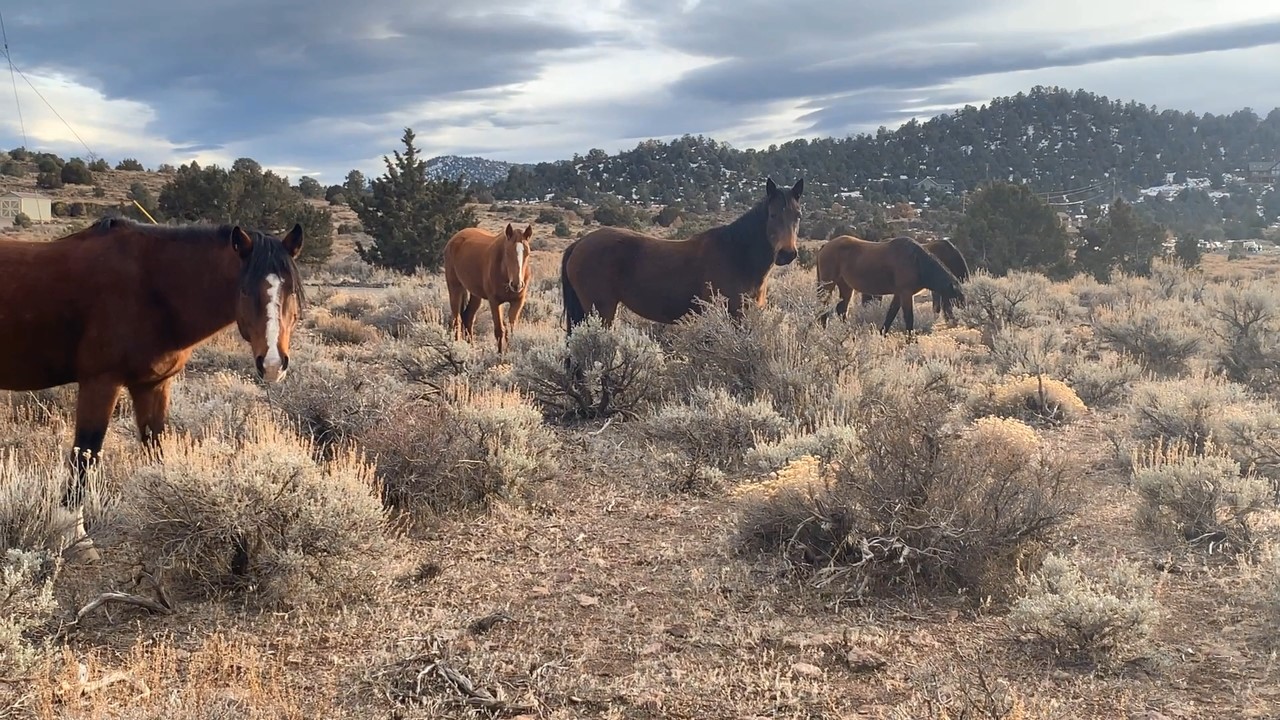
If Wild Horses Had Principal Use of Deeth and Pole Creek
The permits on these allotments, located in northeastern Nevada, are up for renewal.
Together, they offer 21,055 active AUMs on 130,698 public acres, according to the Allotment Master Report.
The AMLs are zero. The nearest HA is Spruce-Pequop.
How many wild horses could the allotments support?
Using the principle of forage interchangeability, the True AML would be 21,055 ÷ 12 = 1,755, the number of horses the land could support if it was managed principally for them as specified in the original statute.
The stocking rate would be 1,755 ÷ 130,698 × 1,000 = 13.4 wild horses per thousand public acres.
Why is this important?
The bureaucrats and ranchers claim that public lands in the western U.S. can only support one wild horse per thousand acres (27,000 animals on 27 million acres).
The advocates, defeated a long time ago, bolster the narrative with their darting programs.
If the allotments were an HMA, the AML would be 130 and 1,625 horses would be consigned to off-range holding because of permitted grazing.
BLM allotments in Nevada carry livestock equivalent to 173,144 wild horses on 40,194,360 public acres, or 4.3 wild horses per thousand public acres.
Wild horses can be placed on public lands not identified for their use by acquiring base properties associated with grazing allotments and flipping the preference to horses, as American Prairie did for bison in Montana.
RELATED: The Allotments Tell the Story: They’re Lying, All of Them.

Mustang Monday
On the Bisti Badlands with Kenneth F. Thornton II.
 Western Horse Watchers Association