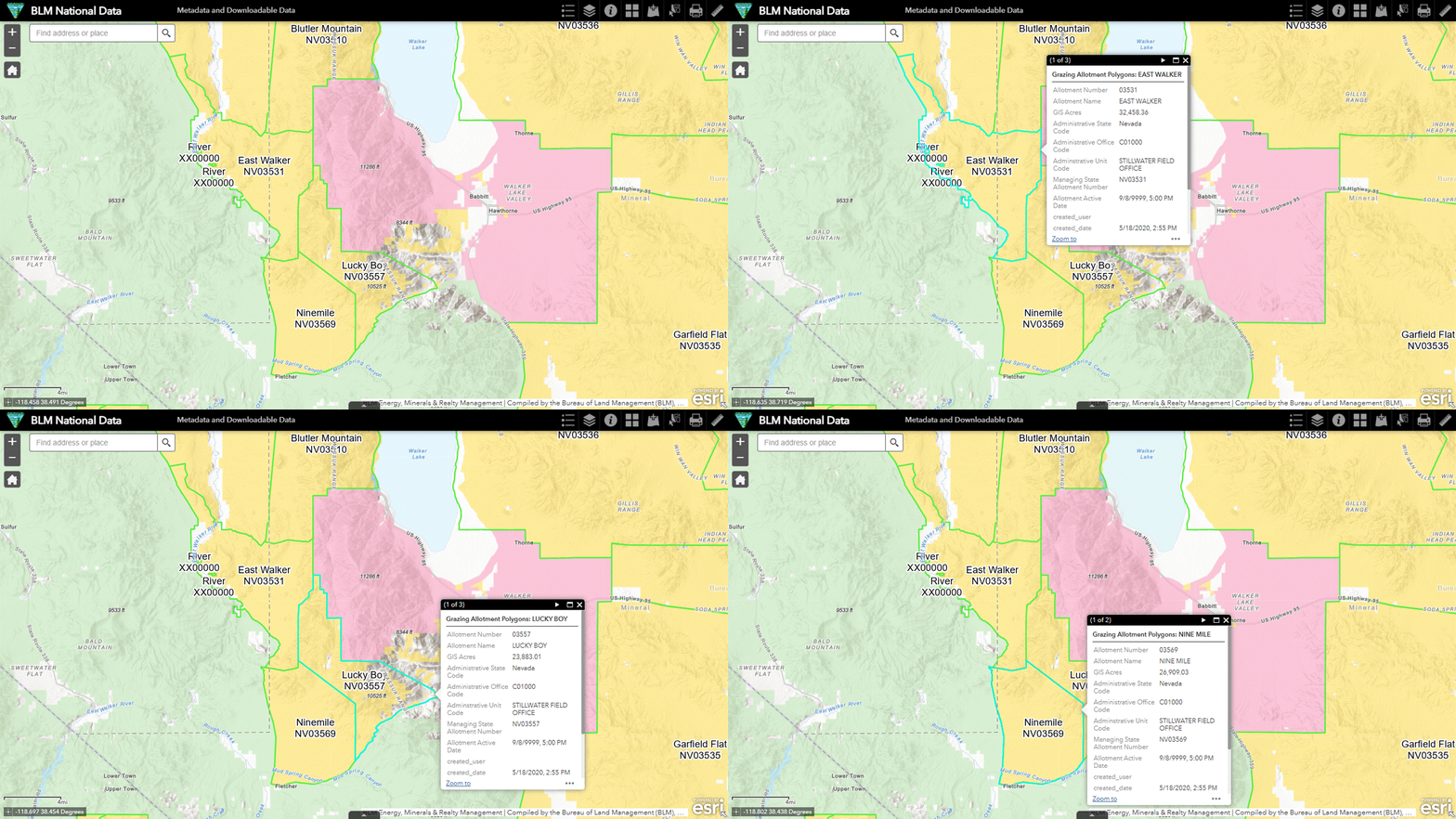
The HMA sits on top of nine grazing allotments, discussed in Section 3.2.2 of the Final EA for pest control and resource enforcement therein.
The map in Appendix H shows the arrangement (page 103 in the pdf).
The National Data Viewer indicates that some of the allotments extend beyond the HMA boundary, taking with them a small percentage of the active AUMs, but that will be ignored in this report.
The management plan allows 758 wild horses in the HMA plus 116 wild burros.
These animals require 758 × 12 + 116 × 6 = 9,792 AUMs per year.
The Allotment Master Report provides management status, acreage and active AUMs.
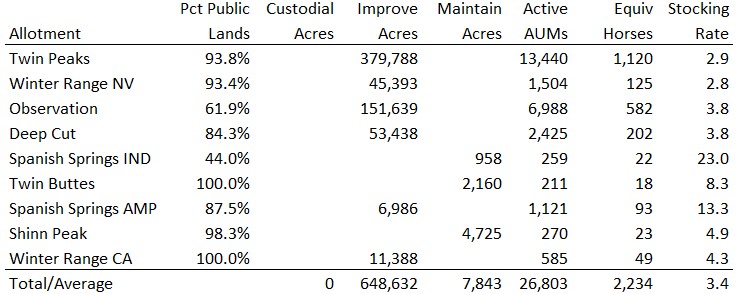
The allotments offer 26,803 active AUMs per year on 656,475 public acres.
Approximately 99% of that acreage is in the Improve category.
The AUMs would support 2,234 wild horses, on top of the 758 allowed by plan.
The pre-gather population of 1,800 is well within this range.
Current management practices give the resource to the ranchers, who pay $1.35 per AUM, while consigning 2,234 wild horses to off-range holding at a cost of $5 per head per day.
The cash flow in this scenario, Alternative A, is:
1.35 × 26,803 – 2,234 × 5 × 365 = -$4,040,865.95 per year
The Proposed Action, Alternative B, would shift the resource back to the horses by confining the ranchers to their base properties, for a cash flow of zero.
No income from grazing, no expenditure for off-range holding, with net savings to taxpayers of $4 million per year.
RELATED: Twin Peaks Roundup Announced.











 Western Horse Watchers Association