Foal-Free Friday, Go Big or Go Home Edition

In their bid to win the approval of the bureaucrats and ranchers. the advocates have gone “all in” for the Montana Solution, hoping the collapse of the Salt River and Virginia Range herds will finally convince them that the pesticide is a viable alternative to motorized removal.

The tipping points should be reached this year.

They’re not trying to slow population growth as in the old days, but to erase entire populations through mass sterilization.

The absence of foals is just a symptom.

The Maryland side of Assateague Island shows what can be accomplished in the long run but they can’t take credit for it.

RELATED: Foal-Free Friday, Lies, Damned Lies and Statistics Edition.

Pesticides R Us Better Way 11-07-23

White Mountain Roundup Set for Mid-August

Yesterday’s announcement said the current population was 791, compared to an AML of 205-300, so 586 excess horses have to go.

A helicopter will push them into the trap and they’ll be taken to the off-range corrals at Wheatland or Rock Springs.

There are no plans to treat any of the mares with fertility control pesticides and return them to the range.

The HMA covers 391,868 total acres, including 207,372 public acres, most of them in the Wyoming checkerboard.

The news release did not indicate if operations would be open to public observation.

As of today, a gather page has not been created.

The HMA intersects the Lombard, Highway Gasson and Rock Springs allotments.

RELATED: White Mountain Decision Issued.

White Mountain HMA with Allotments 07-04-24

White Mountain Decision Issued

The BLM has determined that there are 586 excess horses in the HMA, home of the Pilot Butte Wild Horse Scenic Tour.

The Proposed Action, described in Section A of the DNA Worksheet, calls for gather and removal via helicopter, with roping or bait-trapping as needed.

There are no plans to treat any of the mares with fertility control pesticides and return them to the range.

The agency reviewed previous planning documents and concluded they adequately analyzed the impacts associated with the Proposed Action.

The DR was copied to the project folder along with the FONSI and DNA Worksheet.

The HMA overlaps the Lombard, Highway Gasson and Rock Springs allotments.

It was not zeroed-out in the Final Rock Springs RMP Decision.

RELATED: Comments Invited on DNA for White Mountain Roundup.

White Mountain HMA with Allotments 07-04-24

Putting the CBD Lawsuit in Perspective

How much poison has Robin Silver of the Center for Biological Diversity pumped into the Salt River herd?

How many mares has he sterilized?

How much time does he spend praying for the older horses to die?

How many times has he gone on record claiming that PZP does not cause infertility?

How many times has he called the pesticide a vaccine?

How much money has he given to the Campaign Against America’s Wild Horses and its surrogate, the Salt River Wild Horse Darting Group?

The real villains in the case are the advocates, not the biologists.

As for genetic diversity, both sides are wrong.

It’s the size of the breeding population that matters, not the size of the herd, and at the Salt River you can count it on one hand.  (Refer to Section 4.4.6.3 in H-4700-1.)

In a few years, that number may be on the high side, thanks to the advocates.

RELATED: Hypocrisy of Advocates on Full Display at Salt River.

If Wild Horses Had Principal Use of Fourth of July

The allotment, located northeast of Rock Springs in the Wyoming checkerboard, offers 836 active AUMs on 12,968 public acres, according to the Allotment Master Report.

The forage assigned to horses is zero.

How many wild horses could live there?

Using the principle of forage interchangeability, the True AML would be 836 ÷ 12 = 70, the number of horses the land could support if it was managed principally for them as specified in the original statute.

The stocking rate would be 70 ÷ 12,968 × 1,000 = 5.4 wild horses per thousand public acres.

Why is this important?

The bureaucrats and ranchers claim that public lands in the western U.S. can only support one wild horse per thousand acres (27,000 animals on 27 million acres).

The advocates give their assent through their darting programs.

If the allotment was an HMA, the AML would be 13 and 57 horses would be consigned to off-range holding because of permitted grazing.

BLM allotments in the state carry livestock equivalent to 158,425 wild horses on 17,312,214 public acres, or 9.2 wild horses per thousand public acres.

RELATED: The Allotments Tell the Story: They’re Lying, All of Them.

Fourth of July Allotment 07-04-24

North Lander Roundup, Day 3

The incident started on July 1.  Results through July 3:

  • Scope: North Lander Complex
  • Target: Horses
  • AML: 536
  • Current population: 3,035
  • True AML: 4,616
  • Type: Planned
  • Method: Helicopter
  • Category: Cruel and costly (according to advocates)
  • Better way: Sterilize mares with PZP (according to advocates)
  • Goals: Gather 2,766, remove 2,716
  • Captured: 573, up from 383 on Day 1
  • Shipped: 386, up from zero on Day 1
  • Released: None
  • Deaths: 2, up from zero on Day 1
  • Average daily take: 191.0
  • Unaccounted-for animals: 185

The figures above are based on the daily reports.

A mare was dispatched on Day 2 due to a fractured head and a foal was put down because of malformed vertebrae in the neck.

The death rate is 0.3%.

The capture total includes 227 stallions, 240 mares and 106 foals.

Youngsters represented 18.5% of the animals gathered.

Of the adults, 48.6% were male and 51.4% were female.

Body condition scores were not given.

The location of the trap site is not known.

The Complex is subject to permitted grazing.  Resources liberated to date:

  • Forage: 6,876 AUMs per year
  • Water: 5,730 gallons per day

The June 3 schedule indicates that 20 mares will be treated with fertility control pesticides and returned to the range but this is not discussed at the gather page.

The roundup supports three tenets of rangeland management.

RELATED: North Lander Roundup Begins.

North Lander Allotments 06-27-24

Hypocrisy of Advocates on Full Display at Salt River

The ringleader of the Salt River Wild Horse Darting Group said in yesterday’s article about the CBD lawsuit “We believe that wild horses have a positive impact on their environment.”

If that’s true, why are you trying to get rid of them?

She also said the darts, which contain PZP, don’t make the mares infertile, yet she knows they won’t get pregnant after five years of treatment even if darting stops.

They’re not sterile, they’re “self-boosting.”

That’s what happened on the Maryland side of Assateague Island, an area the advocates pointed to as a model of wild horse management.

Now that the truth is out—that the herd is still shrinking eight years after the darting program was shut off—they have a bad case of amnesia.

So if the court rules in favor of the plaintiffs, the herd will remain with 50 animals.

Let Us Fix Your Wild Horse Problem 02-18-23

But if it sides with the defendants, there will be no herd at all because nobody’s trying to stop these charlatans from destroying it through mass sterilization.

The Salt River Wild Horse Darting Group receives support from the Campaign Against America’s Wild Horses, a leader in nonmotorized removal.

RELATED: CBD Cares More About Salt River Horses Than Advocates.

CBD Cares More About Salt River Horses Than Advocates

The Center for Biological Diversity says the herd should be no larger than 50 according to a story by ABC15 News of Phoenix.

The current population is slightly over 300.

The advocates say the herd should contain at least 200 wild horses, so they’re the good guys, right?

Only if you think mass sterilization is good for the herd.

The darts mentioned in the article contain PZP, a restricted-use pesticide that tricks the immune system into attacking the ovaries.

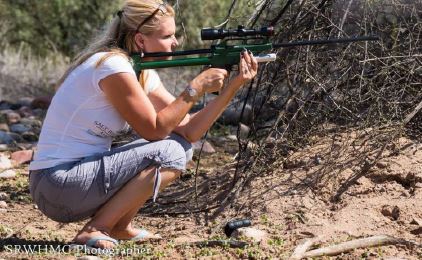
Simone Neterlands with Darting Rifle 09-02-23

Damage begins with the first injection and proceeds to sterility after five years of treatment.

The mares will be sterile halfway into the ten-year program, which occurs this year.

The goal of 200 will be reached in a few more years but the decline won’t stop there.

The herd on the Maryland side of Assateague Island, where the same pesticide was applied, is still shrinking eight years after the darting program was shut off.

Fifty will look good as the herd disappears into the sunset.

The Salt River Wild Horse Darting Group is a puppet of the Campaign Against America’s Wild Horses, a leader in nonmotorized removal.

RELATED: Salt River Advocates Suffering from Mental Illness?

Blue Wing Roundup Announced

The incident will begin on or about July 8 according to today’s news release.

The plan targets 1,373 wild horses and 356 wild burros for capture and removal.

Helicopters will push the animals into the traps and operations will be open to public observation.

The announcement does not indicate if any of the mares will be treated with fertility control pesticides but the June 3 schedule puts the figure at 40.

The Blue Wing Complex consists of five HMAs, a subset of the land designated in 1971.

The National Data Viewer shows the arrangement.  Click on image to open in new tab.

Animals identified for removal will be taken to the off-range corrals in Fallon with some of the burros going to Axtell.  Both facilities are privately owned.

The Complex lies within the Blue Wing – Seven Troughs Allotment, which offers 20,316 active AUMs on 1,192,778 public acres, or 17 AUMs per year per thousand public acres.

The roundup supports three tenets of rangeland management.

RELATED: Scoping Begins for Blue Wing HMAP.

Blue Wing Complex with Allotments 05-02-24

Best Use of North Lander AUMs?

Taxpayers spend around $5 per day for a horse in short-term holding, so if he receives one AUM, enough to keep him on the range for a month, taxpayers save $150, or $1,800 per year.

The government loses the grazing value of that forage, equal to $1.35 per month or about $16 per year.

Now scale it up.

The BLM gave 48,964 AUMs per year to privately owned livestock in the Complex, thereby consigning 4,080 wild horses to off-range holding.

If the forage was shifted back to the horses, meaning they had principal use of the land as specified in the original law, taxpayers would save 4,080 × 1,800 = $7,344,000 per year, while the BLM forfeits 4,080 × 16 = $65,280 per year in grazing fees.

The net benefit exceeds $7 million per year, to be achieved by confining the ranchers to their base properties in a year-round off season.

RELATED: If Wild Horses Had Principal Use of North Lander Complex.

Cattle and Horses

Socialist Media Update for June 2024

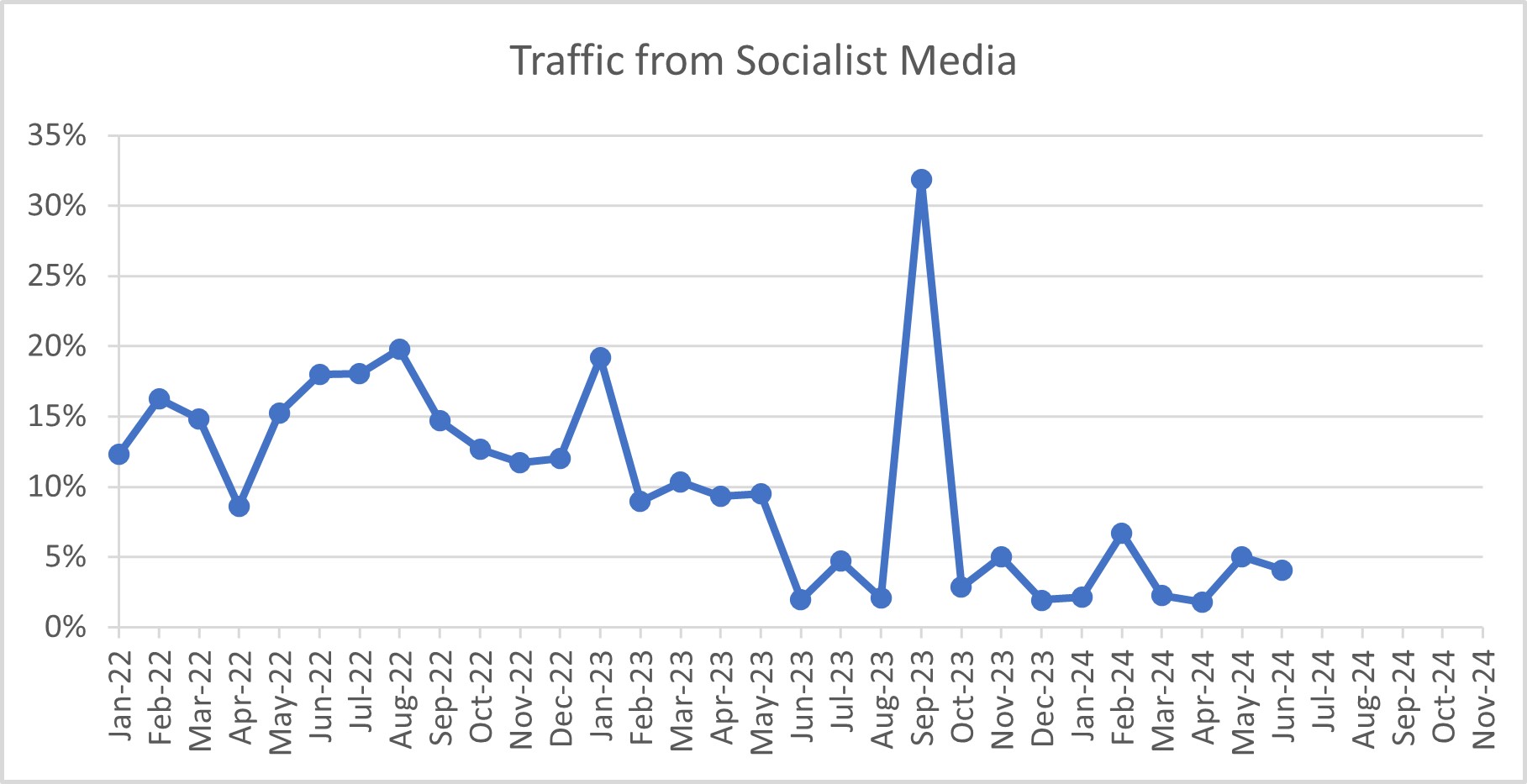
Traffic from Facebook and Twitter accounted for 4.1% of the total during the month, down considerably from the same period two years ago.

Did you know that livestock in the North Lander Complex receive seven times more forage than the horses and that an additional 4,080 horses could be on the range but are rotting instead in off-range holding because of permitted grazing?

You didn’t hear that from the advocates because it undermines the rationale for their ruinous darting programs.

Western Horse Watchers brings you the truth about wild horses, resource management and the Love Triangle on America’s public lands.

RELATED: Socialist Media Update for May 2024.

Traffic from Socialist Media June 2024 07-01-24