As of this evening, there were ten likes and a 40% favorable rating, suggesting there were fifteen dislikes.
The video was published on May 26 and subscribers were not notified.

Western Horse Watchers Association
Exposing the Hypocrisy, Lies and Incompetence of the Wild Horse Advocates
As of this evening, there were ten likes and a 40% favorable rating, suggesting there were fifteen dislikes.
The video was published on May 26 and subscribers were not notified.
A story by KFYR News says “the park service has agreed to leave the horses where they are and to follow their existing environmental assessment,” which means they’ll enforce the current management plan, limiting the herd to 60 or less.
This is like throwing a fresh piece of meat to the advocates.

If the keynote address is any indication, you didn’t miss much.
Instead of condemning the Campaign Against America’s Wild Horses and its mass sterilization program on the Virginia Range, there was praise for its good work (19:33).
Instead of trying to change the system (22:24), change the statute, restoring it to its original form.
Regarding the Veterans for Pesticides Act (25:00), you can reduce the need for helicopters by clearing the land of privately owned livestock, allowing the herds to fill their niche and manage themselves. Funny how the advocates won’t talk about that.
As of today, the channel contains eleven videos.
RELATED: SHOCKER: Advocates Don’t Know What to Do.
With the darting program now in its sixth year, presumably, many of the Virginia Range mares are now at risk of sterility.
The dwindling breeding population will not be able to keep up with deaths and the herd will implode, just like Assateague Island.
This is the promise of nonmotorized removal, the final solution.
RELATED: Foal-Free Friday, Replacing Life with Death Edition.
As of today, the Campaign Against America’s Wild Horses has not posted the Year 6 Agreement with NDA to its darting resources page.
The summary for Year 5, which ended on April 30, has not been posted to the monthly reports page.

With many of the mares at risk of sterility, now is the time to finish the herd off and win the approval of the bureaucrats and ranchers.
A bale of alfalfa-grass mix sold for $30 today, 20 bales minimum, down from $34 in March.
The feed store did not indicate if this was a special offer or the new rate.
A horse would need around five bales per month, putting the cost of feed at $150 per AUM.
The poor ranchers, forced to live in multi-million-dollar base properties, pay $1.35 per AUM on public lands managed by the BLM and Forest Service.
Three years ago, before Bidenomics kicked in, the same bale fetched $19.
RELATED: Price of Hay Defies Gravity.
The BLM allows 23,866 wild horses and 2,919 wild burros on 26,917,766 public acres according to the 2024 population dataset.
That’s equivalent to 23,866 + 2,919 ÷ 2 = 25,326 wild horses on 26,917,766 public acres.
As reported on April 22, the agency authorizes privately owned livestock equivalent to 1,023,481 wild horses on 145,895,940 public acres.
To match the stocking rate and resource loading of the grazing program, the wild horse and burro program would have to satisfy the following relationship:
x ÷ 26,917,766 = 1,023,481 ÷ 145,895,940
Solving for x, the new AML would be 188,832.
The current wild horse and burro population, equivalent to 66,236 wild horses, is well within this limit.
Why are the advocates working with the bureaucrats to take the numbers lower?
Why are you still giving them money?
RELATED: New Report Ties Poor Rangeland Health to Permitted Grazing.

Today’s news release indicates that 44 million acres do not meet BLM’s minimum standards, with livestock being the primary cause, either in whole or in part.
PEER Rocky Mountain Director Chandra Rosenthal noted that an estimated 1.5 million cattle forage BLM lands compared to fewer than 75,000 wild horses.
As reported by Western Horse Watchers on April 22, the agency authorizes livestock equivalent to 1,023,481 wild horses on 145,895,940 public acres in ten western states, or seven wild horses per thousand public acres.
The agency allows 26,785 wild horses and burros on 26,917,766 public acres, according to the 2024 population dataset, or one such animal per thousand public acres.
Which species has the larger footprint and potential for rangeland degradation?
The current wild horse and burro population is equivalent to 66,236 wild horses, or 2.5 wild horses per thousand public acres.
You’d need to increase the wild horse population to 188,424 to have the same resource loading as privately owned livestock.
The incident started on April 16. Results through May 23:
The figures above are based on the daily reports.
A stallion was dispatched on Day 39 due to blindness.
Another stallion was dispatched on Day 42 due to injuries sustained in capture, sorting or holding, boosting the death rate to 3.6%.
The capture total includes 102 stallions, 110 mares and 40 foals.
Youngsters represented 15.9% of the animals gathered, consistent with a herd growth rate of eleven percent per year.
Of the adults, 48.1% were male and 51.9% were female.
Body condition scores were not given.
The location of the trap site is not known.
The Complex is subject to permitted grazing. Resources liberated to date:
There are no plans to treat any of the mares with fertility control pesticides and return them to the range.
The roundup supports three tenets of rangeland management.
RELATED: Caliente Roundup, Day 38.
The incident started on May 1. Results through May 28:
The figures above are based on the daily reports.
Two horses died on Day 27 due to injuries sustained in capture, sorting or holding, lifting the death rate to 3.3%. No details were given.
To date, only one death has been attributed to pre-existing conditions.
The capture total includes 106 stallions, 81 mares and 26 foals.
Youngsters represented 12.2% of the animals gathered, consistent with a herd growth rate of seven percent per year.
Of the adults, 56.7% were male and 43.3% were female.
Body condition scores were not given.
The location of the trap site is not known.
The status of captured animals has not been disclosed.
The HMA is subject to permitted grazing. Resources liberated to date:
Ten mares will be treated with GonaCon Equine, a fertility control pesticide, and be returned to the range according to the latest schedule.
The roundup supports three tenets of rangeland management.
RELATED: Bordo Atravesado Roundup, Day 24.

So says a report by KPHO News of Phoenix.
There is no greater danger to the herd than Simone Netherlands, interviewed for the story, and her band of merrymen, who are sterilizing the mares with PZP, an ovary-killing pesticide.
RELATED; CBD Brings Another Complaint Against Salt River Horses.
The Wild Horse Integrity and Slaughter Prevention Act would reduce adoption wait times and criminalize the transfer of wild horses and burros to foreign jurisdictions for commercial processing, according to a story dated May 28 by The Floridian.
The relationship to the SAFE Acts (House | Senate) is unknown.
The wait time for adoption may refer to titling, which currently requires a year.
The measure likely corresponds to HR 8541, introduced on May 23 and referred to the House Committee on Natural Resources.
To the advocates, conservation denotes mass sterilization with ovary-killing pesticides.
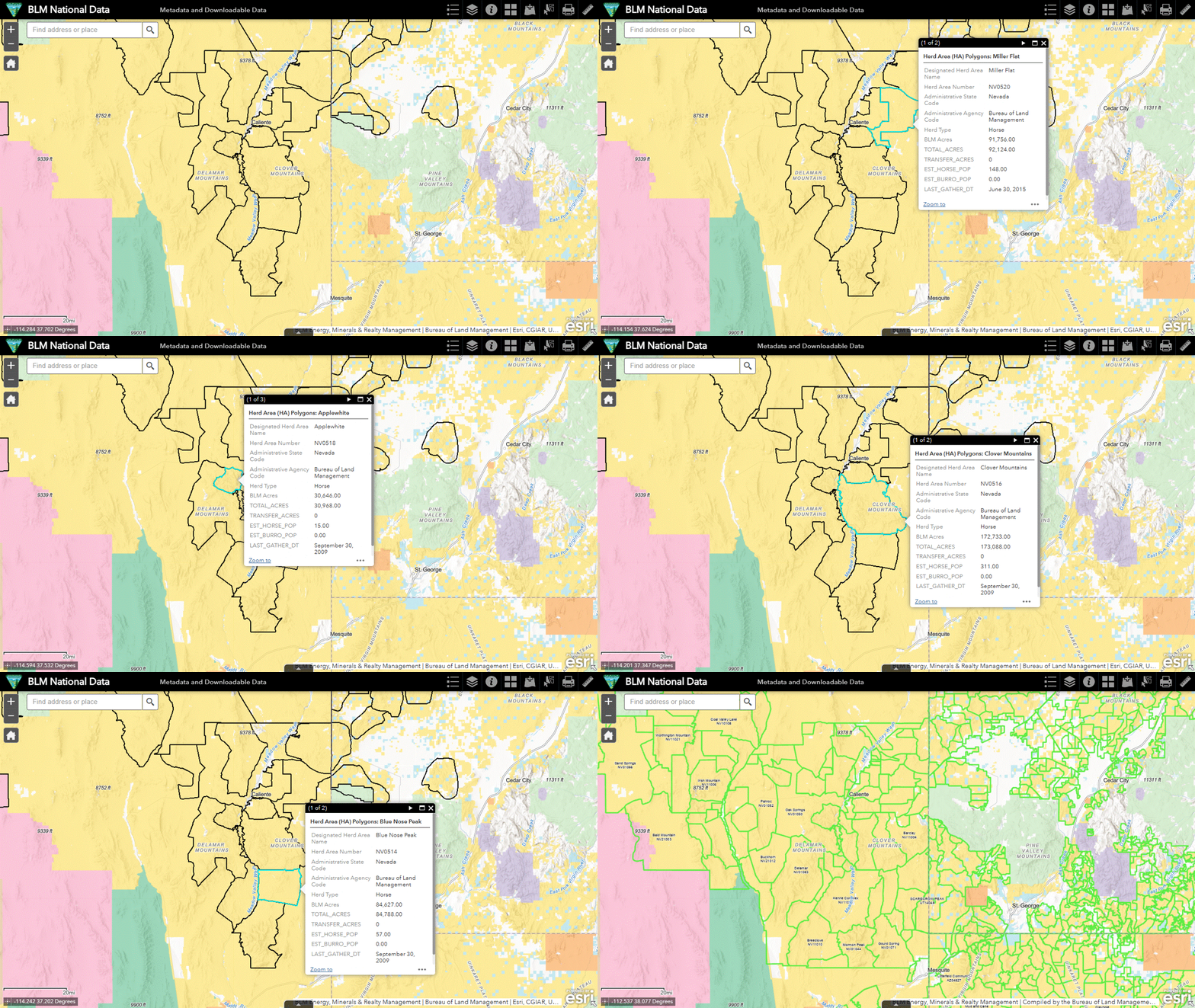
The Proposed Action, discussed in Section 2.2 of the Draft EA, would immediately remove wild horses outside the WHT, using helicopters and/or baited traps.
The current population is thought to be 699 according to today’s news release.
The project area covers BLM and Forest Service lands around Mono Lake, some of which are subject to permitted grazing.
Although the announcement seeks comments on the Environmental Assessment, the project ties them to a cover letter dated May 28.
The participation period closes June 26.
RELATED: Scoping Begins for Montgomery Pass Wild Horse Removal.

The Center for Biological Diversity has filed a second lawsuit against the Forest Service seeking a drastic reduction of the population according to a story dated May 28 by KPNX News of Phoenix.
A link to the complaint was not provided.
Personnel with the Salt River Wild Horse Darting Group are reducing the population with PZP, a pesticide that tricks the immune system into destroying the ovaries.

With few if any new foals hitting the ground, the average age of the herd is increasing, along with the death rate.
The tiny breeding population will no longer be able to keep up with attrition and the herd will implode, just like Assateague Island.
Why can’t CBD be patient and let the advocates have their way?
RELATED: Court Dismisses Salt River Legal Action.
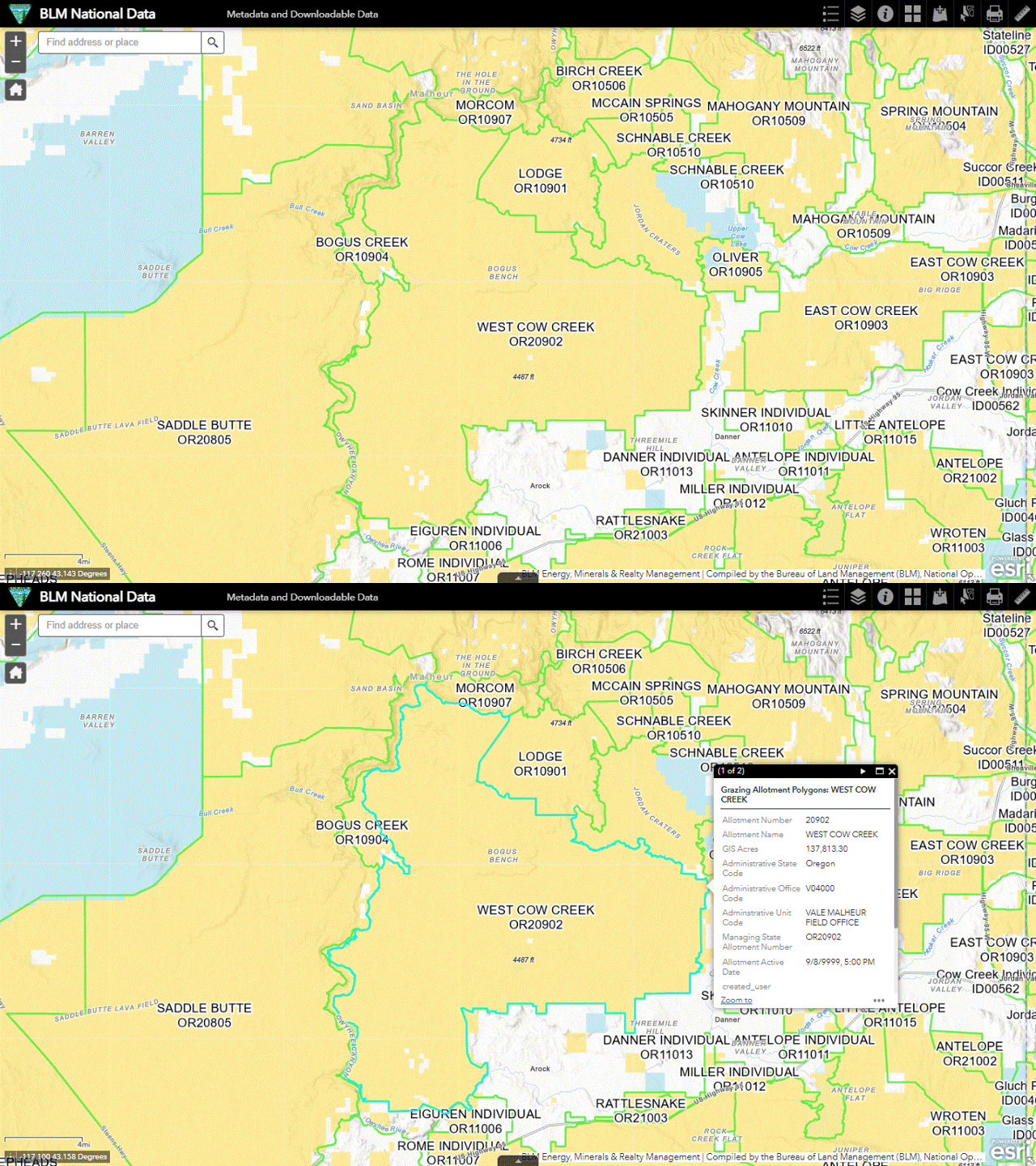
The allotment, on the east side of Sand Springs HMA in Oregon, offers 9,594 active AUMs on 139,885 public acres, according to the Allotment Master Report.
The forage assigned to horses is zero.
How many wild horses could live there?
Using the principle of forage interchangeability, the True AML would be 9,594 ÷ 12 = 800, the number of horses the land could support if it was managed principally for them as specified in the original statute.
The stocking rate would be 800 ÷ 139,885 × 1,000 = 5.7 wild horses per thousand public acres.
Why is this important?
The bureaucrats and ranchers claim that public lands in the western U.S. can only support one wild horse per thousand acres (27,000 animals on 27 million acres).
The advocates reinforce the fairy tale with their darting programs.
If the allotment was an HMA, the AML would be 140, and 800 – 140 = 660 horses would be consigned to off-range holding because of permitted grazing.
BLM allotments in the state carry livestock equivalent to 87,934 wild horses on 13,130,302 public acres, or 6.7 wild horses per thousand public acres.
RELATED: The Allotments Tell the Story: They’re Lying, All of Them.
The article is silent about permitted grazing, lopsided forage allocations that favor the ranchers and confiscation of lands identified for wild horses in 1971.
Instead of clearing these areas of privately owned livestock and giving principal use to the horses—as specified in the original statute—the BLM should use fertility control to limit the numbers according to the advocates.
The writer says nothing about its harmful effects, which the advocates conveniently ignore, evident on the Maryland side of Assateague Island and soon to appear at the Salt River and Virginia Range.
They don’t want to rock the boat.
They don’t want changes that actually help the horses.
They are allies of the bureaucrats and ranchers, defenders of the status quo.
RELATED: How Wild Horse Advocacy Really Works.

On the Virginia Range with Western Horse Watchers.
PZP, sometimes referred to as the Montana Solution, is a restricted-use pesticide, meaning it can only be applied to _________ wild horses.
a.) Cherished
b.) Beloved
c.) Innocent
d.) Treasured
e.) Iconic
f.) Majestic
The correct answer is None of the Above. The advocates use these terms to make you think they’re helping the horses instead getting rid of them.
RELATED: Test Your Knowledge of RUPs.

The incident started on April 16. Results through May 23:
The figures above are based on the daily reports.
A mare was dispatched on Day 36 due to a fractured neck, bringing the death rate to 3.1%.
The capture total includes 93 stallions, 96 mares and 35 foals.
Youngsters represented 15.6% of the animals gathered, consistent with a herd growth rate of ten percent per year.
Of the adults, 49.2% were male and 50.8% were female.
Body condition scores were not given.
The location of the trap site is not known.
The Complex is subject to permitted grazing. Resources liberated to date:
There are no plans to treat any of the mares with fertility control pesticides and return them to the range.
The roundup supports three tenets of rangeland management.
RELATED: Caliente Roundup, Day 35.
The incident started on May 1. Results through May 24:
The figures above are based on the daily reports.
The death rate is 2.9%.
The capture total includes 86 stallions, 64 mares and 23 foals.
Youngsters represented 13.3% of the animals gathered.
Of the adults, 57.3% were male and 42.7% were female.
Body condition scores are not known.
The location of the trap site is not known.
The destination of captured animals is not known.
The HMA is subject to permitted grazing. Resources liberated to date:
Ten mares will be treated with GonaCon Equine, a fertility control pesticide, and be returned to the range according to the latest schedule.
The roundup supports three tenets of rangeland management.
RELATED: Bordo Atravesado Roundup, Day 21.
 Western Horse Watchers Association