
Comments Invited on Draft EA for Lake Mead Gather Plan

BLM announced yesterday the availability of a preliminary environmental assessment for wild horse and burro management actions in the Lake Mead Complex near Las Vegas, NV.

The Proposed Action, described in Section 2.2.2 of the EA, features roundups over a ten year period and fertility control vaccines.  All wild horses would be removed from the Complex and burros would be removed to the lower end of their AML.

The Complex includes three herd areas near the state line.  The BLM map shows HMAs inside the HAs but the EA says only one of them has an AML.  Refer to Section 4.3.1.5.
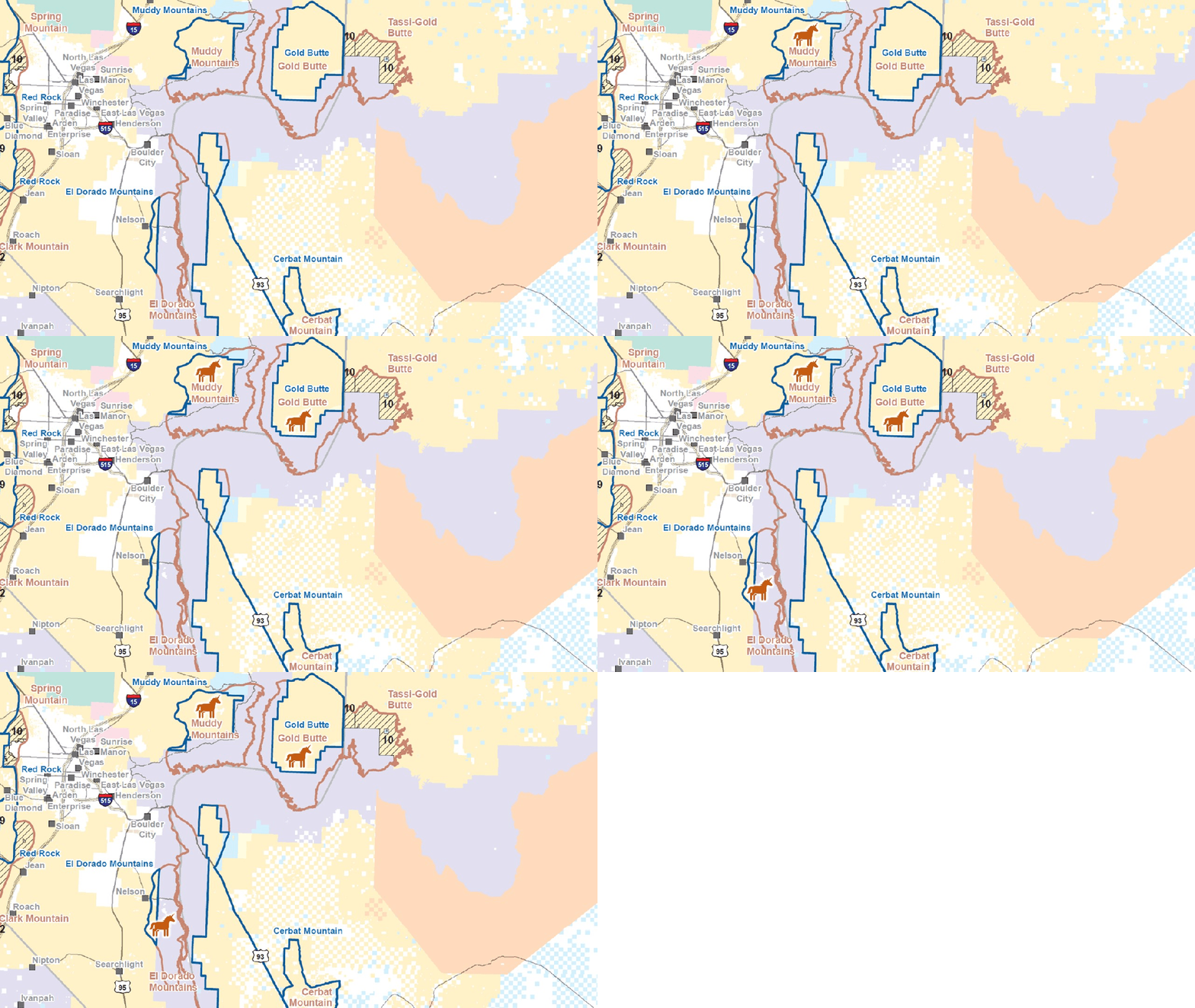
Lake Mead Complex Map 04-02-21

Livestock grazing is not allowed inside the Complex, according to Section 3.1, but the grazing status of surrounding lands was not given.  A keyword search of the EA yielded no occurrences of ‘AUM.’

The AML for wild horses is zero in all three areas.  The AML for burros is zero in Muddy Mountains and El Dorado, and 98 in Gold Butte, per Section 1.2.  However, the HMA page for Muddy Mountains shows an AML of 50.

The aimed-at stocking rate at Gold Butte is 98 ÷ 178,000 × 1,000 = 0.6 wild burros per thousand acres, equivalent to 0.3 wild horses per thousand acres.  The target stocking rate across all HMAs is one wild horse per thousand acres.

A draft FONSI has been posted with the project documents.

Comments will be accepted through April 30.
Thriving Ecological Imbalance at Little Colorado HMA

The HMA, one of five affected by the Rock Springs gather plan, does not contain any checkerboard land and is not included in the Rock Springs RMP amendments, as noted at the end of Section 1.1 in the Draft EA.

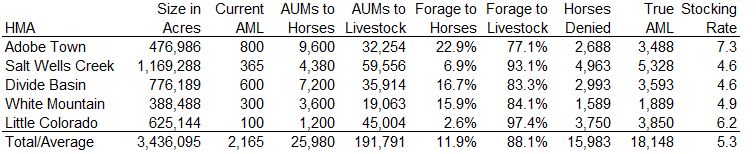
The management plan assigns 1,200 AUMs per year to wild horses at the upper end of the AML, with 45,004 AUMs per year assigned to privately owned livestock.

That means the horses are allowed to consume up to 2.6% of the authorized forage in the HMA, also known as ‘their food.’

Doesn’t that seem a bit strange?  The land was set aside for the horses.

The proposed action will gather the HMA to the lower end of the AML, leaving around 69 horses.  Growth rates will be minimized with contraceptives.

The horses will need 828 AUMs per year after the roundup, about 1.8% of the authorized forage.

The fertility control program locks the pattern in, maximizing benefits to the public-lands ranchers.

RELATED: Aim of Rock Springs Gather Plan.

Aim of Rock Springs Gather Plan

The proposed action will achieve a thriving ecological balance in the five HMAs targeted by the project.  The EA makes sure there will not be too much collateral damage when it is carried out.  A finding of no significant impact does not apply to wild horses!

What are the management priorities in those areas?  Data from Tables 1 and 8 in the EA tell the story.

Rock Springs HMA Data 03-31-21

Roughly 16,000 wild horses have been displaced from their home range by privately owned livestock, about one third of those in off-range holding.

How many have been forced out by drilling and mining?

The True AML is eight times higher than the current AML.  The average stocking rate across the five HMAs at the new AML is 5.3 wild horses per thousand acres, about half of that on the Virginia Range.

The current population of 5,105 is well within the new limit, so there is no need for a roundup or fertility control program.  There are no excess horses and the area is not overpopulated.

The problem is public-lands ranching.

Although the land was set aside for wild horses, roundups may occur as early as July because the HMAs are managed primarily for livestock.

RELATED: Comments Invited on Draft EA for Rock Springs Gather Plan.

Thriving Ecological Balance-3