
Courtesy of Megan Smith.
Month: December 2020
What Is a Scandal?
When the words or deeds of one person cause others to lose the faith or act in ways that offend God, you have a scandal.
Here are a few facts about the material world, in case you didn’t get the memo:
- It’s God’s creation
- You don’t get to make the rules
- All men will be held to the same standard
Keep these things in mind when you look at a nativity scene and see the Word made flesh, lying in a manger.
There are tens of thousands of churches but only one standard. Which one has the fullness of the truth?
RELATED: What Triggered the ‘One-Horse Pony’ Remark?
Two Fish Springs Mustangs Lost In Collision with Truck
Refer to this report, posted this morning by The Record-Courier of Gardnerville, NV.
What Triggered the ‘One-Horse Pony’ Remark?
It was a question about the Hunter Biden scandal, originally covered by the New York Post, and the rivers of money associated therewith.
If you’re on socialist media, you were likely insulated from the story in the weeks before the election, thanks to the jackals who run those services.
RELATED: What Is a One-Horse Pony?
Black Mountain Roundup Marked Complete
The gather page says the operation has concluded, with 503 burros removed, but a formal announcement has not appeared on the BLM news site.
RELATED: Black Mountain Roundup Over?
What Is a One-Horse Pony?
That’s how the would-be usurper of the White House referred to a Fox News reporter yesterday, after he asked an embarrassing question, but does the animal actually exist?
Of course it does.
It’s a wild mare subject to ‘humane management practices.’ Barren most of her life, except for the year when the PZP zealots decide not to dart her.
Wild Horses Confiscate Stroller?
The story does not say when and where the incident occurred, other than it was in Florida, and has been picked up mostly by news outlets in India, such as New Delhi Television and Republic World.
RELATED: Keeping a Safe Distance.
Pinging the Desatoya Horses
Some of the horses captured in the December, 2019 roundup were to be fitted with GPS radio transmitters and returned to the HMA, according to NEPA Project DOI-BLM-NV-C010-2020-0004-CX, but the news release announcing the end of the incident doesn’t mention it.
The transmitters were to be braided into their tails, according to Attachment 1 of the Categorical Exclusion approved in November, 2019.
The 127 horses remaining after the roundup have blossomed to 215 in less than a year, according to Section 1.2 of the Draft EA for the new resource enforcement plan.
House Spending Bill Increases WHB Funding
The FY 2021 Omnibus Appropriations and Coronavirus Relief Package, passed by the House yesterday, increases spending for the wild horse and burro program by $14 million, compared to FY 2020, according to the Division G explanatory statement.
That division covers the Department of the Interior (BLM), Environmental Protection Agency, Forest Service and related agencies.
The funds “are in response to the Bureau’s May 15, 2020 proposal to institute an aggressive, non-lethal population control strategy to address the current unsustainable trajectory of on-range wild horse and burro population growth.”
The other 11 divisions can be accessed in a news release dated December 21 by the House Committee on Appropriations.
Horsemeat Cures Anemia?
So says the writer of a letter to the editor of The Salt Lake Tribune, published today.
In the wild horse world, ‘overpopulation’ means they’re consuming more than their allocated share of the resources, usually just crumbs. The lion’s share goes to privately owned cattle and sheep.
Family, Freedom Overrated
Roundups are not necessarily a bad thing for wild horses, according to the writer of the Sac Bee article, because humans will “find them loving homes and a life of fresh hay, warm barns and veterinary care.”
No more hooves stuck in cattle guards.
Instead, they’ll be locked in stalls and fed a steady diet of bits, spurs, tiedowns, blankets, braided tails and maybe even shoes, everything they dreamed of while on the range.
And, of course, everybody has a heated barn with running water, except the host of Western Horse Watchers.
RELATED: Sac Bee Publishes Hit Piece On Wild Horses.
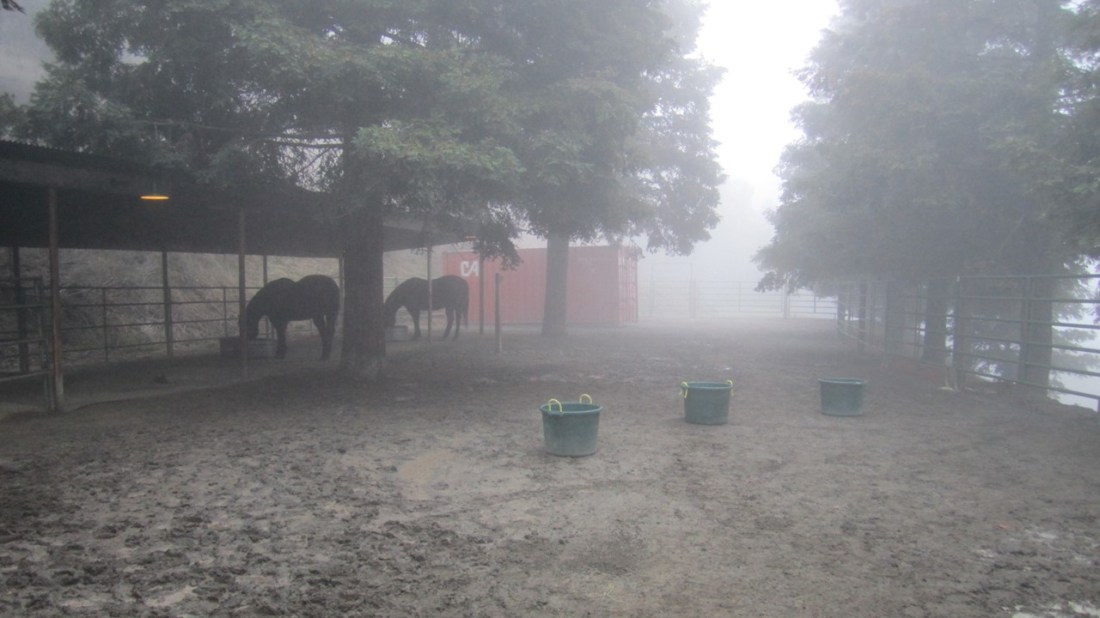
Sac Bee Publishes Hit Piece On Wild Horses
The article, based on recent events at the Devil’s Garden WHT, features just about every piece of anti-horse propaganda you can imagine.
The management plan, not considered in the story, assigns most of the resources to privately owned livestock. Everything else follows from that.
RELATED: Devil’s Garden Horses Get Short End of Stick.

Mustang Monday
At or near the Heber WHT with Friends of the Heber Wild Horses.
Desatoya Wild Horses Get Short End of Stick
The Desatoya HMA covers 157,836 acres of public lands in central Nevada and has an AML of 180. The stocking rate allowed by plan is 1.1 horses per thousand acres, slightly more than the average rate of one animal per thousand acres across all areas managed for wild horses and burros.
The horses allowed by plan require 180 × 12 = 2,160 AUMs per year.
The HMA intersects four grazing allotments. Table 3-2 in the Draft EA for wild horse management actions provides grazing seasons and permitted forage inside the HMA but does not provide the allotment sizes. Those were obtained from the Allotment Master in the Rangeland Administration System.
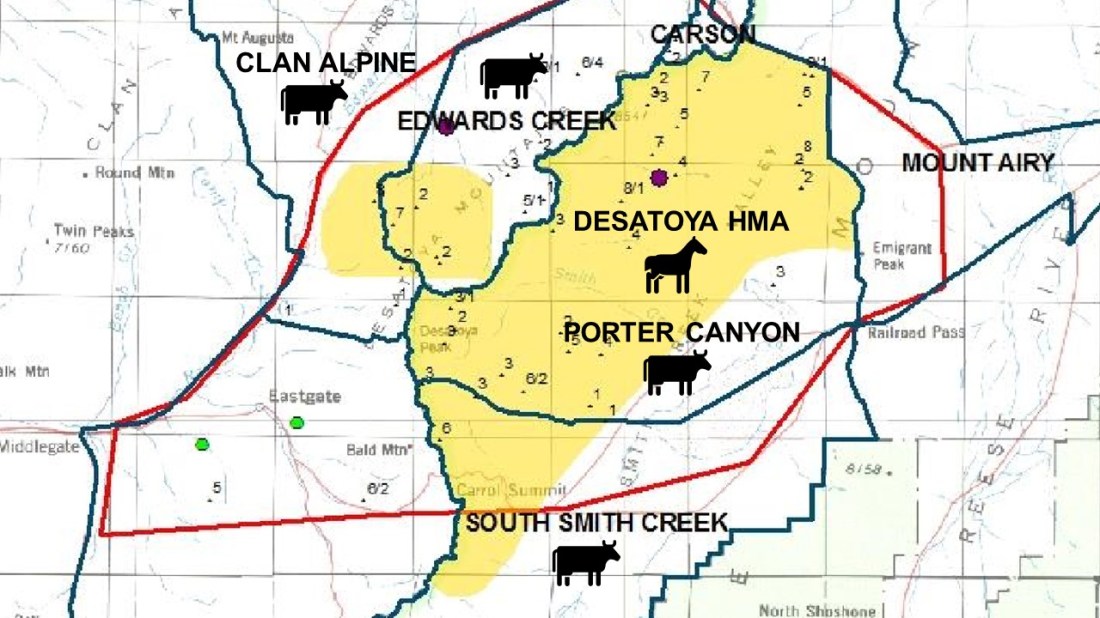
Three of the allotments are managed by the Stillwater Field Office and one is managed by the Mount Lewis Field Office.
Although cattle and sheep are allowed, the following calculations are based on cow/calf pairs only, for a direct comparison to wild horses. The resource requirements of wild horses and cow/calf pairs are said to be equivalent.
The total allotment acreage inside the HMA is approximately equal to the size of the HMA so the HMA was assumed to be 100% subject to permitted grazing.

The Clan Alpine permittees would have to place 851 cow/calf pairs inside the allotment to graze off 10,210 AUMs in 12 months. The Porter Canyon permittee would have to place 605 cow/calf pairs inside the allotment to consume 7,256 AUMs in 12 months.
Note that the stocking rates (densities) for the allotments are several times larger than that for wild horses, consistent with an observation made earlier that productivity goes up when land is designated for livestock.
The forage available to livestock inside the HMA was provided in Table 3-2, so no calculations are required in that column. The total across the four allotments is 9,608 AUMs per year.
The Porter Canyon permittee would have to place 529 cow/calf pairs inside the HMA to consume 6,352 AUMs in 12 months. The total number of cow/calf pairs allowed by plan inside the HMA is 811 and the weighted average grazing season is 11.8 months per year, almost identical to that of the horses.
The stocking rate allowed by plan is 811 ÷ 157,836 × 1,000 = 5.1 cow/calf pairs per thousand acres.
These figures are compared in the following charts.

The HMA—an area set aside for wild horses—is managed primarily for livestock, with the horses receiving just 18% of the authorized forage, excluding wildlife.
The forage assigned to livestock would support an additional 801 horses, for a true AML of 981.
The current population of 215 horses, according to Section 1.2 of the EA, is well within that range, so there are no excess animals and there is no justification for a roundup or fertility control program.
However, given the current management philosophy, and the absence of any meaningful opposition by the so-called advocacy groups, those will be the preferred methods for enforcing the resource allocations and improving rangeland health.
Confusion Roundup In the News
A BLM public affairs officer told the St. George News that the “nonreproduction component” is still an “if,” but does not say why.
She noted that adoptions have declined this year due to changes in the economy, even though the $1,000 incentive is still available.
The adoption program is now called the private care program, according to the story.
RELATED: Confusion Roundup Over?, Confusion Lawsuits In the News.
Economic Benefit of Public-Lands Ranching in Wild Horse Areas?
The federal government sells about 12 million AUMs per year to public-lands ranchers, across 155 million acres, mostly in the western U.S.
That transaction generates about $16 million per year in revenue for the government, which manages those lands—supposedly—for the benefit of the American people.
How much of that income is produced in areas identified for wild horses and burros?
One way to answer the question is to scale the revenue according to acreage.
The management plans assign 27 million acres to horses and burros, approximately 17% of the land authorized for grazing. The estimated revenue would be .17 × 16 = $2.7 million per year.
Another approach would be to consider the resource allocations in areas designated for wild horses and burros, where the plans allow 27,000 of them. Data reviewed on these pages suggest that livestock receive eighty to eighty five percent of the forage, excluding wildlife. That means they receive four to five times as much as the horses and burros.
If that’s true in other areas, the forage assigned to livestock in areas identified for horses and burros would be 27,000 × 12 × 5 = 1.6 million AUMs per year, worth $2.2 million per year at current prices.
Not much of an offset for the tens of millions of dollars spent every year—confiscated from American wage earners—to remove and warehouse the horses and burros, so the ranchers can enjoy more of what their allotments have to offer.
The major economic benefit accrues at harvest time. Of course, those revenues stay with the ranchers and their overlords, not the American people.
It’s redistribution of wealth, classic socialism. That’s what the farm bureaus, stockgrower’s associations and cattlemen’s groups are trying to defend.
Fish Creek Roundup Starts Next Weekend
The incident will begin on or about December 26, according to a BLM news release.
The capture goal is 195 wild horses, with 60 to be returned to the HMA, including 30 mares treated with contraceptives.
The operation was originally scheduled for November 16.
RELATED: Fish Creek Gather Delayed.
Man Sought for ‘Unnatural Acts’ with Horses
What the CAWP Can’t Do
The program can’t change the resource allocations that leave America’s wild horses and burros with crumbs, necessitating their removal from public lands in favor of privately owned livestock.
So as the roundups accelerate and the ‘Path Forward‘ is put into practice, know that the animals are being treated humanely—even the ones that don’t survive—while cattle and sheep graze peacefully on land that belongs to them.
RELATED: BLM Reaffirms Commitment to CAWP.

BLM Reaffirms Commitment to CAWP
The Comprehensive Animal Welfare Program provides standards for humane treatment of wild horses and burros during roundups, transportation, public events and off-range holding, according to a news release issued today.
The policy statement dated December 18 includes links to the program documents.
 Western Horse Watchers Association