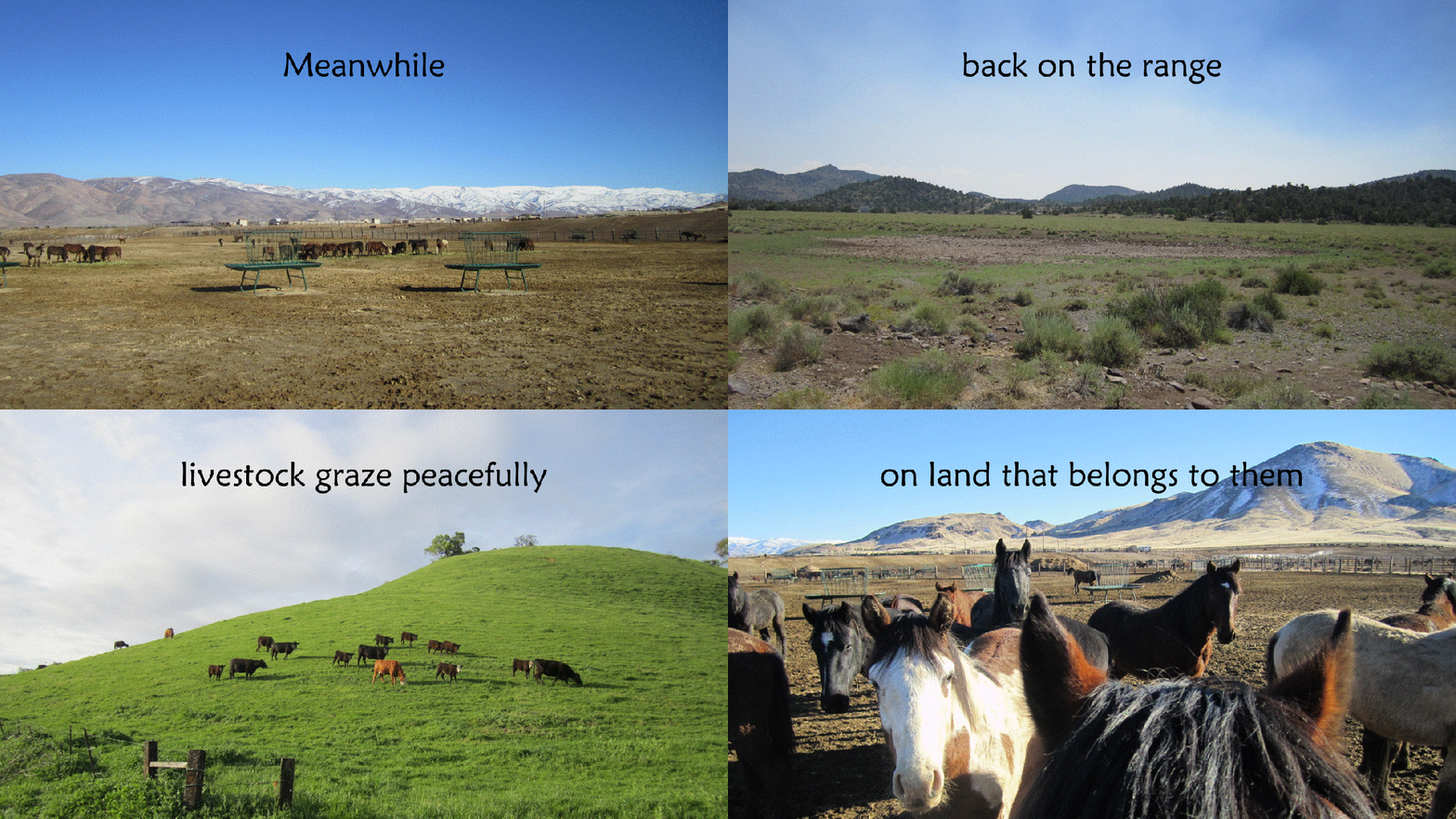
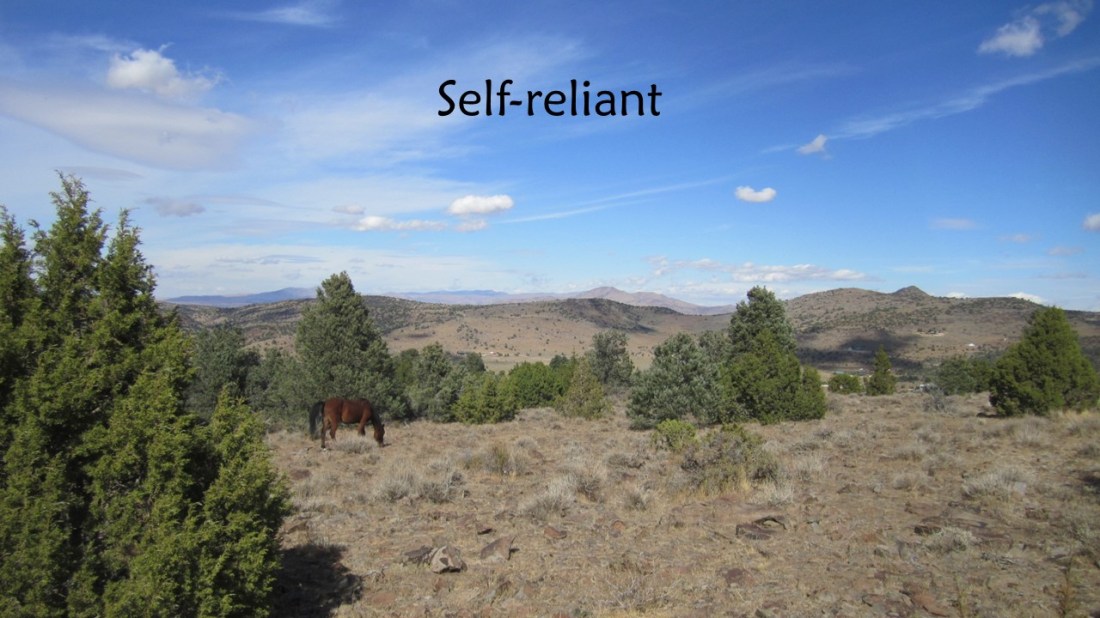
BLM FY 2021 Budget Request Targets Wild Horses

The President’s budget proposal for FY 2021 will take meaningful steps to address the untenable state of the WHB program and the unsustainable proliferation of wild horse herds on public lands, which far exceed what is healthy for the land and has impeded resource availability for other wildlife species, according to a news release issued today.

Not so fast, Chester.

What can’t be defended are the lies of omission about privately owned cattle and sheep on public lands designated for the horses and the amount of forage consigned thereto.

Consider the four HMAs affected by the Rock Springs RMP amendment, discussed at length on these pages over the last few days.

The total is 159,506 AUMs per year, enough to support 13,292 wild horses.  On just four HMAs!  Can you imagine the loss if the pattern is true for the other 173 HMAs?

There is no wild horse population crisis.  There is more than enough for them to eat on western rangelands.

The problem is the public-lands ranchers, their overlords, cheerleaders and political allies—not to mention their fences, which impede the movement of the horses, and the water holes they’ve stolen from them.
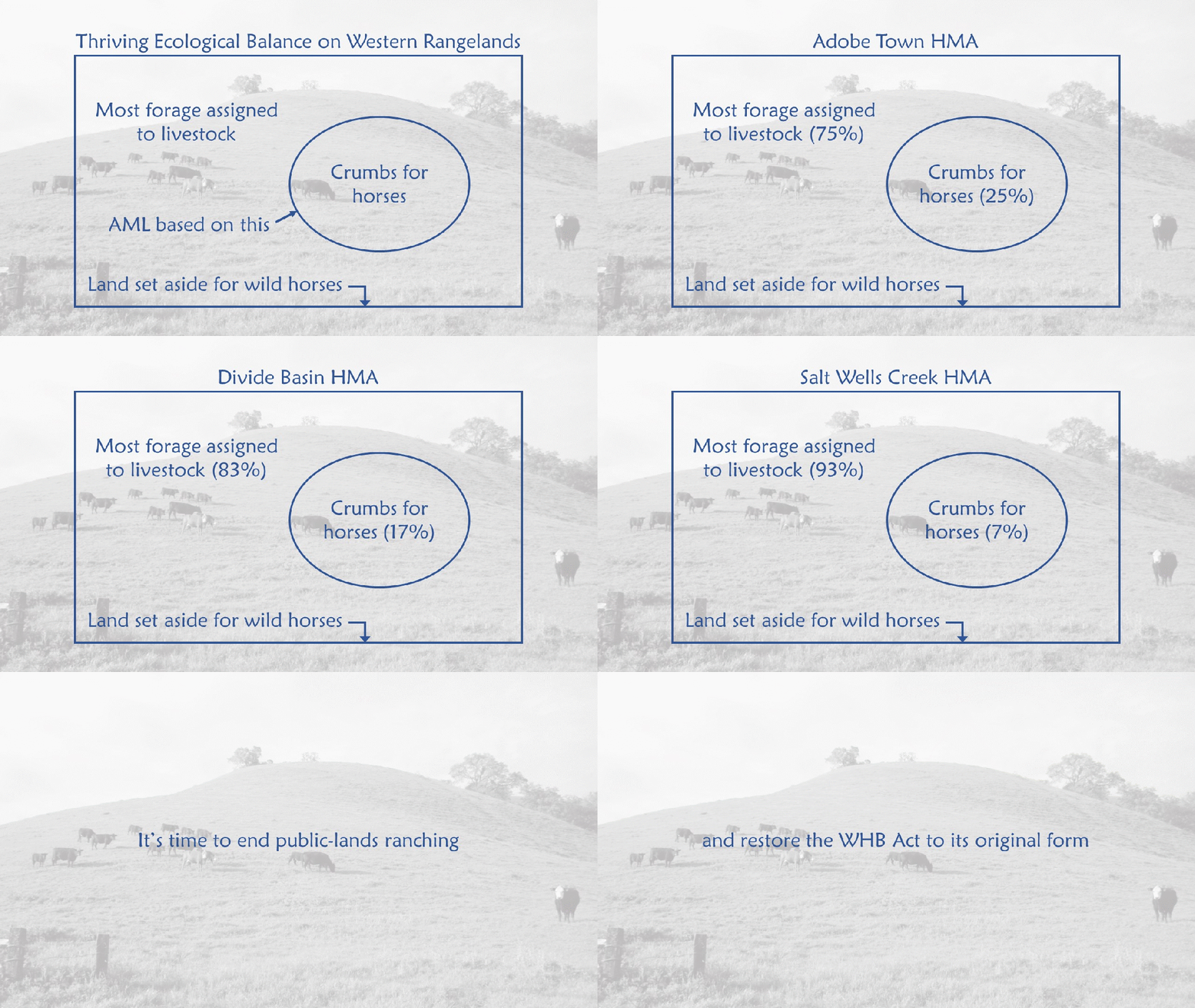
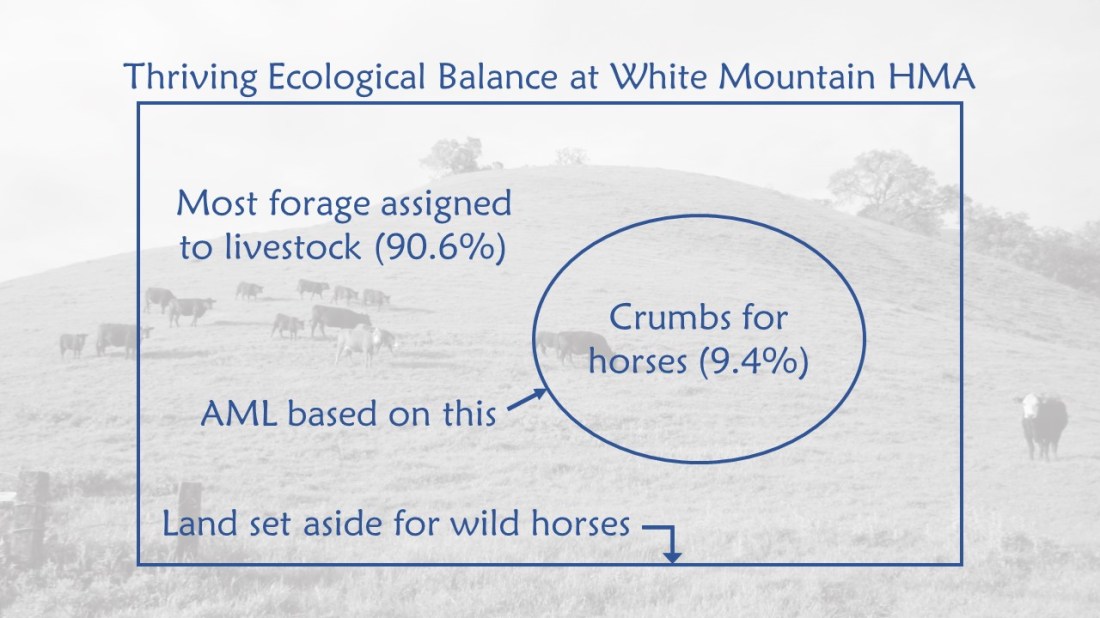
Thriving Ecological Balance on Western Rangelands

White Mountain Horses Get Short End of Stick

The Tier 1 analysis in Appendix A of the draft EIS for the Rock Springs RMP amendment provides data for current conditions at White Mountain HMA.

The HMA is to be managed principally for wild horses per paragraph 1332(c) of the statute, but do the numbers reflect that?

The EIS did not provide allotment sizes, grazing seasons and the type of animals allowed on the HMA.  The grazing season on some of the allotments is three months, according to Section 3.10 of the EIS, and on others it’s four to six months, so an average grazing season of four months was assumed.

White Mountain HMA Calcs-1

Forage requirements and stocking rates for livestock were computed for cow/calf pairs, whose resource requirements are said to be equivalent to those of wild horses, allowing a side-by-side comparison.  The grazing permits may allow other animals.

The results are presented in the following charts.

White Mountain HMA Charts-1

The horses have a much smaller footprint and environmental impact than livestock, but under the RMP amendment, the HMA will be eliminated and the land will be managed exclusively for livestock.

The government will pay between $500 and $1,000 to remove and process each horse from the area, plus another $730 per year to hold him in an off-range pasture, so it can collect $16 per year from the public-lands rancher to whom his food is sold.

It’s crazy.  Nobody in the private sector would do that.

RELATED: Salt Wells Horses Get Short End of Stick, Rock Springs EIS PostedSo Long, Pilot Butte Wild Horse Scenic Loop?

White Mountain Thriving Ecological Balance

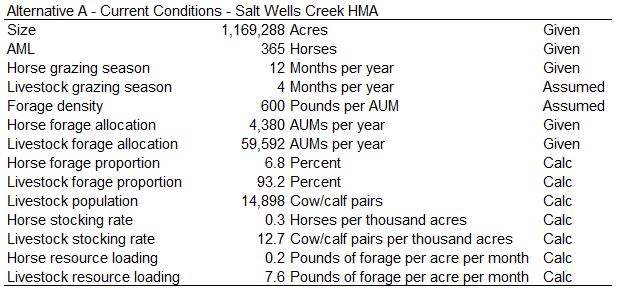
Salt Wells Horses Get Short End of Stick

The Tier 1 analysis in Appendix A of the draft EIS for the Rock Springs RMP amendment provides data for current conditions on the Salt Wells Creek HMA.

The numbers were copied into a spreadsheet to see if the current management plan favors privately owned livestock over wild horses and if so by how much.

The EIS did not provide allotment sizes, grazing seasons, and livestock types within the HMA.  The grazing season on some of the allotments is three months, according to Section 3.10 of the EIS, and on others it’s four to six months, so an average grazing season of four months was assumed.

Salt Wells Creek HMA Calcs-1

Forage requirements and stocking rates for livestock were computed for cow/calf pairs, whose resource requirements are said to be equivalent to those of wild horses, allowing a side-by-side comparison.  The grazing permits may allow other animals.

Key indicators are presented in the following charts.

Salt Wells Creek HMA Charts-1

The HMA is already managed primarily for livestock—the horses are just a blip on the radar screen.  It will be zeroed out in the revised RMP, but who will notice?

The big-name ‘advocacy’ groups, unfazed by these results, will demand more contraceptives for wild horses, because they are allies of the public-lands ranchers.

Don’t give them a penny.

RELATED: Divide Basin Horses Get Short End of Stick.

Salt Wells Creek Thriving Ecological Balance-1

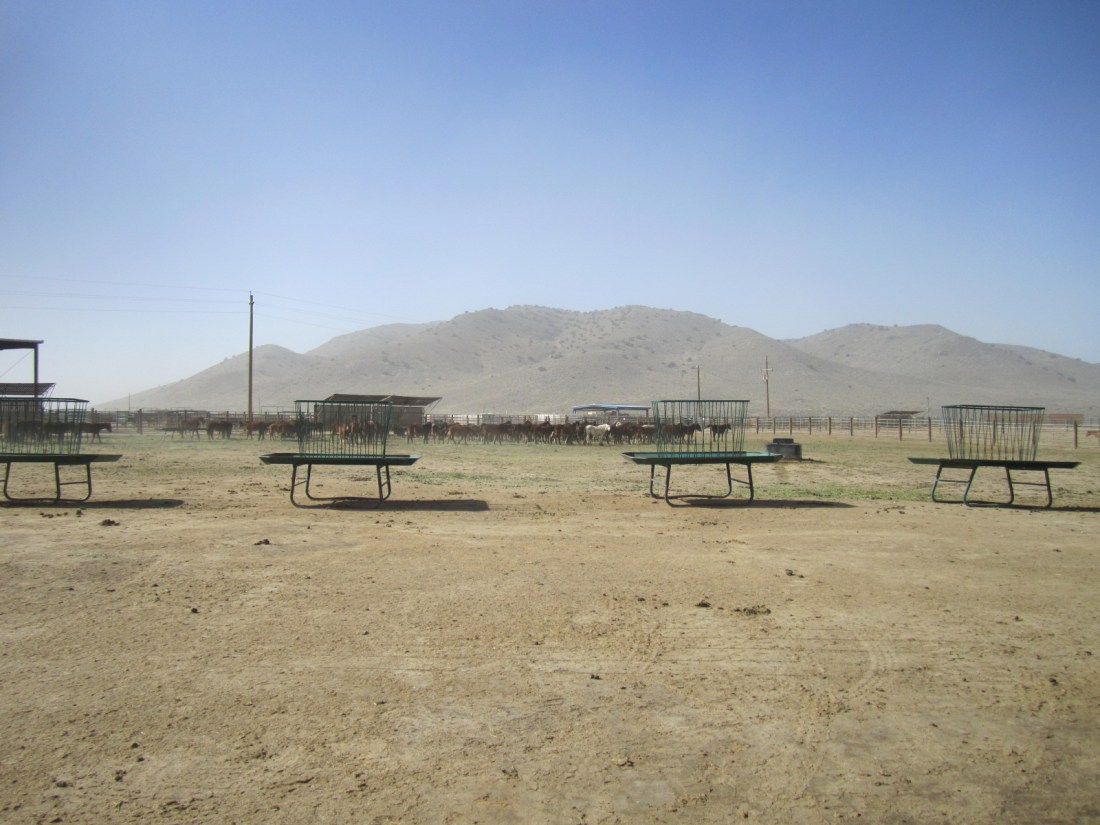
Notes from Palomino Valley

The off-range corrals are now filling up with horses from the Eagle Complex.

When you get out of your car, their heads go up.  If you approach the fence, they bolt.

Yes, Virginia, they really are wild.

Critics argue that they’re escaped ranch stock, nothing special, and while that’s true in some cases, it was generations ago.  There’s no domestication in these guys.

They don’t want anything to do with humans.  As you can see below, safety is more important than food.

What happens when they’re placed into training programs with 100-day timeframes?

Their spirits are literally broken.  The goal is to cashier as many horses as possible through the programs, so more can be removed from the range and their food sold to public-lands ranchers.

Palomino Valley can hold up to 1,850 horses on 98 acres, according to personnel in the office.

Can you imagine the conditions for the horses if the CAFO proposed by Equine Elite is built near Burns, WY, with a capacity of 5,000 horses on a bit more than 80 acres?

RELATED: Laramie County BOC Postpones Decision on Rule Change.

IMG_0484

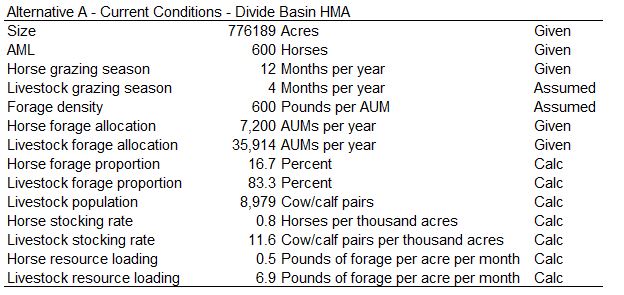
Divide Basin Horses Get Short End of Stick

The Tier 1 analysis in Appendix A of the draft EIS for the Rock Springs RMP amendment provides data for current conditions on the Divide Basin HMA.

Those numbers were copied into a spreadsheet to see how wild horses are managed relative to other mandated users of public lands.

The EIS did not provide allotment sizes, grazing seasons, and animal types within the HMA.  The grazing season on some of the allotments is three months and on others it’s four to six months, according to Section 3.10 of the EIS, so an average grazing season of four months was assumed.

Divide Basin HMA Calcs-1

Management indicators for the other mandated users were computed on the basis of cow/calf pairs, whose resource requirements are equivalent to those of wild horses, allowing a side-by-side comparison.

The results are presented in the following charts.

Divide Basin HMA Charts-1

The indicators show that the HMA has not been managed principally for wild horses, as required by paragraph 1332(c) of the statute.

The horses have a smaller footprint and environmental impact compared to livestock, but the RMP amendment will eliminate them under the preferred alternative.

“Hey WHW, what about CFR 4710.3-2?  The government doesn’t have to manage HMAs principally for wild horses unless it chooses to do so.”

Good question.

Can a federal regulation trump a duly enacted statute?  That would be a substantive comment on the EIS, although it might pertain more to the Adobe Town HMA, which will be downsized in the revised RMP but not wiped out.

RELATED: Adobe Town Horses Get Short End of Stick.

Divide Basin Thriving Ecological Balance-1

Eagle Roundup Day 23

Cumulative totals through 02-07-20, per the BLM roundup page for the Eagle Complex:

  • 1,209 animals gathered
  • 14 deaths (1.2%)
  • 546 studs (45.3%)
  • 658 mares (54.7%)
  • 5 new foals (2019 foals counted as adults)

The proportion of mares, many of whom are now heavily pregnant, continues to be assignably higher than the proportion of studs, based on statistical limits where n = 1,204 and p-bar = .50.

The thriving ecological balance is now only 391 wild horses away (1,700 horses to be gathered − 100 to be returned − 1,209).

PSA 12-12-19

RELATED: Eagle Roundup Day 21, Eagle Wild Horses Get Short End of Stick.

Adobe Town Horses Get Short End of Stick

The three-tier analysis in Appendix A of the draft EIS for the Rock Springs RMP amendment provides data for current conditions on the affected HMAs (listed as Alternative A, No Action).  For more information on the three-tier method, go to Appendix 3 in the WHB Management Handbook.

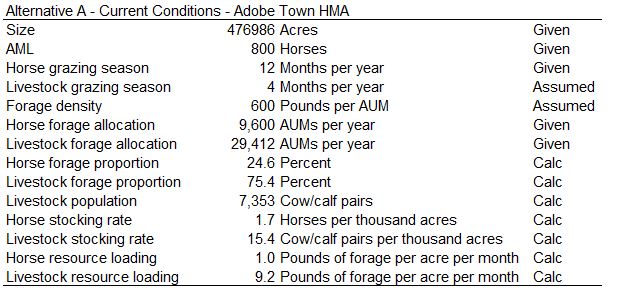
Tier 1 data for the Adobe Town HMA were copied into a spreadsheet so key indicators of wild horse management could be compared to those of livestock.  The HMA is to be managed principally for wild horses per paragraph 1332(c) of the statute, but do the numbers reflect that?

The EIS did not provide the allotment sizes, grazing seasons, and animal types within the HMA.  The absence of those figures would be a substantive comment on the EIS.

Indicators for livestock were computed on the basis of cow/calf pairs, as their resource requirements are equivalent to those of wild horses, allowing a direct comparison.

Adobe Town HMA Calcs-1

The grazing season on some of the Adobe Town allotments is three months and on others it’s four to six months, according to Section 3.10 of the EIS, so an average grazing season of four months was assumed.

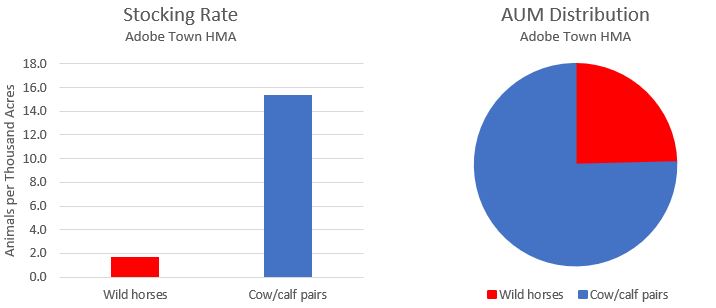
The indicators for horses and livestock are compared in the following charts.

Adobe Town HMA Charts-1

If the ranchers place their animals on pastures within the allotments, the day-to-day stocking rates would be higher than shown above.  If they didn’t rotate pastures the land would be ruined in a season.  More rape and pillage sold as environmental stewardship.

Most of the allotments in the planning area are operated under grazing strategies incorporating rest, seasonal rotations, deferment, and prescribed use levels that provide for adequate plant recovery time to enhance rangeland health.

The HMA is not managed principally for wild horses.  Horses have a smaller footprint and environmental impact than livestock, but the RMP amendment will reduce their numbers appreciably under the preferred alternative.

The RMP update is not about keeping the horses off private lands, it’s about giving the ranchers unfettered access to public lands that surround their private parcels.

Moreover, the BLM is not a hapless victim of a rogue court that’s trying to shove the rancher-friendly consent decree down their throats.  The ranchers could have been ordered off the public lands, making them bear the costs of keeping their property private, not the horses and not the taxpayers.

RELATED: Rock Springs EIS PostedIs Wyoming a Fence-Out State?

What Is the Minimum Herd Size for Wild Horses?

According to Section 4.4.6.3 of the WHB Management Handbook, a minimum herd size of 50 breeding animals (total population size of 150 – 200 animals) is recommended to maintain an acceptable level of genetic diversity within reproducing wild horse herds.

Given an aimed-at stocking rate of one wild horse per thousand acres (27,000 animals on 27 million acres), every HMA should contain at least 150,000 acres.

How many of them fall short of that guideline?  Have at it.

Don’t forget the WHTs.

A minimum recommended herd size for wild burros has not been established.

Laramie County BOC: Consent of Governed Notably Absent

The amendment requested by Equine Elite—to reduce the setback radius around CAFOs by 67%—will reduce the stakeholder base by as much as 89%, because a circle of one mile radius covers only 11% of the area marked by a circle of three mile radius.

So, what will happen at subsequent meetings?  Will the county commissioners throw in with the big-government bullies from Equine Elite—who don’t care what the residents think—or will they respect the wishes of the people that put them into office?

RELATED: Laramie County BOC Postpones Decision on Rule Change.

Eagle Roundup Day 21

Cumulative totals through 02-05-20, per the BLM roundup page for the Eagle Complex:

  • 1,156 animals gathered
  • 14 deaths (1.2%)
  • 520 studs (45.1%)
  • 632 mares (54.9%)
  • 4 new foals (2019 foals counted as adults)

Helicopters were grounded for several days due to high winds.  One mare was put down today due to colic.  The hirelings probably referred to it as ‘capture shock.’

The proportion of mares continues to be assignably higher than the proportion of studs, based on statistical limits where n = 1,152 and p-bar = .50.  The number of new foals does not correspond to a 20% growth rate, not even close.

The thriving ecological balance is now only 444 wild horses away (1,700 horses to be gathered − 100 to be returned − 1,156).

Eagle HMA Charts-1

RELATED: Eagle Roundup Day 16, Eagle Wild Horses Get Short End of Stick.

WHW Mail 02-05-20

Q.

Name: Kerri Miller

Email: jmiller22@hotmail.com

Website: Fuelconsults.com

Comment: It looks like you’ve misspelled the word “Flyin” on your website.  I thought you would like to know :).  Silly mistakes can ruin your site’s credibility.  I’ve used a tool called SpellScan.com in the past to keep mistakes off of my website.

-Kerri

A.

Dear Kerri,

Maybe next time you should mind your own business.  In case you’re a real person.

Regards,

Western Horse Watchers

Laramie County BOC Postpones Decision on Rule Change

The Board of County Commissioners decided yesterday not to render a decision on the reduction of setbacks from Concentrated Animal Feeding Operations requested by Equine Elite, according to a report posted this morning by the Wyoming Tribune Eagle.

Commissioners will consider the proposal in more detail at their March 3 meeting.

RELATED: Laramie County BOC Meeting Agenda Posted.

UPDATE: Public hearing begins at 4:12 in this video.