
Near the Phon D. Sutton recreation area with NarrowRoadJourneys.
Month: January 2020
Answers to Public Lands Quiz
Originally posted on 01-04-20.
1. What is the annual forage requirement for horses on an HMA with an AML of 256?
- Wild horse roam freely 12 months per year, 256 × 12 = 3,072 AUMs per year
2. How many cow/calf pairs would that forage support in a six month grazing season?
- The resource requirements of cow/calf pairs are said to be equivalent to those of wild horses, 3,072 ÷ 6 = 512 cow/calf pairs
3. How much would a public-lands rancher pay for that forage (at current prices)?
- Current price is $1.35 per AUM, 3,072 × $1.35 = $4,147.20
4. What is the approximate size of the HMA?
- The aimed-at density for wild horses across all HMAs is one animal per thousand acres, 256 × 1,000 = 256,000 acres
5. Estimate the total forage available to livestock and horses on the HMA.
- If you don’t know the forage allocation on an HMA, assume it’s 80% to livestock and 20% to wild horses, 3,072 × 5 = 15,360 AUMs per year
“But the land was set aside for the horses!” What does that have to do with anything?

Pneumonia Killing Off Bighorn Sheep in Nevada?
A report posted yesterday by The Ely Times says the greatest threat to the state’s desert bighorn sheep is bacterial pneumonia, which has destroyed entire herds statewide.
The EIS from yesterday’s post on domestic sheep grazing in Colorado noted in Section 3.1.1.1. that
…the preponderance of current scientific literature establishes that Rocky Mountain bighorn sheep and domestic sheep should not share the same space at the same time due to potential for disease transmission.
Section 3.1.1.2. states that
Historic population declines [in RM bighorn sheep] are attributed to over hunting, parasites, disease, competition with domestic livestock for forage, and competition with humans for space…but mortality resulting from epizootic pneumonia is thought to be the primary cause of the historical decline and currently remains the primary factor limiting bighorn sheep recovery.
Could privately owned sheep affect the health of wild sheep in Nevada? How might the bighorns come in contact with those animals?
The action proposed by the BLM in the Colorado EIS (Alternative A), which was based on permittee applications, is not the preferred action (Alternative C), which would reduce the risk of contact between domestic sheep and Rocky Mountain bighorn sheep.
Mustang Monday
On the Virginia Range with Andrea Bates.
Colorado Sheep Grazing
Last week the BLM issued the final Environmental Impact Statement for grazing permit renewals in southwestern Colorado. Refer to Figure 1-A on page 6 of the document for a map of the project area.
Public comments can be submitted through February 10, according to the news release, at which time a decision will be rendered. A 15-day protest period will then commence, followed by a 30-day appeal period for the final decision.
The EIS considered five alternatives, including the termination of grazing on all nine allotments. Wild horses and burros are not allowed on those lands (denoted by a red border in the following map), although the tiny Spring Creek Basin HMA is about 50 miles to the west (blue border).

Although wild horses are not involved, management of western rangelands is always of interest, because privately owned livestock might be treated differently than the horses.
Table 2.1-1 in the EIS, for the proposed alternative, gives the size of the allotments, the available forage and the grazing periods. Those data were copied into a spreadsheet so the population densities (stocking rates) can be determined.

The Cox Park allotment was omitted because it is small and only 51% on public lands.
The American Flats allotment included six horses (domestic), equivalent to 30 sheep, for a total of 580 such animals.
Although the allotments are permitted for sheep, converting them to cow/calf pairs puts the numbers into familiar territory and allows a direct comparison to stocking rates for wild horses.
Given that one cow/calf pair is equivalent to five domestic sheep, in terms of its resource requirements, the 1,230 sheep at American Lake convert to 246 cow/calf pairs.
Likewise for the other allotments.
The densities are reported in animals per thousand acres. Note the huge advantage of livestock compared to wild horses, the same pattern seen at Challis HMA. The target density for horses across all HMAs is one (27,000 animals on 27 million acres).
Folks, this is why the ranchers have to rotate pastures: They load these animals onto the land at rates that would destroy it in a matter of months.
It’s rape and pillage but they try to sell it as environmental stewardship.
Should Federally Owned Lands Be Privatized?
The acting director of the BLM, William Perry Pendley, has been attacked in recent months for his beliefs about wild horses and federal ownership of public lands.
We don’t know what he and other Trump administration officials have been told about America’s wild horses and burros but his remarks don’t appear to be reasonable on the basis of the available evidence.
However, we can be fairly sure that those opposing his agenda are mostly liberals who believe that everything should be controlled by an all-powerful centralized government, which they, of course, would run.
So before you dismiss the idea of selling off [some] public lands, imagine for a few minutes how it could benefit our wild horses and burros.
- Wild horses and burros would be authorized on all the lands where they were found when the WHB Act was signed into law
- Additional lands beyond the Herd Areas would be designated as buffer zones, fully accessible to horses and burros
- The buffer zones would contain enough acreage to offset current and future losses of forage attributable to petroleum exploration, mining, timber production and recreational activities, as well as the return of all horses and burros now held in off-range corrals and long-term pastures
- Livestock grazing would be prohibited on these lands
- The WHB Act would be restored to its original form
- The needs of horses and burros would be balanced with those of wildlife, per the original statute, especially endangered species
- Ranchers could bid on lands not designated for WHB or any other purpose deemed to be of national or local interest
- Ranchers would pay taxes on their parcels (like everybody else) and bear the full cost of operating and maintaining them
- No more federal payments for rangeland improvements (currently $10 million per year) because the grazing program no longer exists
- Ranchers would be exposed to market forces and their fate would be placed in the hands of American consumers
- Horses and burros that stray onto private lands would be returned to their home ranges, not placed in off-range corrals, pastures, sanctuaries or preserves
- Local advocacy groups would be allowed to construct and maintain various improvements that benefit the horses and burros
The last step would be to reorganize or close the government bureaucracies associated with public-lands ranching and amend the statutes as needed.

Public Lands Quiz
1. What is the annual forage requirement for horses on an HMA with an AML of 256?
2. How many cow/calf pairs would that forage support in a six month grazing season?
3. How much would a public-lands rancher pay for that forage (at current prices)?
4. What is the approximate size of the HMA?
5. Estimate the total forage available to livestock and horses on the HMA.
Cost of Feed?
Here is the receipt from a recent trip to the feed store. These supplies will take care of six horses for three to four weeks.
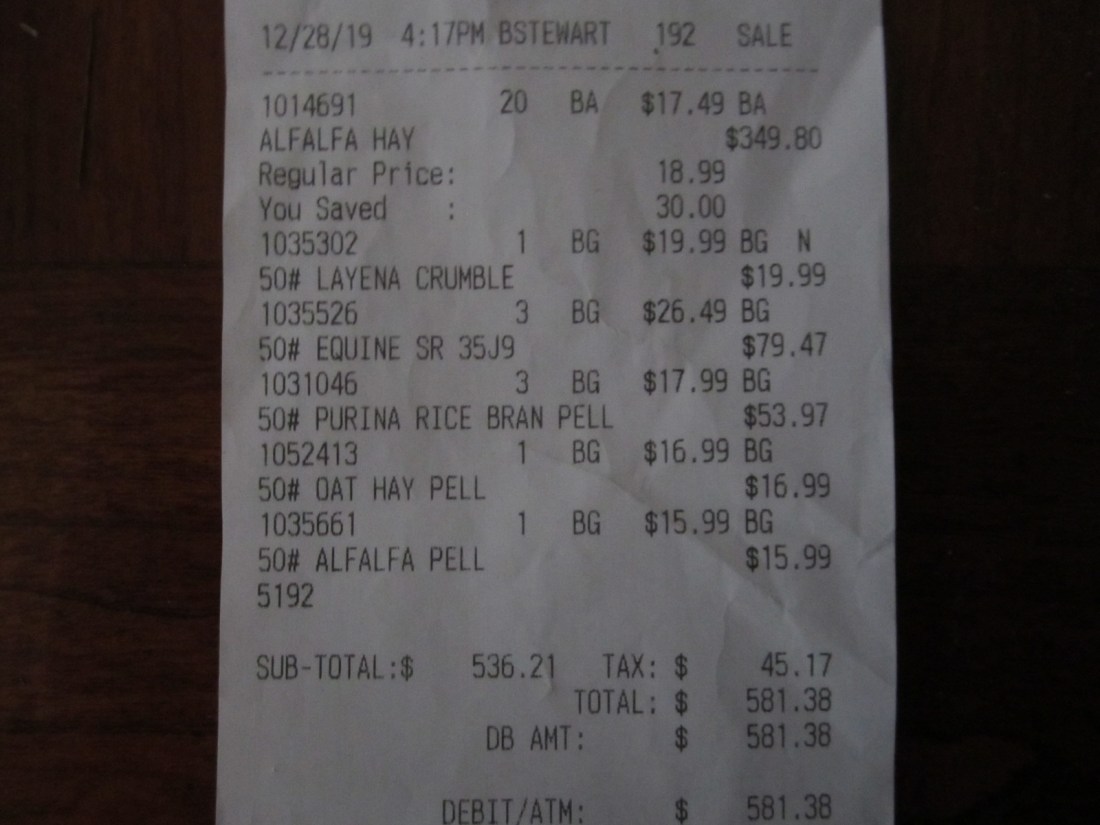
Let’s drop the Layena (chicken food), round the amount to $600 and call it a month.
Six hundred dollars feeds six horses for one month. That’s $100 per AUM.
How much would a public-lands rancher pay to feed six cow/calf pairs for one month?
Eight bucks at current prices.
A cow/calf pair is said to be equivalent to a horse in terms of its resource loading.
RELATED: Grazing Fee Defies FLPMA.
Pendley Keeps Job at BLM for Another Three Months
The acting director of the BLM will retain that role until April 3, according to a report posted today by Federal Times. At that time his appointment can be extended again or the President can nominate him or another individual permanently to the position.
RELATED: Greatest Threat to Public Lands: Wild Horses and Burros.
Solar Farm Coming to Public Lands in Southern Nevada
KTLA News reported yesterday that the final environmental impact statement for the proposed Gemini project has been released for public review.
The facility will produce 690 megawatts (for a few hours on either side of mid day) and will require 7,100 acres. It will be situated on the south side of I-15, between the Moapa Indian Reservation and the Muddy Mountains, home to a small herd of wild burros.
The BLM news release appeared on Monday. Project documentation can be found here.
The map does not show any battery storage buildings, which are in the scope, according to the report.
The project means only one thing for Nevada ratepayers: Their electric bills will be going up, all in the name of climate change, a hoax if ever there was one.
A conventional gas-fired combined-cycle power plant, needed for backup (because, you know, night) would require less than 100 acres and would produce power that’s clean, dependable and affordable, 24/7, rain or shine.
If the lights flicker next time you’re in Las Vegas, it might be the burros chewing on the solar panels, for they, unlike the investors, can spot a boondoggle miles away.

Status of WHB in U.S.
Refer to this opinion piece in Soapboxie, posted today. The writer has the right idea but there are several errors in his assessment. What are they? Show your work.

Off the Range
What do these things have in common?
- Overpopulation narrative
- Plans based on false premises (such as the Path Forward)
- Roundups
- Fertility control
- Chemical sterilization (extended use of contraceptives)
- Surgical sterilization
- Sex ratio skewing
- Sale without limitations
- Adoption events
- Adoption incentives
- Trainer Incentive Program
- Extreme Mustang Makeover
- Inmate training programs
- Sanctuaries and preserves
- New off-range corrals and pastures
They all convey the same message: OFF THE RANGE. Get wild horses and burros off public lands (so they can be replaced by privately owned cattle and sheep).
Many of these ideas are accepted and promoted by the so-called advocacy groups and government agencies charged with the care of these animals.
The truth will set you free, but first, as Rick Gore says, it will piss you off…because you’ve been on the wrong side of the debate.
Why not let 2020 be the year that you started pushing back against the lies and did something for America’s horses not to America’s horses?
Conflict and division will always exist because evil always tries to subdue the good.
Those who ask “Why can’t we all just get along?” are already whipped.

 Western Horse Watchers Association