Seaman Roundup Delayed

BLM said today that the gather was suspended due to weather conditions that allowed the mustangs to move to higher elevations, evading capture.

As of yesterday, 294 excess horses had been removed from their home range, with nine deaths and no animals returned.

The operation will resume in January, according to the news release, when the horses are expected to return to the valleys.

RELATED: Seaman Range and White River Herds to Be Downsized.

Multiple Use – The Old Days

In Section 3 of the original WHB Act, Congress ordered the Secretaries of Interior and Agriculture to balance the needs of horses and burros with those of wildlife, especially endangered species.  There was no provision for domestic livestock.

Overpopulation was to be determined relative to wildlife in the affected area, not privately owned cattle and sheep.

The ranchers, realizing they had been cut out of the will, demanded changes from their political toadies, who gave them FLPMA, PRIA and a watered-down WHB Act.

Today, the ranchers have endorsed a plan that will reduce the number of free-roaming horses and burros to an ‘acceptable’ level, unrelated to the carrying capacity of the land.

Eighty percent of those animals will end up in off-range facilities and the remaining herds will be managed to extinction.

The Marr Plan is a step in the right direction but its scope is too small.

It’s time to get all the livestock off public lands and restore the Wild Horse and Burro Act to its original form.

Multiple Use WHB Act

‘Path Forward’ Opponents Gather at National Mall

Animal Wellness Action, a lobbying group in Washington D.C., said today that wild horse advocates met at the U.S. Capital on Saturday to protest the ill-conceived management plan for wild horses and burros.

They said the Marr Plan was a better option, according to the news release.

Marr Plan-1

The proposal calls for the removal of livestock from public lands—not all, just some—but it’s a step in the right direction.

RELATED: Outside the Box.

No More Wood Shelters!

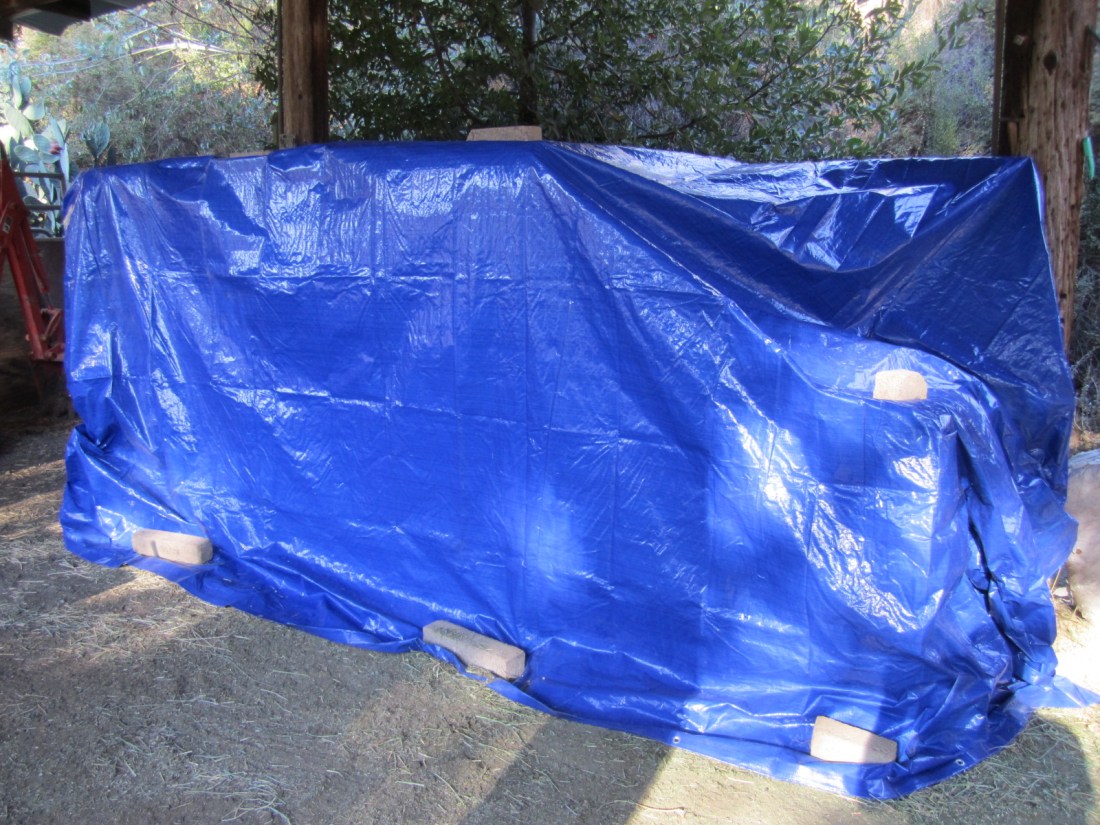
The mustangs have been nibbling on the posts that hold up their shelter but two weeks ago they really got serious about it.  This 4 x 6 post was reduced to about two inches in just a few days.  The 2 x 6 board in the background was hastily added as a splint, to keep the roof from caving in, and they’ve been chewing on that was well.

IMG_0018

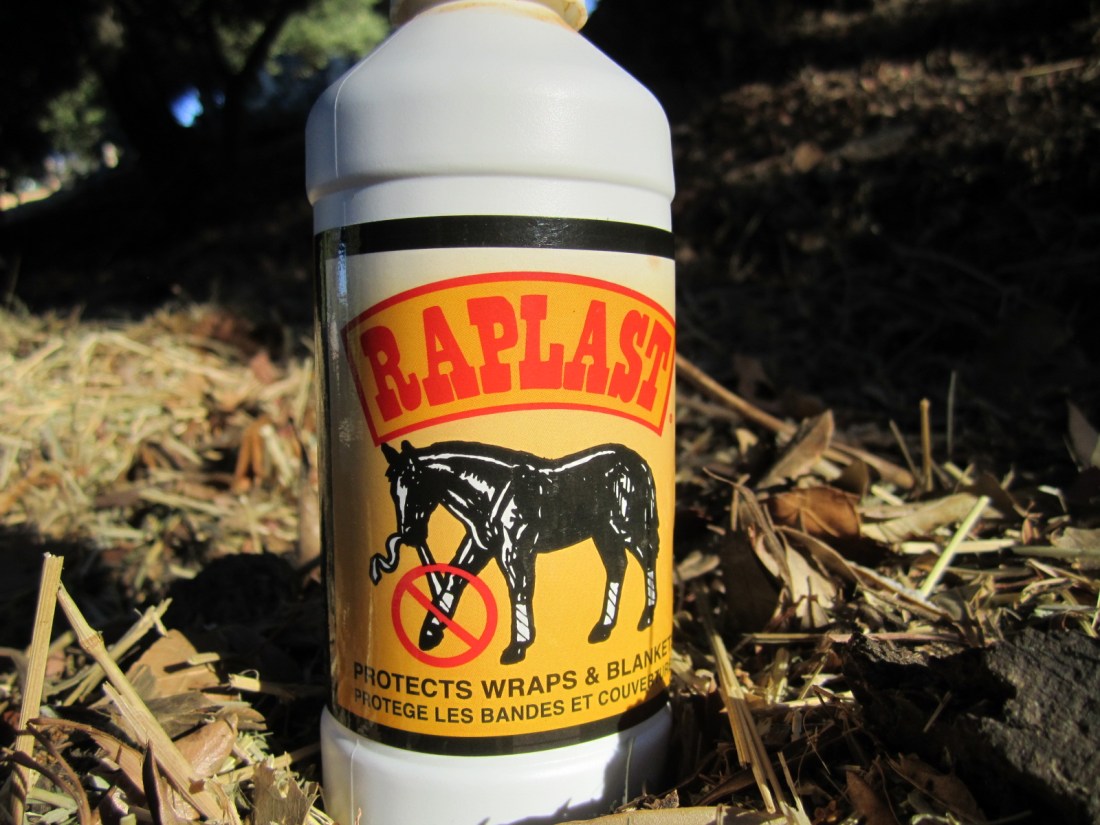
The folks at the feed store suggested a product called Raplast.

IMG_0031

It has an orange tint and can be very irritating to the nose and eyes.  Spray application not recommended.  Took a piece of hay string, dipped it in the bottle and dabbed some onto the post.  Seems to be working.

IMG_0023

As with anything new around horses, start off small and check for adverse reactions.

You may only have to treat a small area for them to get the message.

BLM Relocation Moves Ahead

BLM said yesterday that 159 employees now in Washington, D.C. were notified of their reassignment to offices in the western U.S., with 40 of those jobs moving to the new headquarters in Grand Junction, CO.

Affected personnel have 30 days to accept.  Individuals who decide to relocate will receive an incentive equal to 25% of base pay, according to the news release.

RELATED: BLM Picks New Headquarters.

It’s Not About the President, It’s About the Supreme Court

Is the end drawing near for Justice Ginsburg?

If she dies while he’s in office, the entire liberal program—and one hundred years of ‘progress’—will be put at risk.

Therefore, he has to go.  Either by outright removal or failure to win re-election in 2020.

He cannot be given the opportunity to nominate another justice, because liberals use the institution to drive their ruinous agenda.  Roe and Obergefell are just two examples.

Binge Grazing at Challis HMA

Now that the roundup is over and the horses are gone, the ranchers can enjoy more of what their allotments have to offer.

In just a few short months, thousands of cattle will be turned loose on an HMA that can only support 253 wild horses.  You see, the numbers won’t work with just hundreds of cow/calf pairs—which is what you might guess for an area that recently achieved a thriving ecological balance.

Refer to Tables 2 and 3 in Appendix G of the Environmental Assessment for the HMA management plan.

In the Bradbury Flat allotment, which covers 15,706 acres and is 100% inside in the HMA, 2,490 AUMs have been authorized on six pastures in a 2.5 month grazing season.

Livestock operators would have to place 996 cow/calf pairs on that parcel to consume that much forage in that amount of time.  The animal density would be 63.4 cow/calf pairs per thousand acres!

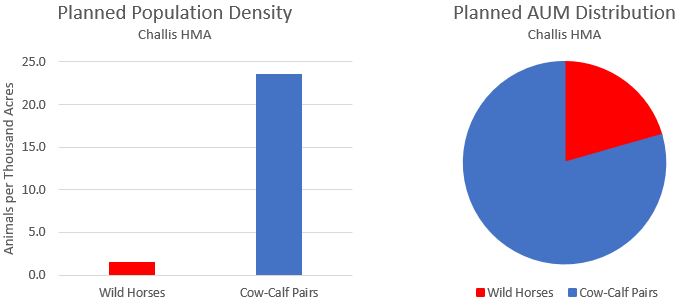
The density allowed by plan for wild horses is 1.5 animals per thousand acres.

On Bradshaw Basin, also 100% inside the HMA, ranchers have access to 850 AUMs on 8,184 acres for 2.5 months.  That translates to 340 cow/calf pairs on the allotment with a density of 41.5 cow/calf pairs per thousand acres.

The number of cow/calf pairs on the other allotments and the cow/calf densities can be found in the following table.  The permitted forage for the Mountain Springs allotment was computed by difference, so the column total matched the figure given in Section 4.2.2 in the EA.  The grazing season was not given so it was estimated.
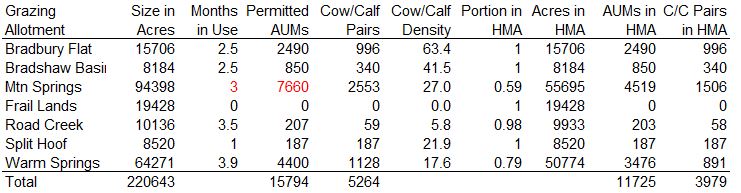
Challis AUM Calcs-1

The chart below shows the forage allowed by plan for horses and livestock on the HMA.

The map showing the allotment locations on the HMA could not be found (mentioned in Section 4.2.2 in the EA) so all of the acreage in the HMA was used in the livestock density calculation.  If some of the land is not subject to livestock grazing, the overall cow/calf density would be higher.
Challis AUM Charts-1

Now you know why over half the horses on the HMA had to be removed.  By the time the ranchers get though, there’s almost nothing left for them.

Never mind that land was set aside for the horses.  That was a long time ago.

UPDATE: If you add the numbers in the ‘Acres in HMA’ column, you get 168,240, which is very close to the size of the HMA stated in the EA (168,720 acres).  Thus, all of the HMA is subject to livestock grazing, except for areas described as ‘Frail Lands.’

RELATED: Challis Roundup Ends.

Hypothesis, Reiterated

The number of wild horses and burros in off-range corrals and long-term pastures (around 50,000) can be explained by the misappropriation of forage on just a few dozen HMAs.

The forage allocated to privately owned cattle and sheep on public lands in the western U.S., about nine million AUMs per year, would support at least 750,000 wild horses and burros, enough to empty all of those corrals and pastures fifteen times over.

You don’t have a horse problem on western rangelands, you have a ranching problem.

RELATED: Hypothesis, Subject to the Test of Future Experience.