
First of a three-part series on the day-to-day routine in a wild horse corral. This can be one of your gentling techniques—just go about your business and let them figure out you’re not a threat. Using an old cracked water bucket to carry hay. Filmed 08/19/18.
Month: August 2018
Bedtime Snack
Every evening they get some rice bran, crimped oats and hay pellets, along with some carrots and apples. Everything mixed in buckets (barn), which are then dumped into the troughs. No hand feeding. Any supplements, such as Farrier’s Formula or Red Cell, go in there too. Sometimes they get a fig newton or some flax seed. Filmed 08/19/18.
The Nokota Horseman
At the Kuntz Ranch, April, 2017. H/T Emma Zeigler.
RELATED: Leo Kuntz, Guardian of the Nokota Horses, Passes On.
Mustang Monday
On the Virginia Range. H/T Lauri Duke.
Life on the Salt River, Part 2
Wild Horses on the Edge (of the Hills)
Virginia Range mustangs at Hidden Valley Regional Park, east of Reno, NV. The fence was probably installed by volunteers, to keep the horses away from populated areas and hazards related thereto.
Unfortunately, it may impair their ability to find water so the other part of the equation is to provide water where you want them to roam, a concept known as ‘diversionary watering.’ Keeping them wild and up in the hills is a good thing.
H/T Dr. Jennifer Jewell, PhD.
Nokota Horse Conservancy
You can support the work of Leo Kuntz and help carry on his legacy with a donation to the Nokota Horse Conservancy.
RELATED: Leo Kuntz, Guardian of the Nokota Horses, Passes On.
Things Horses Do When Not Locked in Stalls
Virginia Range mustangs grazing on private property about an hour before sunset.
Story of the Nokota Horses
An approximate timeline of the wild horses at Theodore Roosevelt National Park and how they came to the Kuntz ranch.
1876
Sitting Bull and his followers defeat George Armstrong Custer and the 7th Cavalry at the Battle of the Little Bighorn. Victory was short-lived, as the federal government sent thousands of additional soldiers to the area.
1877
Sitting Bull and some of his followers flee (on horseback) to Canada under pressure of the federal troops. They find it difficult to find enough food to feed their people.
1881
Sitting Bull and his men, driven by hunger and desperation, return to the U.S. and surrender at Fort Buford (North Dakota). They are disarmed and demobilized.
1882 – 1884
Horses confiscated from Sitting Bull are sold to the public, changing hands several times, until a group of 250 was purchased by the Marquis de Mores and moved to Medora, ND, a town he established.
Early 1900s
Horses from the Medora area escaped or were turned loose by their owners (who couldn’t afford to keep them or no longer needed them due to the advent of machinery). Some migrated to an area known as the Little Missouri Badlands.
Mid 1900s
Wild horses were considered pests by local ranchers, because they competed with their livestock for food and water. Many were rounded up and sold for slaughter or shot on the spot, with the cooperation of state and federal agencies.
1947
Theodore Roosevelt National Park is established by President Truman, taking in and protecting some of the Badlands, along with the Medora horses living there.
Early 1970s
After returning from the Vietnam War, Leo Kuntz discovers the horses in TRNP and starts spending time there to settle his mind.
1980s
NPS decides to replace the native horses of TRNP with those of other breeds, believing that animals descended from other bloodlines would sell better at future herd-management auctions. The horses are rounded up and offered for sale. Leo, seeing an end to the Medora line, buys some of the horses to preserve them. He moves them to his ranch near Linton, ND, where they are bred to maintain and improve their Spanish characteristics. He calls them ‘Nokotas.’
1990s
The Nokota herd grows in size, at one time reaching 600 head. Leo and brother Frank dedicate all of their resources to caring for the horses. They were named state horse of North Dakota in 1993.
1999
The non-profit Nokota Horse Conservancy is created.
2000
The remaining Nokota horses are removed from TRNP. Those observed today are only an exhibit, no longer related to the original Medora horses.
2018
Leo Kuntz dies, leaving the Nokota herd to family, friends and supporters. Refer to the Nokota Horse Preservation Ranch web site and FB page for more info.
See also the documentary at this post and the videos at this page.
Things Horses Do When Not Locked in Stalls
Virginia Range mustangs grazing on private property about an hour before sunset.
New Foal on Assateague Island
It’s a pinto colt, born today to a mare named Giggles. See the report posted today by WMDT in Salisbury, MD.
The birth comes two days after a two year old colt was put down following an accident with a motor vehicle.
Rural Water Systems – Parts
You’ll want to keep some parts on hand to keep your system running smoothly.
- Filter elements
- O-rings for filters
- Wrench for filters
- Bulb for UV unit
- Quartz tube for UV unit
- Pump for well
These items can be stored in the pump house. Filter elements should be replaced when water pressure gets low (takes longer to fill water buckets for your horses). The UV bulb should be replaced annually.

Don’t forget salt pellets for the softener. Not really a spare part but a consumable. Put at least five 50-pound bags in storage. Check the brine tank once a month and add salt as needed.
And Now for Something Completely Different
Herb Alpert, A Taste of Honey.
Leo Kuntz, Guardian of the Nokota Horses, Passes On
He was a Vietnam vet with a couple of medals and a disenchantment with life. Then he discovered wild horses. He followed them in Theodore Roosevelt National Park, buying a few here and there after roundups. He bought 54 horses after a large gather in 1986 and the herd grew to around 600 head. At the time of his death there were around 200 wild horses on the Kuntz ranch.
He called them ‘Nokotas.’
Mr. Kuntz died August 12, at the age of 69, from injuries suffered a few days earlier in a crash of his ATV, according to a report by WDAZ, the ABC affiliate in Grand Forks, ND.
“He took care of them. They were his life. It’s all he had.”
Family and friends are now scrambling to care for the herd.
The horses are traceable in part to ponies confiscated from Sitting Bull and his followers when they surrendered at Fort Buford in 1881.
UPDATE: Video owner no longer allows embedding. View it on YouTube.
UPDATE: Video has been reposted to YouTube.
WHB Coming to Swanzey, NH
Wild horses and a few burros will be offered for adoption at the Cheshire Fairgrounds August 24 – 25, according to a BLM news release posted today. They have been checked by a veterinarian, vaccinated, de-wormed, and blood-tested.
“With kindness and patience, these animals can be trained for many uses.”
A trainer experienced in gentling mustangs will provide demonstrations both days.
WHB posters may be available at the event.

Assateague Horse Euthanized
A two year old colt hit by a vehicle last week on Assateague Island has been put down, according a story posted yesterday in Delmarva Now. The horse was reported down in a salt marsh and unable to stand. He was injured on 08/06/18 but allowed to roam freely after assessing his condition.
August Nights on the Virginia Range, Part 3
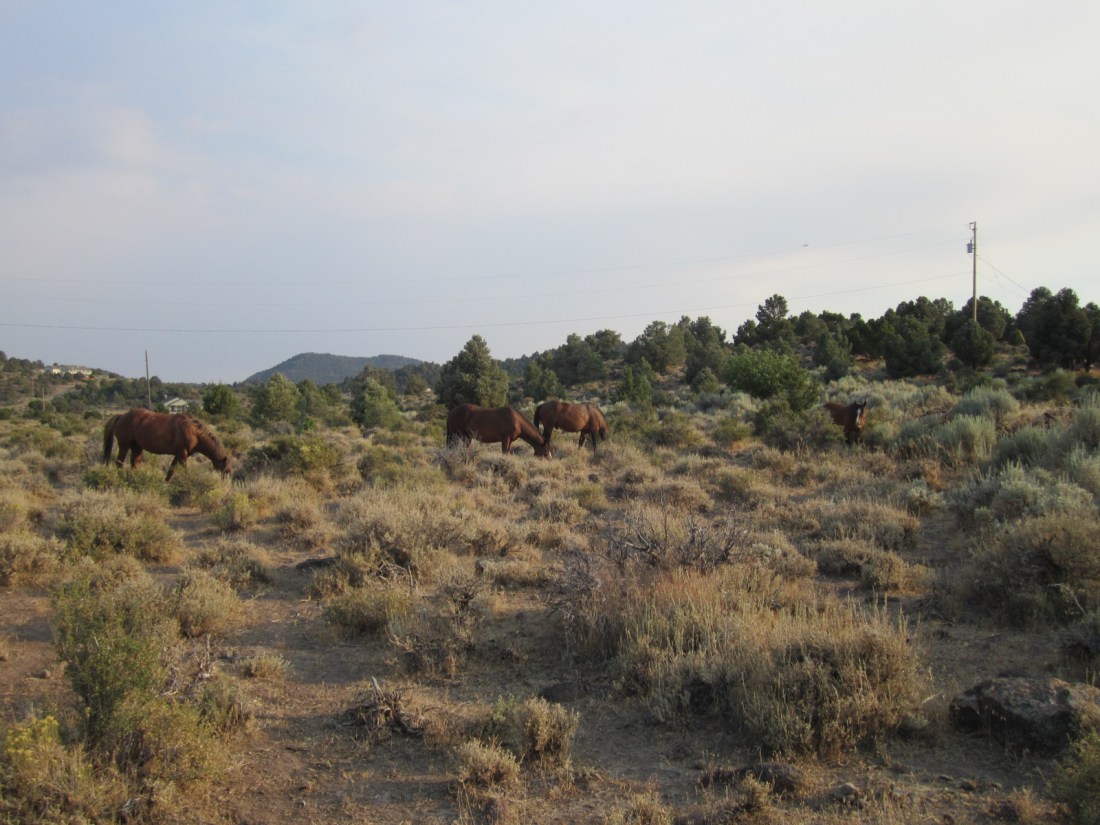
Wild horses grazing on private property just before dusk, 08/10/18.

Who Benefits from Wild Horse Gathers?
Look closely at the images between 0:13 and 0:17. Now you know. The wild horse narrative is just that…a cover story. Filmed on the Green Mountain HMA.
H/T American Wild Horse Campaign.
RELATED: Red Desert Gather Announced.
August Nights on the Virginia Range, Part 2
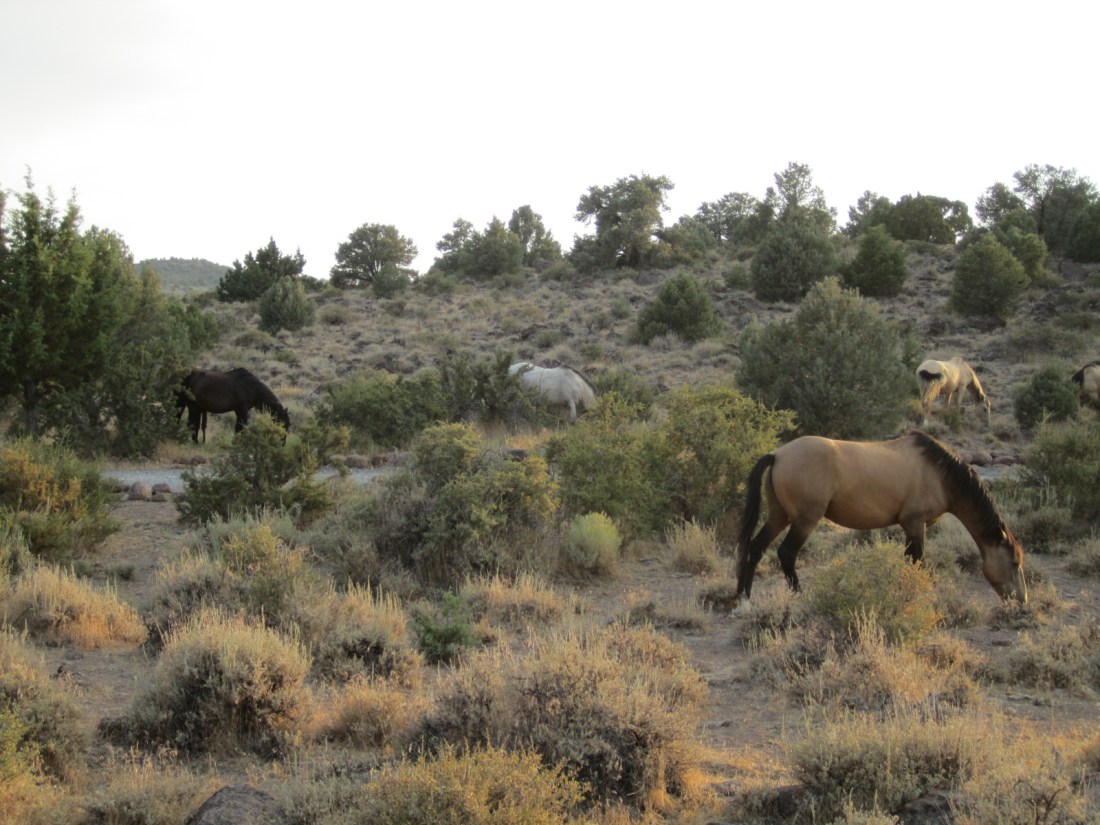
A youngster steps out from behind some trees, 08/10/18.

Volunteers Hauling More Water to Sand Wash Horses
Water deliveries to the Sand Wash Basin HMA have doubled in the last few days according to a story posted 08/14/18 in Steamboat Today. Personnel with Wild Horse Warriors are now bringing 3400 gallons of water to the mustangs.
Continued dry conditions in northwest Colorado, where the HMA is found, may prompt an emergency gather. BLM staff are monitoring the situation.
A fence around the HMA prevents the horses from moving to greener pastures. What might be on the other side? Who would benefit if the horses are confined to a fixed area and can’t reach better sources of food and water?
 Western Horse Watchers Association