Do you think their rescuers, who have been trying to get rid of them since 2019, would make a good-faith effort to keep them on the range?
Really?

RELATED: Advocates Bungle Sunny Hills Rescue, 24 Horses Lose Freedom.

Exposing the Hypocrisy, Lies and Incompetence of the Wild Horse Advocates
Do you think their rescuers, who have been trying to get rid of them since 2019, would make a good-faith effort to keep them on the range?
Really?
RELATED: Advocates Bungle Sunny Hills Rescue, 24 Horses Lose Freedom.
The former HMA, which was zeroed out in 1998 to protect the desert tortoise, covers 101,816 acres of Mojave Desert in northwestern Arizona.
The environmental assessment analyzes the use of periodic removals to achieve and maintain zero wild burros in and around the HA, according to yesterday’s news release.
The current population is thought to be 219.
The Proposed Action, discussed in Section 2.2, would authorize helicopter and bait trapping over an unspecified period.
Comments will be accepted through September 9.
The EA was copied to the project folder along with the news release.
The HA is not subject to permitted grazing but adjacent lands are.
Refer to the maps in Appendix A.
RELATED: New Management Plan Targets Tassi-Gold Butte Burros?
UPDATE: The NPS news release was published on August 12.
The incident started on August 7. Results through August 9:
The figures above are based on the daily reports.
The capture total includes 24 jacks, 39 jennies and 8 foals.
Youngsters represented 11.3% of the animals gathered.
Of the adults, 38.1% were male and 61.9% were female.
The location of the trap site is not known.
The July 31 schedule classifies the roundup as an emergency but the gather page says nuisance.
The BLM asserted that an EA from 2008 fully covers the removal.
RELATED: Lake Havasu Roundup Begins.

The construction site is at the north end of Rio Wrangler Parkway in southeast Reno, on the western slope of the Virginia Range.
Of the 24 animals now at NNCC, the stallions will likely be gelded, the mares may already be ruined (by PZP), and the foals, if any, may have faulty immune systems.
Other than that, the advocates did a fine job caring for the horses.
RELATED: Advocates Bungle Sunny Hills Rescue, 24 Horses Lose Freedom.

The number of horses removed from the construction site has climbed to 24 according to an NDA news release dated August 9.
The news release confirms they were taken to NNCC where they will be microchipped and identified to ensure they are not returned to the range.
An inventory of the animals was not provided.
An advocate with the Campaign Against America’s Wild Horses, organizer of the mass sterilization program, told KRNV News in the following report that the horses could be sent to auction, where they could be sold for slaughter.
RELATED: Sunny Hills 20 Taken to NNCC?
Willis Lamm of LRTC indicates at 0:49 in this report by KOLO News that the horses were taken to the prison (in Carson City), which is probably the Northern Nevada Correctional Center.
The BLM occasionally offers saddle-started horses at the facility, trained by inmates.
RELATED: Advocates Knew “Sunny Hills 20” Were in Construction Zone.
They want you to think they were caught off guard when NDA took 20 wild horses from the housing development to corrals in Carson City. Nobody saw this coming.
The Nevada Department of Agriculture, headed by a public-lands rancher, gave the Campaign Against America’s Wild Horses, organizer of the mass sterilization program, and its affiliate, Wild Horse Connection, several weeks to relocate the horses, presumably to another part of the Virginia Range, but they failed, according to a report by The Nevada Independent.
The advocates say the developer reneged on its word to allow them to move the animals.
NDA staff discovered yesterday that fencing and a lock had been cut at the construction site, letting more wild horses into the area.
RELATED: Advocates Protest Virginia Range Roundup in Carson City.
Western Horse Watchers reminds you that thinning the herds is a necessary step for ranching superiority in the lawful homes of wild horses, but there is a right way and a wrong way to do it.
Actually, there are many wrong ways but only one right way according to the advocates.
UNACCEPTABLE
ACCEPTABLE
Next time they’re consuming more than their allocated share of the resources, call the advocates. They want your business!
RELATED: Foal-Free Friday, Childless Cat Ladies Edition.

The incident started on August 7 with 42 burros captured, none shipped, none released and one dead.
The event was organized by the Campaign Against America’s Wild Horses, whose representative said the removal of wild horses from a construction project in Reno was completely unnecessary, according to a report by Nevada Appeal.

Volunteers with CAAWH are trying to prove that mass sterilization is a practical alternative to motorized removal.
RELATED: NDA Captures Virginia Range Mustangs in Construction Zone.
They were stuck in mud at the bottom of a dried-up pond according to a story by ABC4 News of Salt Lake City.
The mom was so exhausted and dehydrated they killed her on the spot.
The baby was taken an unnamed corral where it was killed due to extreme dehydration.
A photo of the pond suggests it was man made, constructed perhaps by one or more of the permittees.
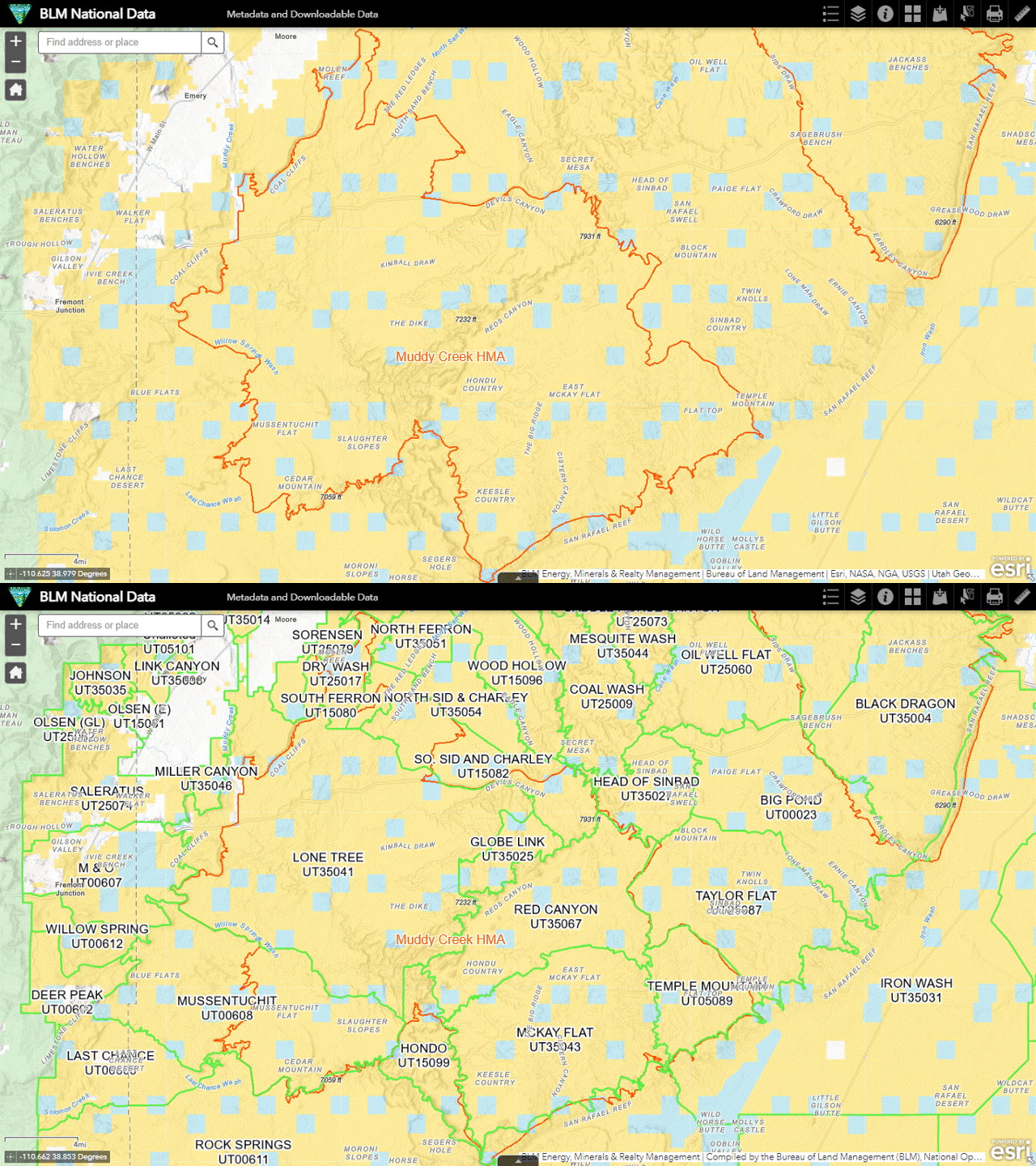
The following allotments overlap the HMA, with some land extending beyond its boundary:
All are in the Price Field Office except Mussentuchit, which is in the Richfield office.
The Authorization Use Reports (Price | Richfield) indicate that every authorization is currently in its off season, meaning there is no livestock grazing in the HMA.
So who cares if the pond goes dry?
The report did not indicate if it was filled by rainfall or if water was piped from a nearby spring or well.
A story by KLAS News on August 6 says the family was getting ready for a photo shoot when a wild horse galloped by, kicking their three-year-old daughter in the head.
She is now recovering in a Las Vegas hospital.
A video report by KTNV News on August 7 shows the horse grazing nearby.
An advocate wants the horses moved to her ten-acre sanctuary near Pahrump according to an update by FOX5 News.
Western Horse Watchers has not seen a satisfactory explanation of the events leading to the incident nor any calls for the involvement of child protective services.
They were bait-trapped, allowed into the area for water then the gate was shut behind them according to a story by KTVN News of Reno.
The person(s) responsible were not identified.
The horses were taken to an undisclosed location in Nevada.
No other details are available at this time.
RELATED: Advocate Defends Virginia Range Sterilization Program.
The agency is changing the way it informs the public about temporary closures and restrictions on public lands, according to an August 6 news release.
Notices will no longer appear in the Federal Register but will be distributed via “widely available communication tools.”
The change will align current practices with those of the Park Service, Fish and Wildlife Service, and the Forest Service.
The new rule goes into effect on September 6 according to today’s announcement in the Federal Register.
RELATED: Rule Changes Would Affect Closure Notices on Public Lands.
She was taken yesterday to the North Carolina State College of Veterinary Medicine for observation and treatment according to a report by Carolina Coast Online.
The story did not indicate if the condition was related to Hurricane Debby and if the foal will be returned to the Reserve.
The news release by North Carolina Department of Environmental Quality does not offer any additional details.
The DNA published last week asserts that a 2008 EA fully covers bait trap removal set to begin this week.
For that to be true, the document must have a useful life of at least 16 years.
Some advocates have argued that a ten-year life, typical for wild horse and burro environmental assessments, is too long.
The EA was not copied to the project folder but Western Horse Watchers sent an email this morning asking for that.
RELATED: Lake Havasu DNA Issued, Not Open for Public Review.
The event will begin with a brief presentation by the Colorado Wild Horse Working Group about its purpose and emerging recommendations regarding fertility control, adoption and other topics, followed by public feedback.
Registration is required.
The aim of the group is to protect hunting and ranching interests by curtailing wild horse numbers with pesticides, reducing the need for motorized removal.

Despite this, two of the four HMAs in the state will see roundups in the next few weeks.
The document asserts that a 2008 EA fully covers bait trap removal scheduled to begin this week.
Operations will occur in an area south of I-40, east of the Colorado River, west of State Route 95 and north of Lake Havasu City. Refer to Figure 1 on page eight.
The project was created in ePlanning on July 31.
It’s on the July 31 schedule in the emergency/nuisance section and operations will begin this week according to today’s news release.
The capture and removal goals are 100 each.
Excess animals will be taken to the off-range corrals in Florence.
They are likely associated with the Havasu HMA.
The incident is not open to public observation.
The agency is developing a new management plan for the HMA and two others, known as the Three Rivers Complex.
UPDATE: The original gather page has been replaced by this one.
The Campaign Against America’s Wild Horses, a leader in nonmotorized removal, reported today that 112 mares received 112 doses of PZP during the month, 17 given as primers and 95 as boosters.
Over the life of the program, which began in 2019, the advocates have pumped 9,626 doses of the pesticide into 2,049 mares, for an average of 4.7 doses per mare.
Since the beginning of the year, 143 foals have been born and 34 died.
The current population is thought to be 3,548, with 311 horses listed as missing, compared to 3,521 with 302 horses listed as missing in June.
The population was 3,502 with 310 horses listed as missing in May and 3,519 with 370 listed as missing in April.
The Year 6 agreement with NDA has not been posted to the darting resources page.
The Year 5 summary has not been posted to the monthly reports page.
A goal for August is to maximize booster treatments so the herd will continue to shrink and to train newly certified darters with experienced team members.

Not discussed:
The report will be submitted to the Nevada Department of Agriculture.
RELATED: Virginia Range Darting Update for June 2024.


