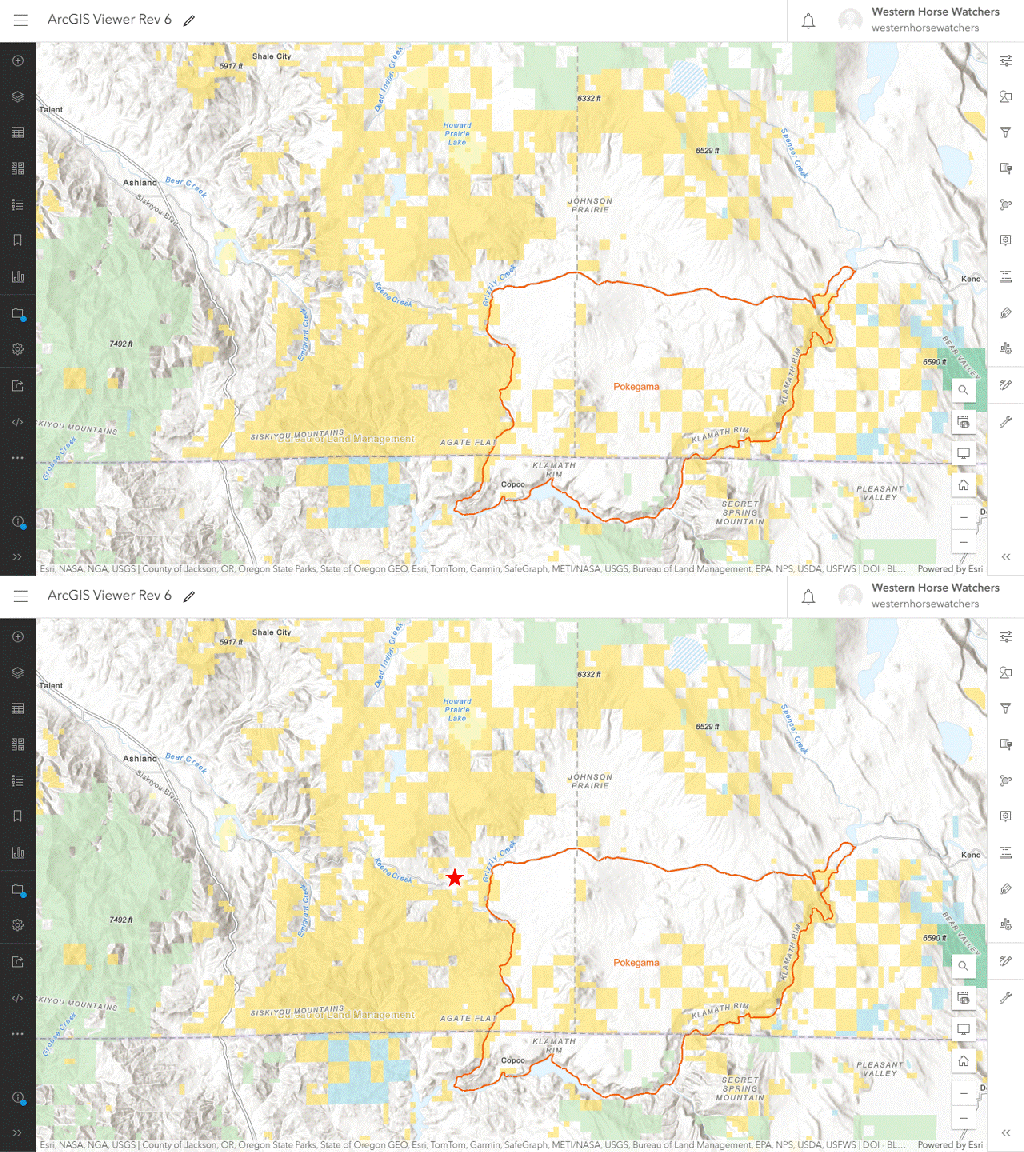
Helicopters are the fastest and most efficient way of shifting resources from wild horses and burros to privately owned cattle and sheep.

An advantage of mass sterilization, favored by the advocates, is that the herds don’t bounce back.

Exposing the Hypocrisy, Lies and Incompetence of the Wild Horse Advocates
Helicopters are the fastest and most efficient way of shifting resources from wild horses and burros to privately owned cattle and sheep.
An advantage of mass sterilization, favored by the advocates, is that the herds don’t bounce back.
Would you vote for a candidate who talks like that?
Then why do you give money to the advocates?

If we don’t poison the mares with ovary-killing pesticides, the herds might grow.
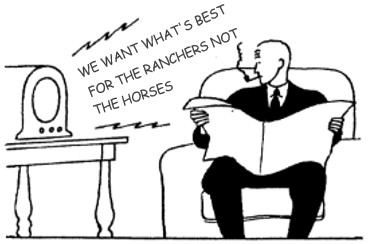
The Wild Horse and Burro Protection Act would phase out the use of helicopters and fixed-wing aircraft for rounding up free-roaming horses and burros, a practice that leads to population growth according to the advocates.

The alternative would likely be long-term use of immunocontraceptives, sometimes referred to as mass sterilization, a service they provide.
The bill would not link Appropriate Management Level, an undefined concept in the statute, to principal use.
It would not repeal the Burns Amendment.
The statement reveals their attitude toward wild horses and burros.
They hate foals. They view these animals as pests and think reproduction is a defect, not an essential characteristic, of nature.
The bill will go nowhere in Congress but it’s a great way to keep their base fired up and the donations rolling in.
RELATED: Shrinking Populations and Managing to Extinction.

Do you see the contradiction in this statement?

Fertility control is the leading cause of stunted and shrinking populations!
Who’s publishing this garbage?
The group that’s driving the Virginia Range herd to extinction via mass sterilization.
Its affiliate at the Salt River is doing the same thing.
These people are shallower than a dry creek on the 92nd day of a drought.

He’s a bay pinto colt according to the list of foals by DSC Photography.
Not bad for a herd of 150.
Meanwhile, at the Salt River, a herd of 280 has only produced one or two foals in 2025 because the advocates are sterilizing the mares with PZP.
At Chincoteague, the saltwater cowboys have turned the wildlife refuge into a puppy mill for wild horses while FWS looks the other way.
The wind and dust can be pretty intense. Filmed 10-07-25.
The advocates want to replace cruel and costly helicopter roundups with cruel and costly sterilization programs.
If they get their way, we won’t have any wild horses.
RELATED: Foal-Free Friday, the Great Disconnect Edition.

There is no announcement at the BLM news page or input and actions page.
A link to the daily reports has not been added to the Nevada gather page.
We’re still waiting for a FY26 roundup schedule.
A temporary banner says blm.gov is not being updated and staff will not be able to respond to inquiries until FY26 appropriations are enacted.
But they can send notices to their media partners, such as KTNV News in Las Vegas.
The capture goal is 250 according to the report.
The driver is public safety and private property encroachment.
They’re billing it as an emergency.
Burros will be drawn into the traps with bait.
Operations are probably not open to public observation.
There are no plans to treat any of the jennies with PZP and return them to the range, a huge disappointment to the advocates.
Animals identified for removal will be taken to the contract corrals in Axtell.
The HMA surrounds the town of Beatty.
The report did not mention that Nevada is a fence-out state.
RELATED: BLM Issues Bullfrog Final Planning Documents.

The NDA website was down at the time but it’s working now.
He stated on August 26 that feeding and watering the horses was illegal.
But the FAQ says on page two that watering is not illegal.

If he’s wrong about that, should we believe what he says about the advocates and their mass sterilization program?
RELATED: Unlawful to Feed or Water Virginia Range Mustangs?

On the Virginia Range with Western Horse Watchers.
The allotment covers 81,960 public acres but there is only one pasture so it may operate as a general use area shared by two permittees, with cattle and sheep moving across the land as specified in the AMR.
The actual arrangement is unknown.
If free-roaming horses replaced cattle, the other permittee would still be entitled to graze sheep.
The advocates may never make such a request as they have been working for years to cement their relationship with the bureaucrats and ranchers.
The base property tied to 1,471 AUMs in the allotment consisted of a 40-acre parcel but the preference was transferred to another parcel inside a 944-acre tract before it was purchased by the advocates.
Thus, the land ratio is very good. Up to 81,960 public acres can be accessed through the acquisition of 944 deeded acres.
Unfortunately, the allotment overlaps the Pine Nut Mountains HA, an area that could be returned to the horses not by spending millions of dollars on a base property but by purging the bureaucracy of ranchers and ranching sympathizers and overturning the planning process that zeroed it out.
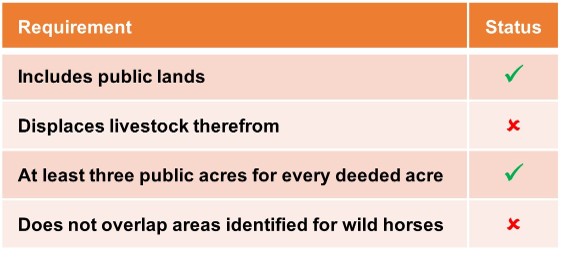
A refuge should increase territory for wild horses while decreasing lands occupied by livestock.
In summary, the allotment satisfies two of four requirements for a refuge:
If the project moves ahead and the cattlemen are howling, along with their cheerleaders, it might be worthy of your support.
RELATED: Buckeye Grazing Preference Transfers to CAAWH.
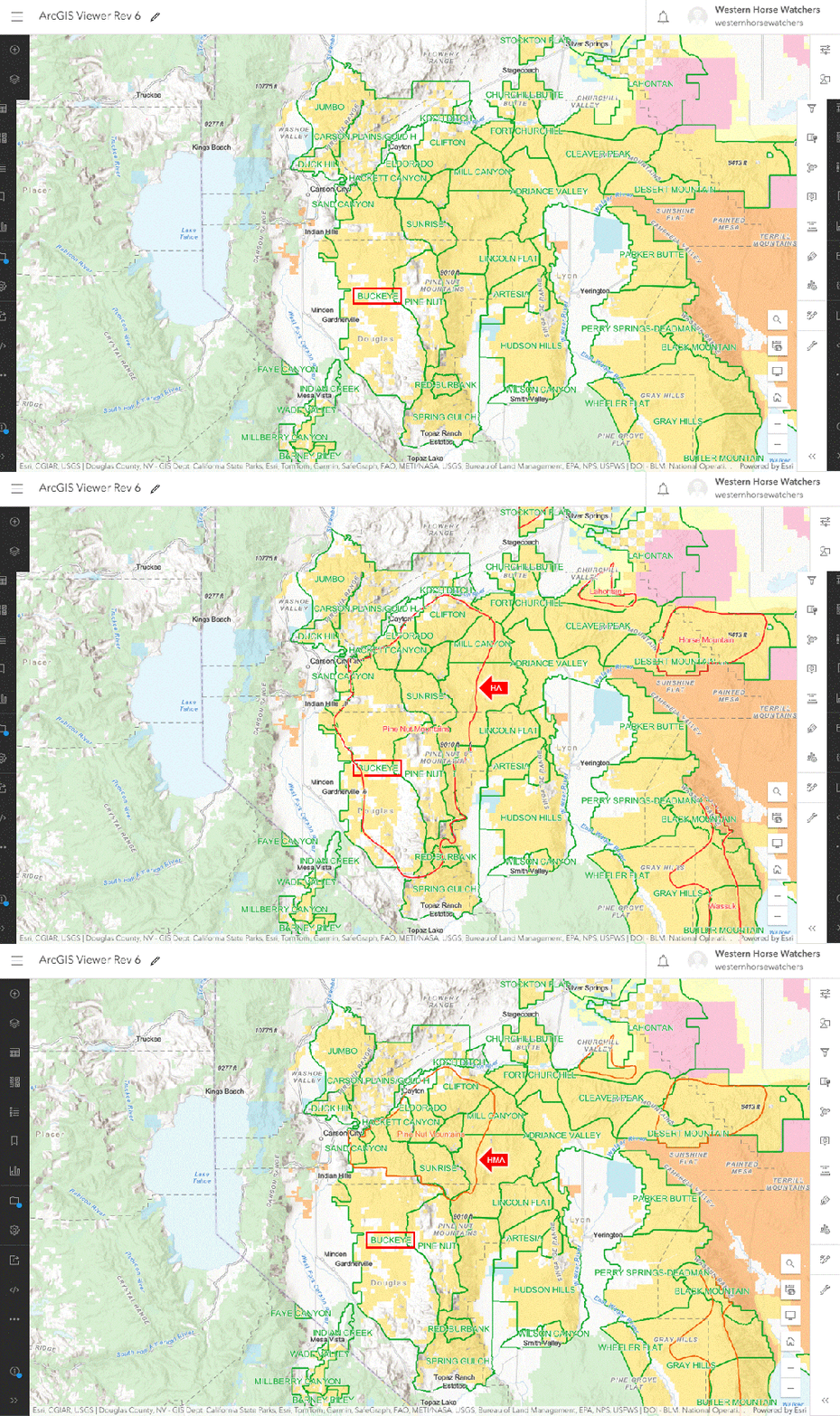
The nonprofit holds 75% of the active AUMs according to the Allotment Master Report.
The percentage of public land is not known.
The Authorization Use Report shows their portion is still permitted for cattle with a 5.5 month grazing season.
Western Horse Watchers does not know if the advocates have asked the BLM to change the livestock type to horses and the grazing season to 12 months, turning the area into a refuge for up to 122 equines.
A search of ePlanning for projects involving Buckeye turned up the grazing preference transfer but nothing for repurposing the allotment.
The portion controlled by CAAWH may not overlap the Pine Nut Mountains HMA but almost certainly overlaps the HA.
RELATED: Who Has Grazing Preference on the Buckeye Allotment?
If they don’t include public lands and don’t displace livestock therefrom, they’re not worthy of your support.
Nonprofits operating solely on deeded acreage do the will of the public-lands ranchers.
The model employed by American Prairie gives hope to wild horses.
They buy base properties tied to grazing allotments and flip the preference to bison.
The problem in the wild horse world is that those who claim to be voices for the horses are actually servants of the ranchers.
If the Public Lands Council isn’t howling about your project, you’re not doing it right.
RELATED: Defund the Advocates Day Set for December 2.

The editors placed it behind a paywall so the identity of the writer is not known.

Western Horse Watchers will not subscribe to any news source, whether it’s written by liberals or conservatives.
The advocates tell us that wild horses face competition from livestock, unfair resource allocations and shrinking habitats but their solution—mass sterilization—aligns with and can only aggravate the problem.

The ranchers couldn’t have asked for more feckless opponents.
Why are you still giving them money?
The incident concluded on September 30.
The documented capture total, based on the daily reports, is 268, including 120 stallions, 121 mares and 27 foals.
The capture goal was 350.
Youngsters accounted for 10.1% of the sample.
Of the adults, 49.8% were male and 50.2% were female.
The average daily take was 7.7.
The death rate, based on the stated capture total of 276, was 2.5%.
Body condition scores were not given.
The number of animals shipped is not known.
The operation liberated 3,216 AUMs per year.
The WHT is subject to permitted grazing.
The Decision Record authorizes Alternative A, the Proposed Action, discussed in section 2.4 of the Final EA.
Details of the new HMAP can be found in Appendix XIII.
Recall the rallying cry in the Nevada Current op-ed: “America’s wild horses have faced competition from livestock, unfair resource allocation, and shrinking habitat for generations.”
How does the new plan fix any of that?

It doesn’t. The only change the advocates want is more government spending on services they provide.
RELATED: Antelope-Triple B Preliminary EA Out for Review.

In some circles it’s known as Giving Tuesday but think of it as an opportunity to give the advocates the boot.
The Decision Record authorizes the Proposed Action, discussed in Section B of the Categorical Exclusion, clearing the way for bait-trap removal of six wild horses that have strayed from the Pokegema HMA onto school property.
A map of the project area was not provided but the incident would probably take place near Highway 66 on the west side of the HMA based on the school address.
The news release did not indicate if Oregon was a fence-out state and if the barrier around the school meets the requirements of a legal fence.
Funding for the operation would come from ______________________.
RELATED: No FY26 Budget, No FY26 Roundup Schedule.