Trump Nominates Sgamma to Lead BLM

She currently serves as president of the Western Energy Alliance according to a report by AP News.

Western Horse Watchers was unable to find a statement opposing wild horses at the WEA public lands page.

You’ll have to go the American Farm Bureau Federation or Public Lands Council for that.

The advocates would have you believe that drilling and mining are the greatest threats to these animals, as permitted grazing devours entire HMAs and beyond.

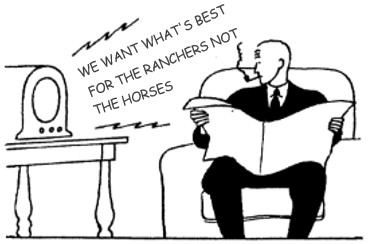
We Want Whats Best for the Ranchers 04-01-25

As of today, the BLM org chart shows the director’s position as vacant.

RELATED: Shultz to Head Forest Service.

Leadership Harder to Find at Salt River Than Foals!

One of the objectives in the Land Management Plan for the Tonto National Forest is to evaluate at least one vacant allotment every two years to (1) convert it to forage reserves, (2) grant it to a current or new permittee or (3) close it to permitted grazing.

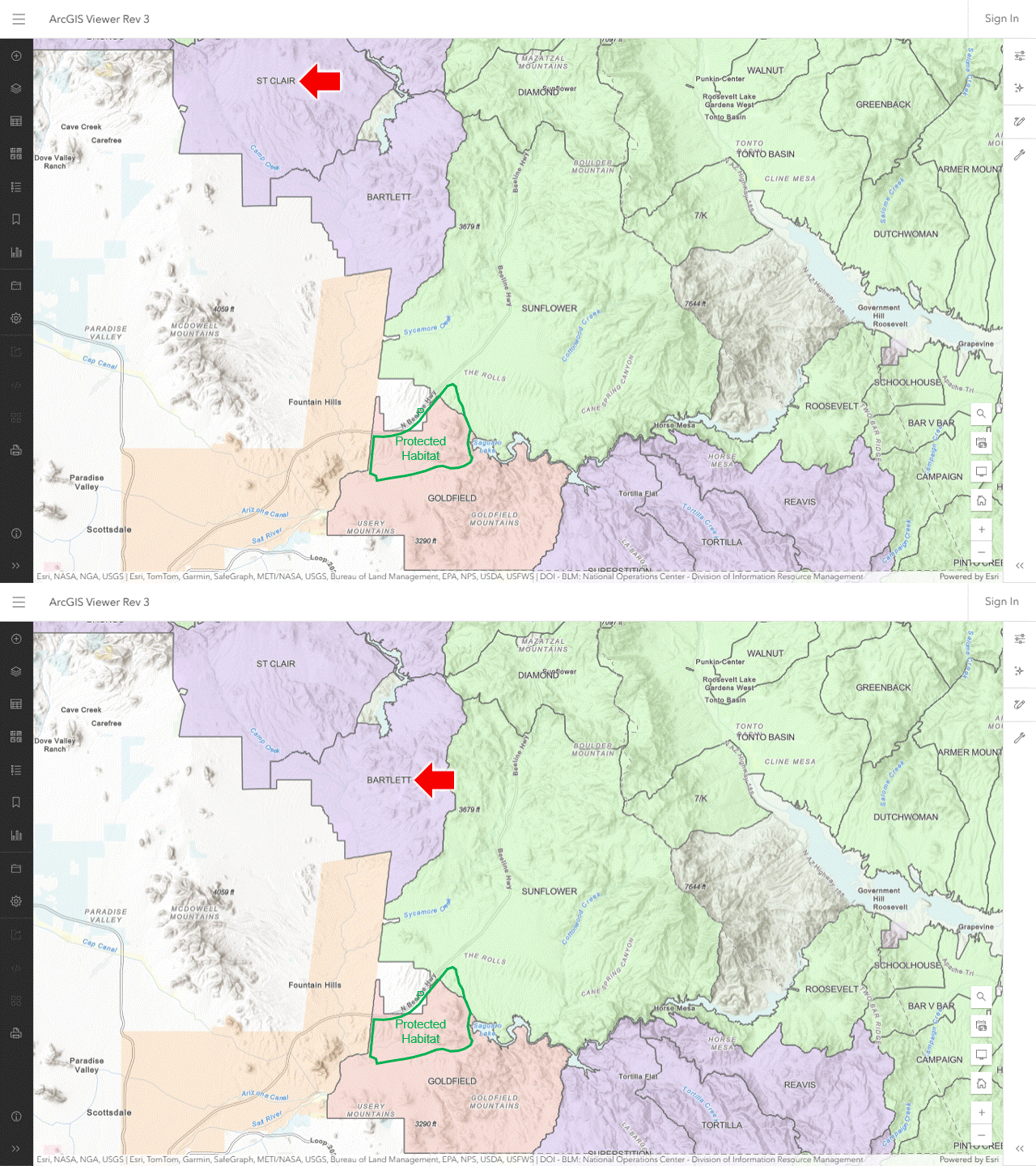
The 2018 report on forage availability states in Appendix 5 that the Goldfield, Bartlett, St. Clair and Sunflower allotments are most similar in vegetation, soil, and topography to the Salt River horse zone.

The ArcGIS viewer indicates that Bartlett and St. Clair are vacant.

Appendix 5 also indicates that the two allotments offered a combined 7,404 AUMs on 116,430 acres, equivalent to 617 wild horses, or 5.3 wild horses per thousand acres.

Your faithful public servants claim the rangelands in the western U.S. can only support one wild horse per thousand acres.

If the advocates had a base property that met Forest Service requirements, they could ask the agency to attach it to one or both of the allotments, securing grazing preference thereon.

The livestock type would be horses and the season of use would be 12 months.

This would probably require a NEPA review, which could span several years, complete with blowback from ranching interests.

But it would be better for the horses compared to their current situation, crammed into a 20,000-acre habitat with the number of viable mares decreasing every year.

RELATED: Leadership Needed at Salt River.
More Options for Salt River Horses 03-18-25

Draft EA for Rock Springs Wild Horse Removal Out for Review

An assessment of the environmental effects of zeroing out the Divide Basin, Salt Wells Creek and northern portion of the Adobe Town HMAs has been copied to the project folder for public comment.

Alternative II, discussed in Section 2.2, calls for the removal of all wild horses from the project area.

Map 1 shows the arrangement.

The preferred method would be helicopter drive trapping but roping and bait may also be used.

Operations would commence on July 15, assuming there are no major findings, and would continue until all wild horses are removed, which may require several years.

The comment period will close on April 30 according to the news release.

RELATED: Scoping Begins for Rock Springs Wild Horse Removal.

BLM Releases Pryor Mountain Final Planning Documents

They were copied to the project folder on March 17.

The Decision Record authorizes a change to the Billings Resource Management Plan regarding genetic diversity, to be followed by a similar decision from the Forest Service.

Other parts of the Proposed Action, discussed in Section 2.3 of the Final EA, will be covered by separate decisions.

Appendix I still refers to outdated registrations for GonaCon Equine. suggesting that accuracy is not a desired characteristic of the planning process.

Recent observations suggest that PZP causes reductions in ovary size and function, described by the writers as a “complementary hypothesis” in a discussion of the direct effects of the pesticide.

Contradictory might be a better term, a rebuttal of the sperm-blocking theory peddled by the advocates.

RELATED: Pryor Management Plan Moves to Protest Stage.

CAAWH Still Looking for Director of Development?

In this role, you’ll sell mass sterilization as wild horse preservation.

The successful candidate will have a demonstrated commitment to animal/wildlife conservation, equine protection and diversity-equity-inclusion.

Even if you didn’t know what they’re doing to the Virginia Range herd, and want to do to other herds, that last qualification is reason enough to withhold your financial support.

RELATED: Help Wanted: CAAWH Seeks Development Director.

Adobe Town DNA Out for Public Review

The Proposed Action would gather and remove excess horses from the Adobe Town HMA and apply fertility control treatments of unspecified type.

The current population is thought to be 2,438.

No other documents were copied to the project folder.

The description does not indicate when the roundup would occur.

The deadline for submitting comments is April 28.

RELATED: Adobe Town Confusion.

UPDATE: A map of the project area was not included in the DNA but the BLM news release suggests it applies to the portion of the HMA that will not be zeroed-out by the Rock Springs RMP Amendments.

Foal-Free Friday, Cycle of Dependency Edition

The advocacy groups rely on their misguided followers to sustain their ruinous agenda.

They’re constantly inventing new gimmicks to keep them engaged and their donations rolling in.

Wild Horse Protection Month 03-27-25

Their followers depend on the advocacy groups to validate their ill-informed notions about wild horses and the way public lands are managed.

Together, they support legislation that marginalizes the horses in favor of hunters and ranchers.

Some try to masquerade as independent voices but they arrive at the same conclusions and promote the same policies as the advocates, a phenomenon known as groupthink.

Sign HB25-1283 Petition 03-27-25

RELATED: Foal-Free Friday, Thinking Outside the Box Edition.

Pesticides R Us Better Way 11-07-23

New Wild Horse and Burro Corrals in Montana?

The facility would be built with government-furnished materials on private land in Hamilton according to the Section B of the CX.

The BLM will pay for services such as maintaining, feeding, sorting, marketing, training and trimming of hooves.  Veterinary care would be provided as needed.

The capacity is 110.

There are no other documents in the project folder and there were no opportunities for public comment.  A news release was not provided.

The address of the ranch was not given but appears to be 736 Alvista Loop.

The aerial image shows a horse setup with a barn, arena, corrals and pastures.

Google Maps labels it “Hamilton Training Center/Mustang Matt Facility.”

New Adoption Center in Montana 03-27-25

Leadership Needed at Salt River

Consider two approaches to herd management:

A. Obtain grazing privileges on one or more allotments in the Tonto National Forest and flip the preference to horses, as Wild Horse Refuge did in Colorado.

B. Sterilize the mares with PZP.

Which one requires a long-term strategy, some diplomacy and tact, a solid donor base and a sincere desire to protect the horses?

Which one can be done by trained monkeys?

RELATED: Salt River Herd Doomed?

Salt River Herd Doomed?

Consider two options for wild horse management.  One was announced by the Forest Service, the other proposed by the advocates.

Can you tell which is which?

Alternative A

  • Initial population: 400
  • Final population: 0

Alternative B

  • Initial population: 400
  • Final population: 0

Let’s add headings and change the numbers to reflect the way they were sold to the public.

Alternative A – Motorized Removal

  • Initial population: 400
  • Final population: 0

Alternative B – Nonmotorized removal

  • Initial population: 400
  • Final population: 200

Now can you tell the difference?

The bureaucrats decided to implement Alternative B, the plan submitted by the advocates.

Why is it a hoax?

Because the volunteers are sterilizing the mares.

The final population will be zero.

RELATED: Advocates, Not Forest Service, Destroying Salt River Herd