
Horses have the day off. At the Black Mountain HMA with Shifting Gears 2 RV Life.
Identity of Pryor Mountain Shooter Revealed
A story by Aspen Daily News says BLM employee Jace Stott pulled the trigger.
A profile on LinkedIn suggests he’s a Rangeland Management Specialist, sometimes referred to as ranching advocate.

Other search results indicate he was affiliated with University of Nebraska – Lincoln and has been involved with animal agriculture from a very young age.
The article is the first of a two-part series that explores wild horse management.
Forage Requirements of Wild Horses and Burros
If you want to compare the resource loading of burros to horses, cut the burro numbers in half.
A herd of 200 burros is equivalent to 100 wild horses.
An AML of 50 burros is equivalent to an AML 25 wild horses.
An allotment that supports livestock equivalent to 1,200 wild horses supports livestock equivalent to 2,400 wild burros.
An allotment that supports livestock equivalent to 5.6 wild horses per thousand public acres supports livestock equivalent to 11.2 wild burros per thousand public acres.
An allotment that offers 3,600 AUMs per year to livestock offers 3,600 AUMs per year to horses or 3,600 AUMs per year to burros.
RELATED: Equivalent Horses and Stocking Rates for Allotments.

Troops in LA?
Maybe to break up their PRIDE parade or something.

Practice with Synonyms
How many synonyms for mass sterilization can you find in this Google search result?

Hint: There’s more than two and less than four.
RELATED: Advocates, Not Project 2025, Invented Humane Disposal.
Salt River Feud Escalating?
Jackie Hughes is co-leader of the Wild Horse Transition Team, one of the groups vying for the new management contract.

Consider the possibility that both parties are unsavory.
Western Horse Watchers does not read or link to anything on socialist media.
Origin of Banker Horses?
Legend ties them to shipwrecks and new world explorers but no one really knows how they got there according to a story by the Daily Press.
They’ve survived under harsh conditions for 500 years but today they face a threat nobody imagined: The advocates and their ovary-killing pesticides.
Caisson Platoon Returns to Work
They went back on the job this week with the burial of Private Bernard Curran who died in 1942 after being captured by the Japanese.
The horses have pulled the flag-draped coffins of America’s war heroes to their final resting place at Arlington National Cemetery for more than 70 years according to a report by Fox News.
The program was halted two years ago after the Army linked the deaths of several animals to poor living conditions.
RELATED: Return of Caisson Platoon Delayed Indefinitely?

Article About Salt River Contract Uses the S-Word!
One of the challengers to the Salt River Wild Horse Darting Group said in a story by the Payson Roundup that “…horses receiving multiple doses of PZP over the course of several years can become functionally sterile,” a condition nobody wanted to talk about until today.
The group’s ringleader claimed responsibility for herd reduction via mass sterilization, ratifying a June 2 commentary by Western Horse Watchers: “We invented this humane management protocol…”
No foals have been born this year according to the report.
RELATED: Who Would Want to Be Responsible for Salt River Herd?
Who Would Want to Be Responsible for Salt River Herd?
Imagine submitting a proposal to manage the herd at 150 head and instead of seeing it grow, you’re watching it shrink, irreversibly.
Everyone’s looking at you with suspicion.
But you had nothing to do with it.
The problem was created by your predecessor, the Salt River Wild Horse Darting Group and its overlords at the Campaign Against America’s Wild Horses.

RELATED: Four Organizations Bidding on Salt River Management Contract.
Foal-Free Friday, Humane Disposal Edition
In the introduction to a 2012 Q&A about PZP, Jay Kirkpatrick of the Billings School of PZP Darting and Public Deception stated that “…oversight by The Humane Society of the United States assures that the vaccine is used only to slow reproduction and may not be used for the extermination of entire herds.”
Further, “PZP is designed to bring about short-term infertility and is reversible, if not used beyond five consecutive years.”
On page 29 he refutes the remarks on page 3: “The HSUS will permit the use of PZP to manage, even reduce, but not to eliminate wild horses.”
Writing about the disaster at Assateague Island, which he did not live to see, “the first sign of population reduction took about eight years, but herd reduction has been moving more quickly since then. The following eight years, herd numbers went down from 175 to 114, without any removal of horses, treating anywhere from 48% to 79% annually.”
If a helicopter took the herd from 175 to 114, 61 horses would be removed and the advocates would be howling, but if it’s done with pesticides, no horses are removed.
Moreover, the job took eight years to complete and eight is greater than five, so most of the mares had been ruined by the time the population hit 114.
This is evident today.
You cannot shrink a population without driving the birth rate to zero, or nearly so, for an extended period, which usually exceeds five years.
Herd reduction leads to sterilization and sterilization leads to extermination, which the Humane Society won’t allow, supposedly.
NOTE: HSUS is now HWA.
RELATED: Foal-Free Friday, One Track Mind Edition.
Four Organizations Bidding on Salt River Management Contract
The Arizona Department of Agriculture will reopen the RFP soon according to a story by Phoenix New Times but a date was not given.
The article looks at the incumbent and one of its challengers, a group led by historian John Mack and Forest Service contractor Jacquelyn Hughes.
Hughes was involved in the removal of wild horses from the Apache-Sitgreaves National Forest in 2022.
Simone Netherlands of the Salt River Wild Horse Darting Group suspects the contract will go to the group that proposes the smallest population goal.
That will raise questions in some circles about genetic diversity but the point is moot when most of the mares have ruined by PZP.
RELATED: Salt River RFP Cancelled.
AMLs Don’t Indicate Genetic Diversity or Carrying Capacity
Those who would combat myths about wild horses are often the greatest spreaders thereof.
Genetic viability correlates with breeding populations, not AMLs or herd sizes.
You have to correct the figures for the number of mares that have been ruined or are in the process of being ruined with fertility control pesticides.
For example, the current population at the Salt River is approximately 260 and most advocates would conclude that genetic diversity is satisfactory when in fact most of the mares have been sterilized by PZP and the breeding population can be counted on one hand.
As for carrying capacity, if a wild horse area is subject to permitted grazing, which is almost always the case, the AML is small relative to the available resources and the land can support many more animals than the bureaucrats admit.
The Silver King HMA in eastern Nevada supports livestock equivalent to 2,530 wild horses, on top of the 128 allowed by plan.
A herd that large is not safe from the advocates.
Volunteers with the Campaign Against America’s Wild horses are wiping out the Virginia Range mustangs with PZP, a population that exceeded 3,000.
Currituck Colt Found Dead After Sparring with Stallion?
More Nuisance Roundups in Latest Schedule
Clover Mountain and Pine Nut Mountains were added to the June 3 update.
Chloride, Four Mile and Bible Spring were added in May.
No change to the bottom-line totals.
Bait-and-Switch Not Uncommon in Wild Horse World
The advocates lure you in with remarks about helicopter roundups then ask you to give them money so they can eradicate the herds with pesticides.

File Under: Charlatans.
Non-Horse People Should Adopt Wild Mustangs?
“Let the mustang be in charge.”
Can you think of a better way to set him up for failure and put yourself at risk of injury?
The full video runs nearly two hours.
Some equestrians are as nutty as the wild horse advocates.
Advocates, Not Project 2025, Invented Humane Disposal
Lately they’ve referred to it as humane management, in-the-wild management or one of these terms:
- Defending wild horses
- Protecting wild horses
- Preserving wild horses
- Conserving wild horses
- Safeguarding wild horses
- Managing wild horses
- Saving wild horses
They all mean the same thing: Wiping out herds with ovary-killing pesticides.
There are no helicopters, no horses falling out of trailers on the way to off-range corrals and no euthanizing animals for pre-existing conditions.
But the results are the same, with the added benefit that the herds don’t bounce back.
RELATED: Humane Disposal of Wild Horses and Burros?
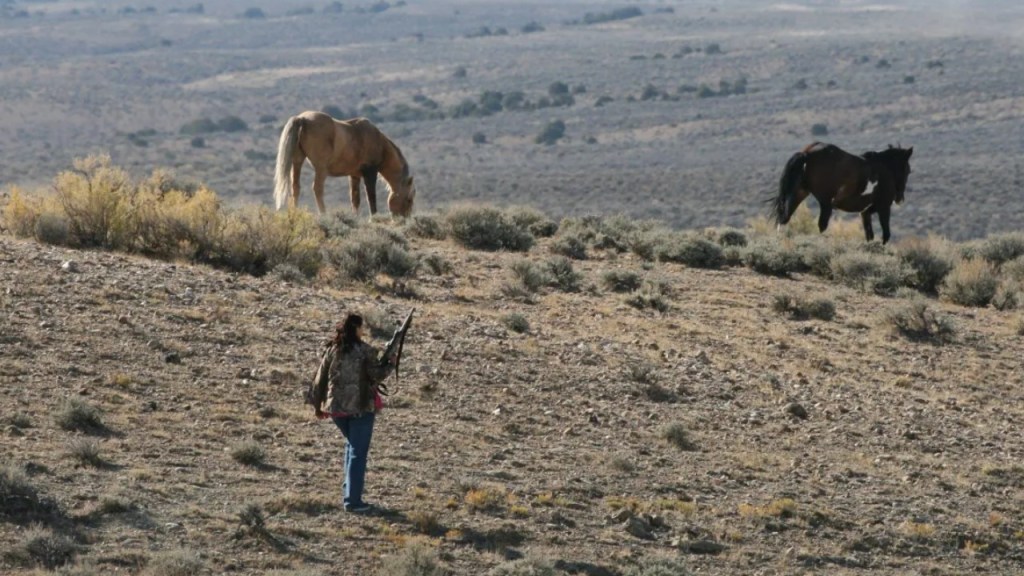
Mustang Monday
Horses have the day off. In the Hickison HMA with DebraElaine McDonald.
Montana Permit Renewals Show Abundant Forage
From the project description in ePlanning:
The Wolf Creek allotment would contain 8,253 acres of BLM administered land, 2,712 deeded acres and 640 acres of state lands. The BLM administered acreage would have 1,242 AUMs of active use, equivalent to 103 wild horses or 12.5 wild horses per thousand public acres.
Your faithful public servants insist the public lands in the western U.S. can only support one wild horse per thousand acres (25,500 animals on 25.6 million acres).
The Square Butte allotment would contain 5,039 acres of BLM administered land, 2,280 deeded acres and 663 acres of state lands. The BLM administered acreage would have 754 AUMs of active use, equivalent to 63 wild horses or 12.5 wild horses per thousand public acres.
The Ely allotment would contain 1,563 acres of BLM administered land and 480 deeded acres. The BLM administered acreage would have 326 AUMs of active use equivalent to 27 wild horses or 17.4 wild horses per thousand public acres.
The 7-W allotment would contain 6,201 acres of BLM administered land, 6,729 deeded acres and 640 acres of state lands. The BLM administered acreage would have 1,430 AUMs of active use, equivalent to 119 wild horses or 19.2 wild horses per thousand public acres.
The Six-X allotment would contain 10,327 acres of BLM administered land, 8,978 deeded acres and 1,920 acres of state lands. The BLM administered acreage would have 2,125 AUMs of active use, equivalent to 177 wild horses or 17.1 wild horses per thousand public acres.
The D.K. North Pasture allotment would contain 4,470 acres of BLM administered land, 13,686 deeded acres, and 640 acres of state lands. The BLM administered acreage would have 758 AUMS of authorized active use, equivalent to 63 wild horses or 14.1 wild horses per thousand public acres.
The advocates don’t want you looking at the numbers because they contradict their allies, expose the gravy train and destroy the rationale for their darting programs.
RELATED: Montana Allotment Split Reveals Abundant Forage.
 Western Horse Watchers Association