Deseret Op-Ed Asks Wrong Question About Wild Horses

The article begins with a faulty assumption.

The title should say “How should Utah fix the mismanagement of resources in the lawful homes of wild horses and burros?” not “How should Utah rein in the wild horse and burro problem?”

The writer noted that wild horse and burro numbers in the state far exceed appropriate management levels and that animals are straying outside of federal management areas.

So what?  AMLs don’t indicate carrying capacities.

Those sounding the alarm are usually involved with animal agriculture.

Putting more wild horses in private sanctuaries, identified as a possible solution, is exactly what they want.
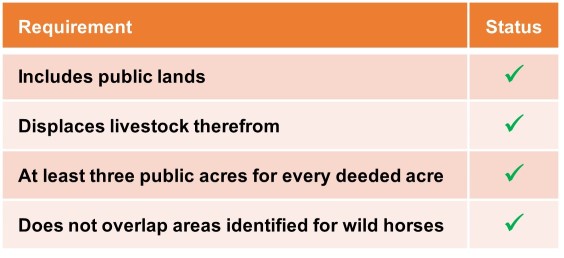
If a proposed facility doesn’t include public lands and doesn’t displace livestock therefrom, it’s not worthy of your support.

Muddy Creek Emergency Roundup Announced

The unplanned event will begin on or about June 24 due to lack of water.

The capture and removal goals are 40 each.

Horses will be drawn into the traps with bait.

Operations will not be open to public observation.

Captured animals will be taken to the Axtell off-range corrals.

A link to the gather page was not given.

The HMA covers 283,474 total acres, including 252,086 public acres, according to the 2025 population dataset.

The AML is 125.

The BLM news release did not give the status of livestock grazing in the overlapping allotments.

PZP Doesn’t Kill Wild Horses, It Kills Wild Herds

Those who sound the alarm about wild horses and burros are often among their worst enemies.

Take for example the Campaign Against America’s Wild Horses, a leader in humane disposal and faithful servant of the bureaucrats and ranchers.

Who’s the greater threat to wild horses, a President whose budget will be tempered by Congress or a nonprofit that’s wiping out herds with mass sterilization?

Is Stupidity a Problem in the Wild Horse World?

Do these people not understand that the Campaign Against America’s Wild Horses, a leader in nonmotorized removal and servant of the public-lands ranchers, is sterilizing the Virginia Range mares with PZP, a restricted-use pesticide that tricks the immune system into attacking their ovaries?

How stupid do you have to be to support an organization like that?

File under: Charlatans.

Errors in Adobe Town DNA?

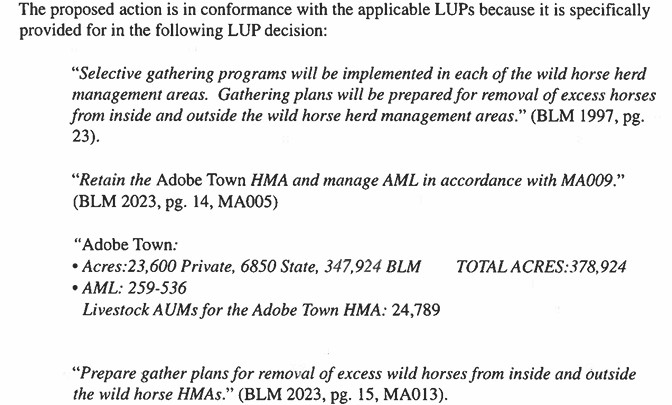
The DNA Worksheet refers to the 2023 Record of Decision and Approved Resource Management Plan Amendment for Wild Horse Management, the “Other Document” listed at the beginning of Section B.

The worksheet says “Retain the Adobe Town HMA and manage AML in accordance with MA009,” followed by a reference to item MA005 in the ROD.

But item MA005 in Table 1 of the ROD states “Retain the White Mountain HMA and manage AML in accordance with MA009.”

In the Rock Springs RMP Amendments, White Mountain was retained in whole but Adobe Town was retained in part.

The figures for acreage in the worksheet don’t match those of item MA009 in the ROD.

The 2025 population dataset gives the acreage as 347,924 BLM, 357,849 total.

The final statement about preparing gather plans matches item MA013 in the ROD.

The worksheet indicates 24,789 AUMs for livestock in the HMA, equivalent to 2,066 wild horses, meaning the AML could go as high as 2,602.

The current AML tells you the HMA is managed primarily for livestock.

The advocates generally don’t challenge forage allocations, arguing that they should be enforced with pesticides, not helicopters.

RELATED: Adobe Town DNA Approved.

Putting the Silver King Theory to the Test

The AML, currently 128, could go as high as 2,658 by removing livestock from the HMA.

Every AUM taken from the ranchers and given back to the horses would save taxpayers at least $150 per year, far offsetting the loss of $1.35 in grazing fees.

Twelve AUMs mean a horse can come out of holding and go back on the range, saving at least $1,800 per year.

Given today’s hay prices, the figure may be closer to $2,500 per year.

Rewilding 1,000 captive horses might save up to $2.5 million per year.

Ranchers would continue to operate on their base properties and/or rented pastures as they do during the off season.

Western Horse Watchers believes the new HMAP will do none of this.

Instead, it will protect the status quo and life will go on as it does today.

RELATED: WHE Still Doesn’t Get It.

Adobe Town DNA Approved

The Decision Record authorizes the Proposed Action, discussed in Section A of the DNA, which will remove 1,675 wild horses from the downsized HMA, achieving the low end of AML.

There are no plans to treat any of the mares with fertility control pesticides and return them to the range.

The DNA asserts that a 2021 EA fully covers the Proposed Action and constitutes BLM’s compliance with the requirements of NEPA.

A summary of comments was posted to the project folder.

RELATED: Adobe Town DNA Out for Public Review.

Bill Would Allow State to Move Wild Horses and Burros?

S.1942, the Malheur Community Empowerment for the Owyhee Act, would create a land health management program on federal lands in Malheur County, Oregon.

Among the provisions are greater operational flexibility in livestock grazing and the designation of 1.1 million acres as wilderness areas.

Grazing would be allowed on those lands if established before the Act becomes law.

The bill would create a C.E.O. Group consisting of ten voting members, three of whom represent grazing interests and one representing hunting or fishing interests.

Eight nonvoting members would sit on the committee.

The State would be authorized to use aircraft (including helicopters) in the wilderness areas to capture, transplant, monitor and provide water for wildlife populations, including bighorn sheep and feral stock, feral horses and feral burros.

The Hog Creek, Cold Springs, Three Fingers, Sand Springs, Sheepshead-Heath Creek, Coyote Lake-Alvord-Tule Springs and Jackies Butte HMAs are in Malheur County.

The bill was introduced on June 4 and referred to the Senate Committee on Energy and Natural Resources.

WHE Still Doesn’t Get It

HMAPs do not allocate resources.

They cannot change resource allocations.

They ratify/sanction/bless/condone/approve resource allocations already on the books.

“Changes to livestock grazing cannot be made through a wild horse gather decision.”

The RMP must be revised, which is beyond the scope of the project.

If livestock receive 19 AUMs for every AUM assigned to horses before the HMAP, they will receive 19 AUMs for every AUM assigned to horses after the HMAP.

The AML will remain small relative to the available resources and the HMA will be managed principally for livestock.

RELATED: Silver King HMAP Q&A.

Three Rivers Wild Burro Roundup Announced

The incident will begin today according to the BLM news release.

Three HMAs are affected.

The June 3 schedule gives capture and removal goals of 1,100 and 1,000 respectively.

Burros will be baited into the traps.

Operations will not be open to public observation.

Captured animals will be taken to off-range corrals in Utah and Arizona.

Up to 100 jennies will be treated with GonaCon Equine and returned to the range.

RELATED: Three Rivers Wild Burro Roundup Next Week?