If Wild Horses Had Principal Use of Gourd Spring

The allotment, on the east side of the Mormon Mountains HA in Nevada, offers 3,458 active AUMs on 57,700 public acres, according to the Allotment Master Report.

The forage assigned to horses is zero.

How many wild horses could live there?

Using the principle of forage interchangeability, the True AML would be 3,458 ÷ 12 = 288, the number of horses the land could support if it was managed principally for them as specified in the original statute.

The stocking rate would be 288 ÷ 57,700 × 1,000 = five wild horses per thousand public acres.

Why is this important?

The bureaucrats and ranchers claim that public lands in the western U.S. can only support one wild horse per thousand acres (27,000 animals on 27 million acres).

The advocates give their assent through their darting programs.

If the allotment was an HMA, the AML would be 58 and 230 horses would be consigned to off-range holding because of permitted grazing.

BLM allotments in the state carry livestock equivalent to 173,144 wild horses on 40,194,360 public acres, or 4.3 wild horses per thousand public acres.

RELATED: The Allotments Tell the Story: They’re Lying, All of Them.

Gourd Spring Allotment 06-18-24

Bordo Atravesado Roundup, Day 44

The incident started on May 1.  Results through June 14:

  • Scope: Bordo Atravesado HMA
  • Target: Horses
  • Type: Planned
  • Method: Bait
  • AML: 60
  • Estimated population: 276
  • Goals: Gather 235, remove 225
  • Captured: 234, no change from Day 41
  • Shipped: 178, up from 97 on Day 41
  • Released: 31, up from zero on Day 41
  • Deaths: 8, no change from Day 41
  • Average daily take: 5.3
  • Unaccounted-for animals: 17

The figures above are based on the daily reports.

No details were given for the horses released.

The death rate is 3.4%.

The capture total includes 115 stallions, 91 mares and 28 foals.

Youngsters represented 12.0% of the animals gathered, consistent with a herd growth rate of seven percent per year.

Of the adults, 55.8% were male and 44.2% were female.

Body condition scores were not given.

The location of the trap site is not known.

The destination of shipped animals was not stated.

The HMA is subject to permitted grazing.  Resources liberated to date:

  • Forage: 2,436 AUMs per year
  • Water: 2,030 gallons per day

Ten mares will be treated with GonaCon Equine, a fertility control pesticide, and be returned to the range according to the latest schedule.

The roundup supports three tenets of rangeland management.

RELATED: Bordo Atravesado Roundup, Day 41.

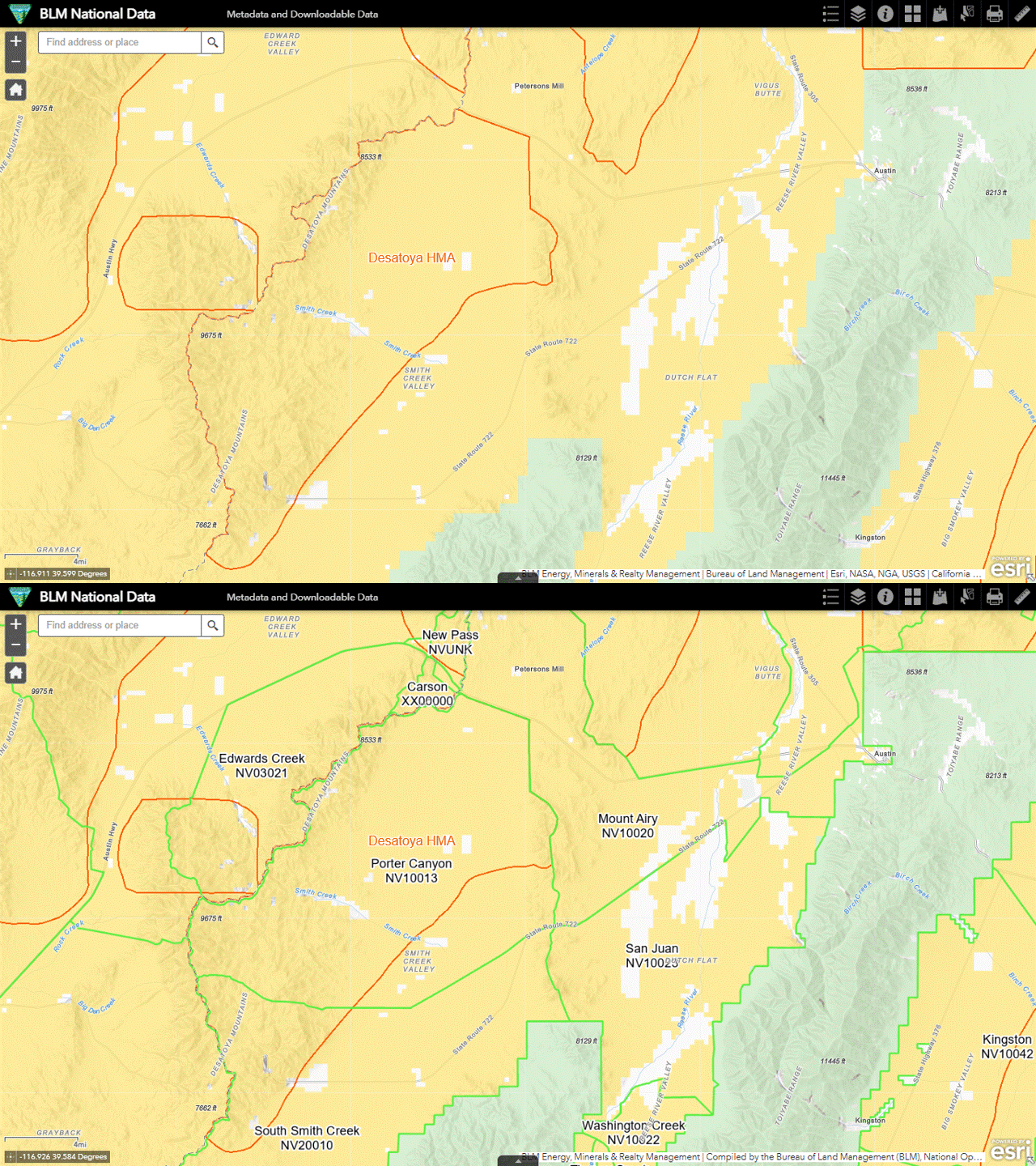
Bordo Atravesado HMA with Allotments 11-17-23

North Lander Roundup Pending

The FY24 regular season resumes on July 1, after a hiatus for foaling season, with a quadruple-HMA roundup in central Wyoming.

The areas of interest are Conant Creek, Dishpan Butte, Muskrat Basin and Rock Creek.

The current population is thought to be 3,035 wild horses, compared to an AML of 536.

The news release did not mention

  • The capture and removal goals (2,766 and 2,716 according to latest schedule)
  • The method of capture (helicopter)
  • If operations are open to public observation (probably)
  • If the HMAs are subject to permitted grazing (yes)

The announcement said the AML was scientifically determined, which is misleading.

Resource availability was scientifically determined, but apportionment was arbitrary.

We Want the Ranchers to Win 04-04-24

Horses identified for removal will be taken to the Wheatland off-range corrals.

Gather stats and daily reports will be posted to this page.

The incident supports three tenets of rangeland management.

RELATED: Coalition Starts Online Protest of North Lander Roundup.

North Lander Complex 06-04-24

Piute Mountain Roundup, Day 14

The incident started on May 31.  Results through June 13:

  • Scope: Piute Mountain HA
  • Target: Burros
  • Type: Emergency
  • Method: Bait
  • Goals: Gather 50, remove 50
  • Captured: 33, up from 20 on Day 8
  • Shipped: 33, up from 20 on Day 8
  • Released: None
  • Deaths: None
  • Average daily take: 2.4
  • Unaccounted-for animals: None

The figures above are based on the daily reports, which now include details for jacks, jennies and foals.

No activity was reported on Days 9, 10, 11 and 12.

The capture total includes 25 jacks, 8 jennies and no foals.

The HA has no AML and is subject to permitted grazing.  Resources liberated to date:

  • Forage: 198 AUMs per year
  • Water: 165 gallons per day

The roundup supports three tenets of rangeland management.

RELATED: Piute Mountain Roundup, Day 8.

Piute Mountain HA 06-04-24

Caliente Roundup, Day 61

The incident started on April 16.  Results through June 15:

  • Scope: Caliente Complex
  • Target: Horses
  • Type: Planned
  • Method: Bait
  • Goals: Gather 350, remove 350
  • Captured: 307, up from 302 on Day 55
  • Shipped: 296, up from 271 on Day 55
  • Released: None
  • Deaths: 9, no change from Day 55
  • Average daily take: 5.0
  • Unaccounted-for animals: 2

The figures above are based on the daily reports.

The only horse captured on Day 59 was a foal.  No details were given.

The death rate is 2.9%.

The capture total includes 129 stallions, 128 mares and 50 foals.

Youngsters represented 16.3% of the animals gathered, consistent with a herd growth rate of eleven percent per year.

Of the adults, 50.2% were male and 49.8% were female.

Body condition scores were not given.

The location of the trap site is not known.

The Complex is subject to permitted grazing.  Resources liberated to date:

  • Forage: 3,684 AUMs per year
  • Water: 3,070 gallons per day

There are no plans to treat any of the mares with fertility control pesticides and return them to the range.

The roundup supports three tenets of rangeland management.

RELATED: Caliente Roundup, Day 55.

Caliente Complex with Allotments 03-28-24

Foal-Free Friday, Breaking with the Past Edition

Initially, the advocates peddled the Montana Solution as a way to slow population growth and reduce the need for roundups.

That didn’t win the approval of the bureaucrats and ranchers.

Today, they sell it as mass sterilization, not by their words but by their deeds, hoping to convince the decision-makers that ovary-killing pesticides are a viable alternative to motorized removal.

They’ve always known that PZP is not reversible after five years of treatment and privately point to Assateague Island as an example of what can be achieved long term but conceal this truth from their unwitting donors.

With the Salt River and Virginia Range herds on the verge of collapse, the advocates may soon be in a position to spread the poison to other areas.

RELATED: Foal-Free Friday, Race to the Bottom Edition.

Pesticide Pushers 07-17-23

Scoping Begins for Pancake HMAP

A new project has been created in ePlanning and one document is available for review.

The Complex, located south of Eureka, NV, includes the Sand Springs West HMA, Pancake HMA, Jakes Wash HA and Monte Cristo WHT.

The comment period runs from June 13 to July 15 according to the news release.

The new HMAP will support three tenets of rangeland management.

RELATED: Pancake Ruling Helps Advocates, Not Wild Horses.

Pancake Complex Map 01-07-22

If Wild Horses Had Principal Use of Little Salt and Corcoran Wash

The allotments, on the north side of the Little Book Cliffs WHR in Colorado, offer 4,352 active AUMs on 40,713 public acres, according to the Allotment Master Report.

The forage assigned to horses is zero.

How many wild horses could live there?

Using the principle of forage interchangeability, the True AML would be 4,352 ÷ 12 = 363, the number of horses the land could support if it was managed principally for them as specified in the original statute.

The stocking rate would be 363 ÷ 40,713 × 1,000 = 8.9 wild horses per thousand public acres.

Why is this important?

The bureaucrats and ranchers claim that public lands in the western U.S. can only support one wild horse per thousand acres (27,000 animals on 27 million acres).

The advocates propagate the fairy tale with their darting programs.

If the allotments were an HMA, the AML would be 40 and 323 horses would be consigned to off-range holding because of permitted grazing.

BLM allotments in the state carry livestock equivalent to 49,546 wild horses on 7,448,367 public acres, or 6.7 wild horses per thousand public acres.

RELATED: The Allotments Tell the Story: They’re Lying, All of Them.

Little Salt and Corcoran Wash Allotments 06-13-24

Red Rock Mares Returned to HMA, Now Crime Scene

A public affairs specialist with the BLM told Western Horse Watchers yesterday that they received their second dose and were released to the range last week.

Your host replied to the email with a link to the 2017 labeling amendment that changed the interval between doses from 30 days to 90 days, seeking comment on the agency’s use of the pesticide.

As of this evening, no response has been received.

The first statement under Directions for Use: “It is a violation of Federal law to use this product in a manner inconsistent with its labeling.”

RELATED: Red Rock HMA to Become Next GonaCon Crime Scene?

Bordo Atravesado Roundup, Day 41

The incident started on May 1.  Results through June 10:

  • Scope: Bordo Atravesado HMA
  • Target: Horses
  • Type: Planned
  • Method: Bait
  • AML: 60
  • Estimated population: 276
  • Goals: Gather 235, remove 225
  • Captured: 234, up from 222 on Day 34
  • Shipped: 97, up from 63 on Day 34
  • Released: None
  • Deaths: 8, up from 7 on Day 34
  • Average daily take: 5.7
  • Unaccounted-for animals: 129

The figures above are based on the daily reports.

No activity was reported on Days 38, 39 and 40.

A horse died on Day 41 of injuries related to capture.  No details were given.

The death rate is 3.4%.

The capture total includes 115 stallions, 91 mares and 28 foals.

Youngsters represented 12.0% of the animals gathered, consistent with a herd growth rate of seven percent per year.

Of the adults, 55.8% were male and 44.2% were female.

Body condition scores were not given.

The location of the trap site is not known.

The destination of shipped animals was not stated.

The HMA is subject to permitted grazing.  Resources liberated to date:

  • Forage: 2,808 AUMs per year
  • Water: 2,340 gallons per day

Ten mares will be treated with GonaCon Equine, a fertility control pesticide, and be returned to the range according to the latest schedule.

The roundup supports three tenets of rangeland management.

RELATED: Bordo Atravesado Roundup, Day 34.

Bordo Atravesado HMA with Allotments 11-17-23

Caliente Roundup, Day 55

The incident started on April 16.  Results through June 9:

  • Scope: Caliente Complex
  • Target: Horses
  • Type: Planned
  • Method: Bait
  • Goals: Gather 350, remove 350
  • Captured: 302, up from 282 on Day 50
  • Shipped: 271, up from 270 on Day 50
  • Released: None
  • Deaths: 9, no change from Day 50
  • Average daily take: 5.5
  • Unaccounted-for animals: 22

The figures above are based on the daily reports.

No activity was reported between June 4 and June 8.

The death rate is 3.0%.

The capture total includes 125 stallions, 128 mares and 49 foals.

Youngsters represented 16.2% of the animals gathered, consistent with a herd growth rate of eleven percent per year.

Of the adults, 49.4% were male and 50.6% were female.

Body condition scores were not given.

The location of the trap site is not known.

The Complex is subject to permitted grazing.  Resources liberated to date:

  • Forage: 3,624 AUMs per year
  • Water: 3,020 gallons per day

There are no plans to treat any of the mares with fertility control pesticides and return them to the range.

The roundup supports three tenets of rangeland management.

RELATED: Caliente Roundup, Day 50.

Caliente Complex with Allotments 03-28-24

If Wild Horses Had Principal Use of Notch Butte

The allotment, on the south side of the Saylor Creek HMA in Idaho, offers 3,163 active AUMs on 27,951 public acres, according to the Allotment Master Report.

The forage assigned to horses is zero.

How many wild horses could live there?

Using the principle of forage interchangeability, the True AML would be 3,163 ÷ 12 = 264, the number of horses the land could support if it was managed principally for them as specified in the original statute.

The stocking rate would be 264 ÷ 27,951 × 1,000 = 9.4 wild horses per thousand public acres.

Why is this important?

The bureaucrats and ranchers claim that public lands in the western U.S. can only support one wild horse per thousand acres (27,000 animals on 27 million acres).

The advocates bolster the narrative with their darting programs.

If the allotment was an HMA, the AML would be 28 and 264 – 28 = 236 horses would be consigned to off-range holding because of permitted grazing.

The stocking rate allowed by plan for Saylor Creek is 0.5 wild horses per thousand public acres, yet the Twin Butte Allotment, just over the line from Notch Butte, supports livestock equivalent to 9.8 wild horses per thousand public acres!

BLM allotments in the state carry livestock equivalent to 110,141 wild horses on 11,003,206 public acres, or ten wild horses per thousand public acres.

RELATED: The Allotments Tell the Story: They’re Lying, All of Them.

Notch Butte Allotment 06-10-24

LRTC Rescue Team Learns About Crime Scene Response

Yesterday, deputies with the Lyon County Sheriff’s Office trained volunteers with Least Resistance Training Concepts on best practices when responding to incidents involving a dead or wounded person or animal, as outlined in a report by KTVN News.

Exercises included a cut fence where horses had been stolen and a party scene where a wild mustang was shot.

The story did not indicate if the session covered unlawful use of pesticides by the wild horse advocates, such as application of PZP to herds that interfere with animal agriculture, pose safety hazards to motorists or are said to be overpopulated.

If Wild Horses Had Principal Use of Mystery Allotment in Nevada

The True AML would be 300,000 ÷ 12 = 25,000, the number of horses the land could support if it was managed principally for them as specified in the original statute.

That’s roughly 40% of the horses in off-range holding.

Sadly, the allotment exists only in the mind of a public affairs officer with the BLM.

RELASTED: Largest Grazing Allotment in Nevada Revealed.

Coalition Starts Online Protest of North Lander Roundup

Refer to this news release on EIN.

Your host has not tested the link and is not familiar with the sponsoring groups.

“Large industries and special interest groups that use public lands for oil, gas and mineral extraction and livestock grazing support the removal of wild equine.”

Western Horse Watchers would like to see a position statement from a trade group representing drillers or miners demanding the removal of wild horses from public lands in the western U.S.  Put the link in the comments.

RELATED; Group Calls for Cancellation of North Lander Roundup.

PSA_177-1

Scoping Begins for Rock Springs Wild Horse Removal

Despite ongoing legal challenges, the BLM announced today the beginning of a plan to remove nearly 5,000 wild horses over a three-year period from the Divide Basin, Salt Wells Creek and Adobe Town HMAs in southern Wyoming.

Divide Basin and Salt Wells Creek will be zeroed out, reducing the number of HMAs from 177 to 175, and Adobe Town will be trimmed back, as illustrated in the map.

The scoping letter was placed in the project folder along with a press release.

Comments will be accepted through July 8.

RELATED: Rock Springs RMP Amendments Cleared for Implementation.

Piute Mountain Roundup, Day 8

The incident started on May 31.  Results through June 7:

  • Scope: Piute Mountain HA
  • Target: Burros
  • Type: Emergency
  • Method: Bait
  • Goals: Gather 50, remove 50
  • Captured: 20, up from 5 on Day 1
  • Shipped: 20, up from 5 on Day 1
  • Released: None
  • Deaths: None
  • Average daily take: 2.5
  • Unaccounted-for animals: None

The figures above are based on the daily reports, which do not include customary details for jacks, jennies and foals.

No activity was reported between May 31 and June 6.

The HA is not managed for wild burros but is subject to permitted grazing.

  • Forage liberated to date: 120 AUMs per year
  • Water liberated to date: 100 gallons per day

The roundup supports three tenets of rangeland management.

RELATED: Piute Mountain Emergency Roundup in Progress.

Piute Mountain HA 06-04-24