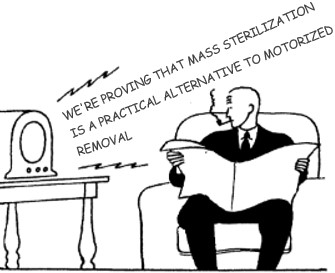
When will the advocates explain how mass sterilization, the inevitable result of humane population reduction, stops competition from livestock, fixes unfair resource allocations and restores lost habitat?
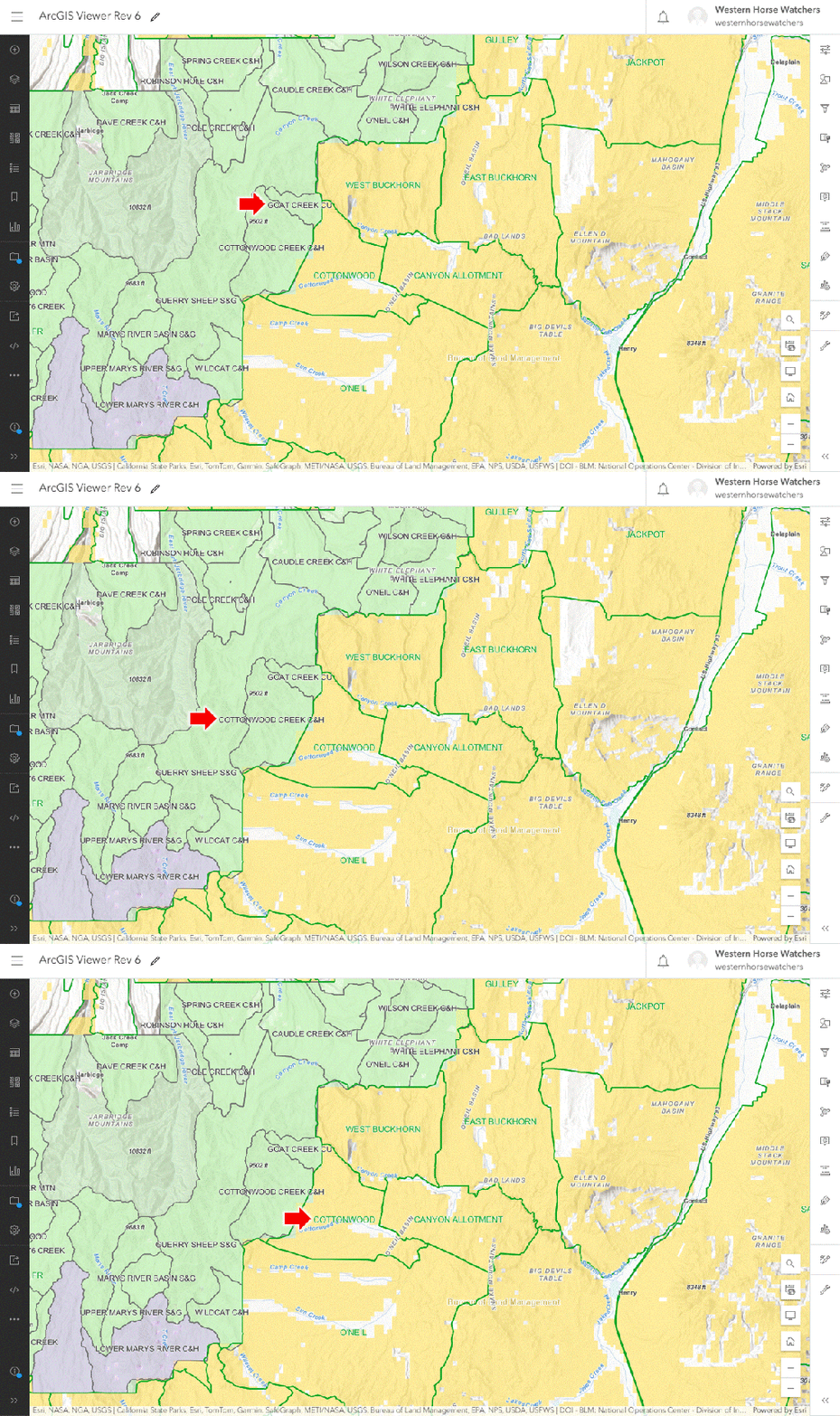
The permittee receives 2,144 active AUMs on 16,689 public acres, equivalent to 179 wild horses, or 10.7 wild horses per thousand public acres, roughly the same stocking rate as the Virginia Range.
Your faithful public servants claim that public lands in the western U.S. can only support one wild horse per thousand acres (25,500 animals on 25.6 million acres).
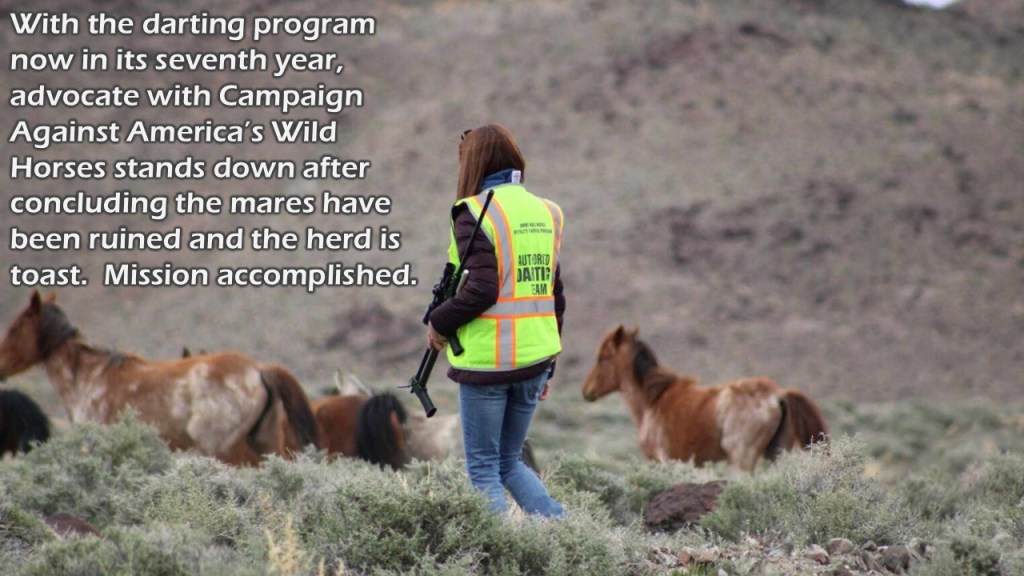
The advocates, defeated a long time ago, give their assent through their darting programs.
If the allotment was an HMA, the AML would be 17 and 162 wild horses would be consigned to off-range holding because of permitted grazing.
Wild horses can be placed on public lands not identified for their use by acquiring base properties associated with grazing allotments and flipping the preference to horses.
The award pertains to virtual fencing on the BLM allotment. Use of the technology on Forest Service lands was not disclosed.
The aim of the grazing program is to ensure that high net worth individuals receive generous government benefits, often at the expense of America’s wild horses, with no means testing and no expiration date.
The aim of the project is to improve riparian habitat while continuing to provide water to free-roaming horses, wildlife and livestock.
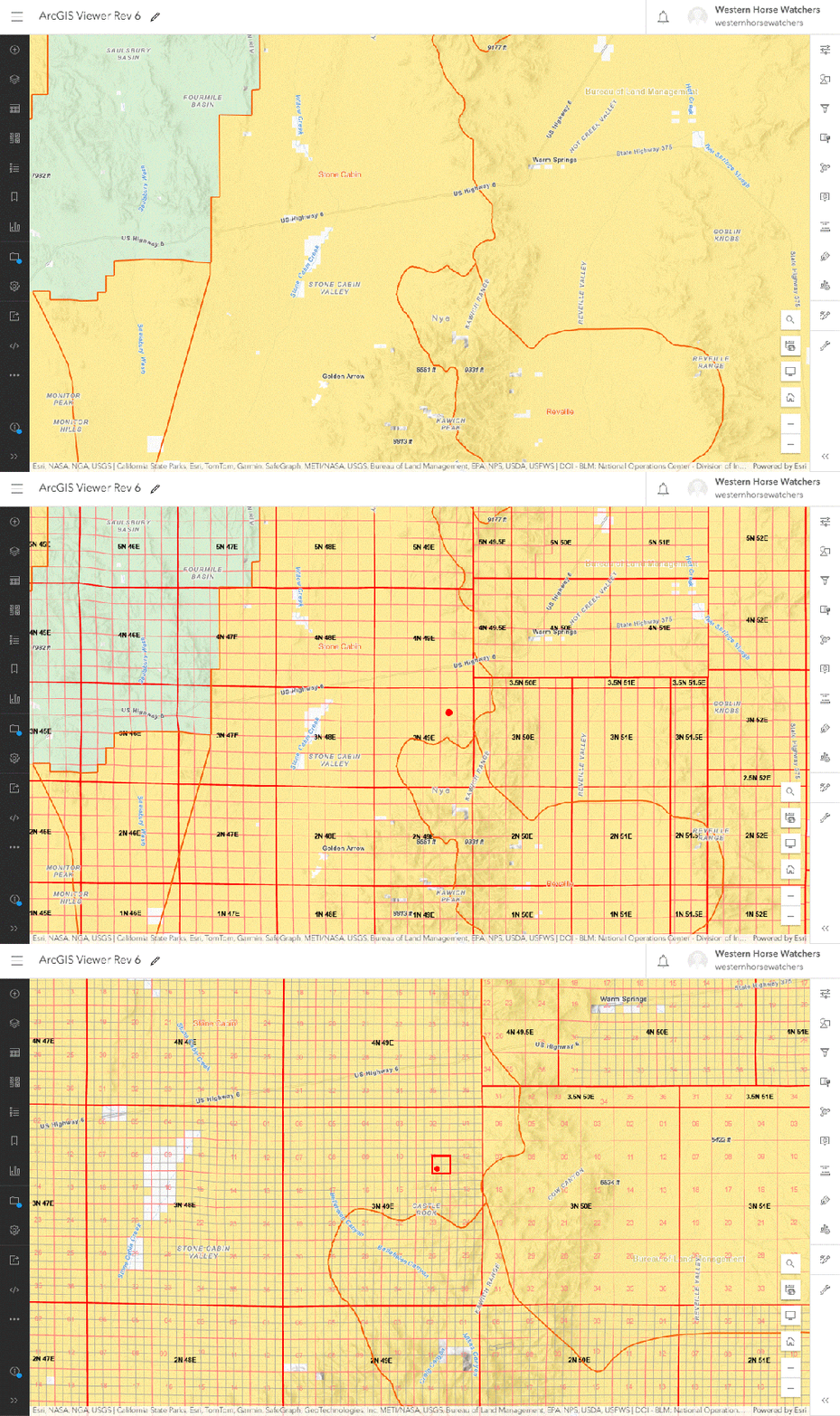
Map 1 in the preliminary decision gives you the location but doesn’t tell you the HMA.
The last page gives the legal description as T. 3 N., R. 49 E., sec. 11, SW1/4SE1/4.
That means the southwest quarter of the southeast quadrant of Section 11 in Township 3 North, Range 49 East (Mount Diablo base and meridian). Probably a 40-acre parcel.
The Proposed Action, discussed in the CX, would install 730 feet of metal fence around the spring, two gates, up to 360 feet of buried water lines, one in-ground tank equipped with a thermoriser and one tire trough located outside the exclosure.
She was captured and taken to an equine hospital where most of the projectile was removed but another surgery is needed to retrieve the head according to a report by KTLA News.
A local sanctuary has offered a reward of $14,000 for information leading to an arrest and conviction of the person(s) responsible.
Curiously, there would be no charges if the advocates were hitting the jennies with pesticide-laced darts.
When will the advocates explain how mass sterilization, the inevitable result of humane population reduction, preserves wild horses for future generations?
When will they stop lying about the reversibility of PZP?
The Forest Service copied the following documents to the project folder on August 29:
Final environmental assessment
Final territory management plan
Draft decision notice
Scroll down to the Project Summary, expand the Project Documents section and click on the AdminReview folder.
Only those who participated in the planning process are eligible to object.
The DN would authorize Alternative 2, the Proposed Action, discussed on page 18 of the EA (page 24 in the pdf) and beyond.
Horses currently occupy an area much larger than the 19,700-acre WHT so initial management actions will be directed at achieving AML within the designated space.
Active AUMs and acreages of surrounding allotments should be reviewed to determine if the proposed AML (104) and stocking rate (5.3 wild horses per thousand acres) are reasonable.
Surgical sterilization was dropped from the analysis.
Chemical sterilization, via PZP and GonaCon, is on the table.
Expanding the territory, increasing the AML and reducing livestock grazing didn’t make the cut.
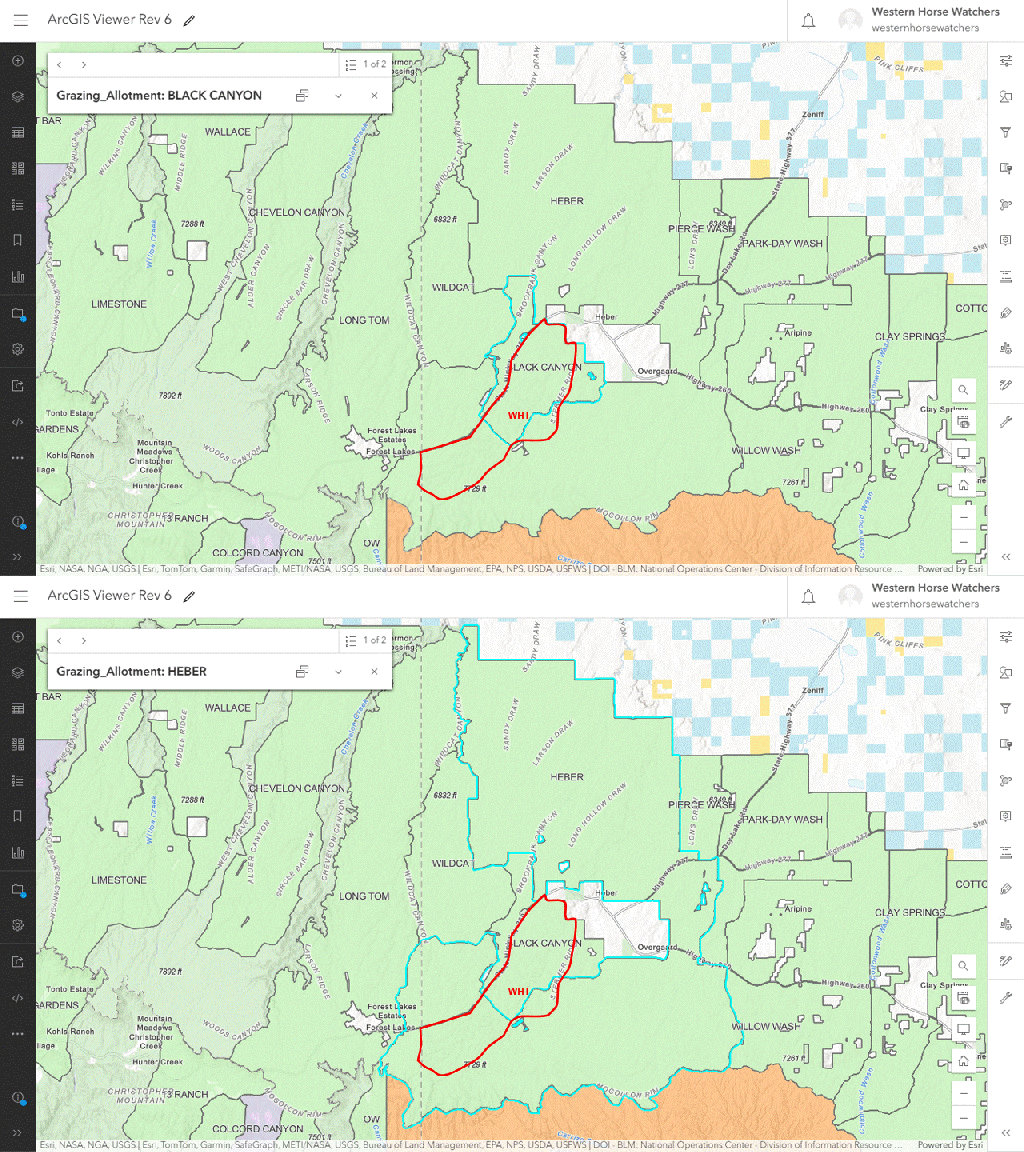
The WHT lies within the Heber and Black Canyon Allotments. Figure 6 in the EA shows the overlapping pastures.
The Forest Service has added deaths to the daily reports.
Shipping data are not provided.
Deceased animals are not included in the daily breakdowns. For example, two horses were put down for unspecified conditions on September 3 but you don’t know if they were stallions, mares or foals.
The daily totals should match the daily breakdowns.
The documented capture total is 68, including 28 stallions, 34 mares and six foals.
Youngsters represented 8.8% of the sample.
Of the adults, 45.2% were male and 54.8% were female.
The average daily take is 6.8.
The death rate, based on a capture total of 72, is 6.9%.
It is the only option calling for a nonreproducing segment in the population, to be achieved by “minimally invasive sterilization” of mares and stallions.
Other features of the plan include:
Forcible removal of excess animals to low AML
Application of fertility control pesticides
Alteration of sex ratios to favor males
Development of a new a new water source
Monitoring of genetic diversity
Commenting in support of the plan was Return to Normal (Before WHB Act). Refer to item 2 in Appendix XVII of the EA.
The project is subject to a 30-day appeal period but that was not mentioned in the news release.
Despite a July 15 appeals court ruling, the agency plans to proceed with permanent removal of wild horses from the Salt Wells Creek and Adobe Town Herd Areas, starting on or about October 13, according to a report by WyoFile.
Referring to them as herd areas, a sign of bureaucratic arrogance, implies validity of the RMP amendments.