They sent delegates to the FREES Conference.

Or they lobby for on-range management, referred to on these pages as poisoning the mares with ovary-killing pesticides.


Western Horse Watchers Association
Exposing the Hypocrisy, Lies and Incompetence of the Wild Horse Advocates
Opinion
They sent delegates to the FREES Conference.
Or they lobby for on-range management, referred to on these pages as poisoning the mares with ovary-killing pesticides.
Nevada State Senator Hansen said the BLM was not in bed with the livestock industry at the September 7 “Dust Up in the Desert” but have you ever heard the advocates deny it?
The agency refers to them as partner organizations.
They claim to be voices for the horses while aiding and abetting their removal.
Who benefits from that?
The advocates need donors to sustain their work.
If you’re a hunter, rancher or supporter thereof, little if any convincing is needed.

You might even be tempted to support the legacy contractors but they’re for-profit companies.
What if you actually care about the horses?
If you understand their true intentions and loyalties, you won’t give them a penny.
If you’re new to the wild horse world, you can be propagandized with flowery terms such as cherished/beloved/innocent wild horses, safe/proven/reversible fertility control and humane management.
You become a useful idiot, a person advocating for a cause, usually with devious or ruthless origins, without understanding its means and ends, allowing yourself to be cynically used by its leaders.
Think about that next time you’re counting the Views and Likes on socialist media.
RELATED: Foal-Free Friday, Safer in Town than on the Range Edition.

Progress in wild horse management is never determined from the horses’ viewpoint, only the special interests who benefit therefrom.
To understand the column about Colorado’s HMAs published today by The Colorado Sun, key terms should be explained. Meanings can be validated not by what the writer says but by what his organization does.
Herd Management Areas – A continually shrinking subset of the original Herd Areas, managed primarily for livestock with few exceptions, two cited in the article.
Herd Areas – The lawful homes of wild horses and burros, identified in 1971 when the WHB Act was signed into law.
Sustain Wild Horses – Control the pests.
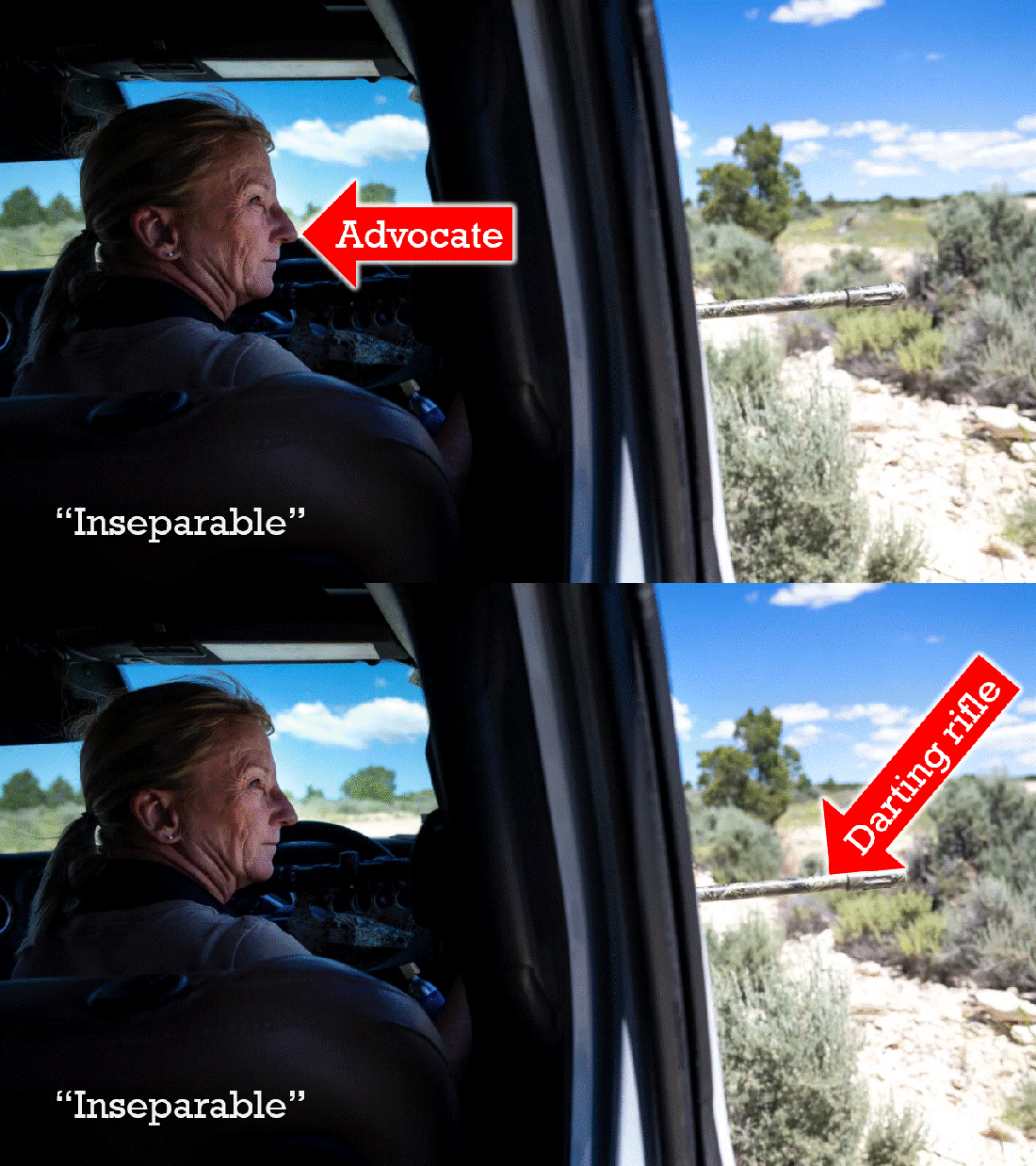
Fertility Control Darting – Beating wild horse populations down with ovary-killing pesticides, usually Zonastat-H or GonaCon Equine, so livestock can access most of their food and water.
Appropriate Management Level – The number of horses allowed by plan, not the number of horses the land can support, usually small relative to the available resources.
Carrying Capacity – The number of wild horses the land can support if it was managed principally for them, referred to on these pages as the True AML.
Healthy Horses on Healthy Rangelands – Appropriate management levels achieved, ranchers enjoying more of what their allotments have to offer.
Partner Organizations – Groups that claim to be voices for the horses while aiding and abetting their removal, referred to on these pages as charlatans.
The author noted that the Sand Wash roundup was called off because of winterkill.
He stated that livestock grazing in Sand Wash Basin and Piceance East Douglas accounts for 14% and 20% of forage use, respectively, while your host has determined that livestock in Sand Wash Basin receive 3.9 times more forage than the horses and those in Piceance East Douglas receive 2.4 times more forage than the horses.
RELATED: What Is a Curated Horse Exhibit?

The BLM reported 31 deaths during the 2022 roundup, but a Freedom of Information request revealed that 69 additional animals died at government holding facilities during and after the roundup.
Fourteen of the deaths were very young foals.
Government records suggested they were foundering due to being run too far during the gather.
One report attributed a death to the stress of being run long distances in rough terrain and in high temperatures.
“It was heartbreaking.”
Who published the findings?
The Campaign Against America’s Wild Horses.
They hate foals! They’re trying to get rid of as many as possible on the Virginia Range.
They tell you these things because they’re trying to separate you from your money.
Don’t fall for it. They are a voice for the bureaucrats and ranchers, not wild horses.
Helicopter roundups are the fastest and most effective way to shift resources from wild horses to the public-lands ranchers.
The optics aren’t great, especially when injuries are caught on film, but at least they are seen and understood by the public.
Have you ever seen video of horses being shot in the head by wranglers because of blindness, swayback or club feet?
It happens at most roundups but is concealed from the public, even the observers who are stationed a mile or more from the trap site.
The advocates have a better way.
Don’t even let them be born.

Snuff out new life and let the herds die off.
Let the ranchers have all of their food and water.
Put the legacy contractors out of business.
Replace motorized removals with removal by pesticides.
The public won’t notice, won’t even care, and that’s a problem.
They’re taking wild horse removals out of the spotlight.
We need to keep the pressure up, keep the bureaucrats and politicians on the hot seat.
That’s what Velma did.
Pay no attention to the advocates. They’re protecting the ranchers, not the horses.
RELATED: What You Won’t Hear at Wild Horse Lobby Day.
If the delegation is led by pesticide pushers and ranching sympathizers, the predominant constituency in wild horse advocacy, there will be no requests to
Instead, you’ll hear complaints about
The advocates will call for an end to the roundups but not the removals, pushing instead for innocuous methods that achieve the same results as helicopters.
RELATED: Wild Horse Lobby Day Set for Next Week.
The Campaign Against America’s Wild Horses indicated in the September update that 89 mares received 89 doses of Zonastat-H during the month, 26 given as a primer and 63 as a booster. If you can’t access the document, click here.
Over the life of the program, 1,949 mares have received 8,116 doses of the pesticide.
The report will be submitted to the Nevada Department of Agriculture.
Of the 163 foals born this year in the primary target zone, 80 have died.
The causes of death were not discussed but predation is likely a factor.
As for the long-term population goal and how many horses they intend to eradicate, the advocates are silent.
No comments about herd demographics.
No discussion of sterility and the growing risk thereof.
The current population is thought to be 3,513 with 356 listed as missing, compared to 3,559 in August, including 395 listed as missing.
A goal for October is to maximize booster treatments, allowing for continued population reduction, equivalent to bait trap removal or helicopter roundups.
RELATED: Virginia Range Darting Update for August 2023.
Sponsored by the Save Our Wild Horses Coalition, participants will have an opportunity meet with lawmakers and urge them to support legislation that protects wild horses and burros.
Sounds great.
But terms in the news release such as humane treatment, living treasures and magnificent animals should raise suspicions.
If the announcement referred to cherished/beloved/innocent wild horses, you could be sure their goal has little to do with protection and much to do with permitted grazing, to be achieved with fertility control programs, not helicopter roundups.
The Bureau of Land Management and U.S. Forest Service selected two new members and re-appointed a third, according to a news release dated September 29.
The two new members represent wildlife and livestock management organizations.
The Board advises both agencies on the management and protection of wild horses and burros on public lands.
With two of the nine seats occupied by permittees, you now have the equivalent of two Palestinian advisors setting policy direction toward Israel.
RELATED: WHBAB Nomination Update.
Who claimed on National Public Lands Day that the federal government is determined to shrink wild horse and burro populations even further while giving most of their land to commercial livestock, as it collaborates with the bureaucrats and ranchers to wipe out the herd at Cedar Mountain?

Who’s working with ranching sympathizers at NDA to ruin the Virginia Range herd?
It’s the Campaign Against America’s Wild Horses, a leader in nonmotorized removal!
If you’re a politician or bureaucrat, which statement will garner more public support?
1. Achieving and maintaining AMLs will protect rangeland health.
2. Ranchers shall receive at least 80% of the forage in areas set aside for wild horses.
The first statement will likely fool more voters, while statement #2 is the truth.
RELATED: Choosing Your Words Carefully.

A column posted this morning by The Daily Sentinel of Grand Junction, CO, a paper known for its anti-horse bias, claims a new era has dawned in wild horse management.
The term is always a euphemism for beating the populations down with helicopters and pesticides, even if it’s prefixed with “Humane,” so ranchers can access most of their food and water.
You thought things would be different at the state level?
The Wild Horse Working Group is sponsored by the Department of Agriculture, whose mission is to strengthen and advance Colorado agriculture!
A preliminary assessment might start with these questions:
If the sponsors were truly interested in helping the horses, these questions would have nonzero answers. They don’t.
RELATED: Colorado Wild Horse Project Helps Ranchers, Not Horses.
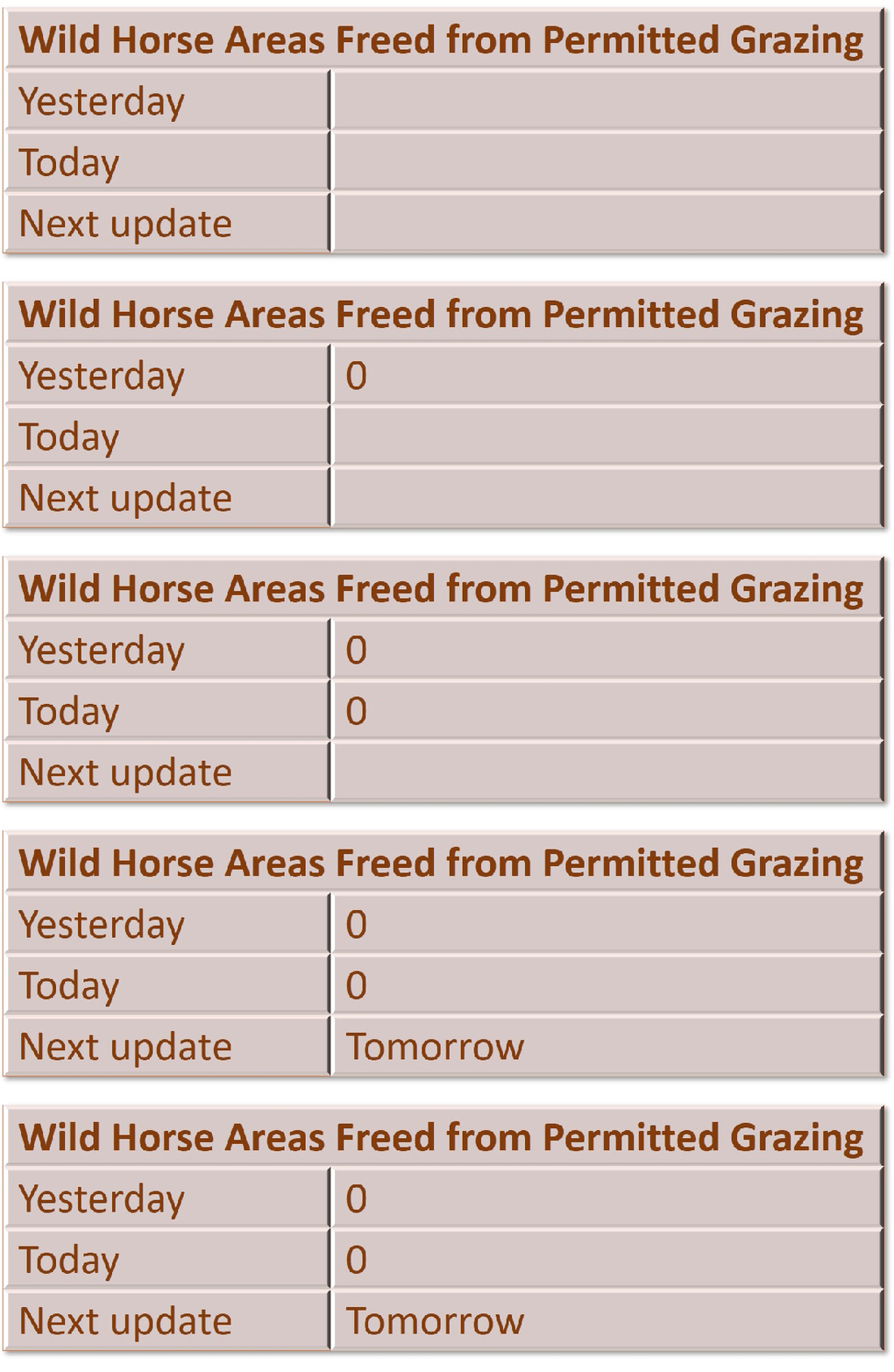
Consider these two groups. All were planned, all were carried out by helicopters.
Group 1
Group 2
The first group saw the advocates howling, videos of injured horses, ad hoc lawsuits and news reports about contractor mistreatment.
In the second group, the advocates were silent, with little if any media attention.
Why the difference?
Roundups in the second group were billed as catch-treat-release.
The advocates have their favorite poisons.
Some like Zonastat, others like Gonacon, but all agree that wild horses should be removed from their lawful homes with ovary-killing pesticides, not motorized equipment, even if motorized equipment is needed to apply the poisons!
RELATED: Bold Prediction for Fertility Control Solicitation.
Obsessed with pesticides? Ranching sympathizer? Wanna be like the Campaign Against America’s Wild Horses, Piceance Mustangs and High Desert Strategies?
Then you need to apply for a grant and the September 28 webinar will show you how.
Registration is required.
RELATED: BLM Awards $1 Million for Wild Horse Protection?
The advocates can’t be trusted with anything, especially your financial support.

Make all footage available to the public.

The proposed supplementary rule, which addresses public conduct, safety concerns involving exploding targets, flammable devices and target shooting, the possession or use of alcohol and the burning of wood pallets, among other things, would apply to all public lands in Wyoming, according to a notice appearing today in the Federal Register.
The last two provisions involve wild horses. Accordingly,
15. You must not intentionally engage in any activity within any distance that disturbs, displaces, or otherwise interferes with the free unimpeded movement of wild horses.
16. You must not feed, water, or touch any wild horse.
Would #15 include the filming wild herds with drones, chasing them with manned aerial equipment or poisoning the mares with pesticide-laced darts?
The rule would not apply to federal, state, local and military employees or contractors acting within the scope of their official duties.
Only you.
Comments will be accepted through November 13.
Was it truly a presentation of opposing viewpoints or simply a dispute about fine points between two factions of the same coalition?
Three reports have hit the wires in the last 24 hours:
Hansen wants the horses removed with helicopters and Beckstead wants them removed with ovary-killing pesticides.
Are wild horses overpopulated in Nevada? Yes, there are more animals than allowed by plan.
Are there more horses than the land can support? No, most of the resources in their lawful homes have been assigned to privately owned livestock. If you confine the ranchers to their (multi-million dollar) base properties in a year-round off season, and expect them to pay the going rate to feed their animals, there would be plenty of food and water for the horses.
As of this morning, video of the debate has not been posted to the AWA YouTube channel.
RELATED: Dust-Up in the Desert Set for September 7.

The Campaign Against America’s Wild Horses, a leader in nonmotorized removal, said in the August update that 116 mares received 116 doses of PZP during the month, 27 given as a primer and 89 as a booster. If you can’t access the document, click here.
Over the life of the program, 1,940 mares have received 8,027 doses of the pesticide.
The report will be submitted to the Nevada Department of Agriculture.
If it was written by a stockgrower’s association, farm bureau or cattlemen’s group, there’d be few if any changes.
Of the 158 foals born this year in the primary target zone, a record low, 74 have died.
The causes of death were not discussed but predation is likely a factor.
As usual, the advocates are silent about the long-term population goal and how many horses they intend to eradicate, as well as herd demographics. What does the sex ratio look like nowadays?
There is no mention of sterility and the growing risk thereof.
The current population is thought to be 3,559, including 395 listed as missing.
RELATED: CAAWH Publishes Virginia Range Darting Resources.
The Campaign Against America’s Wild Horses, a leader in nonmotorized removal, said in a news flash posted by Lucky Three Ranch that the Cedar Mountain mustangs will never have to face the helicopters again, thanks to a new BLM grant.
This will be accomplished by turning the HMA into an HTA, a place where the mares are gradually poisoned with PZP, a restricted-use pesticide.
The project brings together diverse stakeholders, according to the announcement, including the Utah BLM, one of the permittees and CAAWH.
Except there’s no diversity in that group—it’s the Love Triangle!
With shared goals of humanely managing the Cedar Mountain horses, stewarding their habitat and eventually eliminating helicopter roundups, it’s “a model for collaboration in the wild horse conservation space.”
RELATED: Foal-Free Friday, Removal by Pesticides Edition.
As envisioned by the Campaign Against America’s Wild Horses, it’s a place where
Forget about HMAs and managing principally for wild horses, those ideas are as old and irrelevant as the Ten Commandments.
RELATED: If You Repeat a Lie Long Enough, People Will Believe It.

