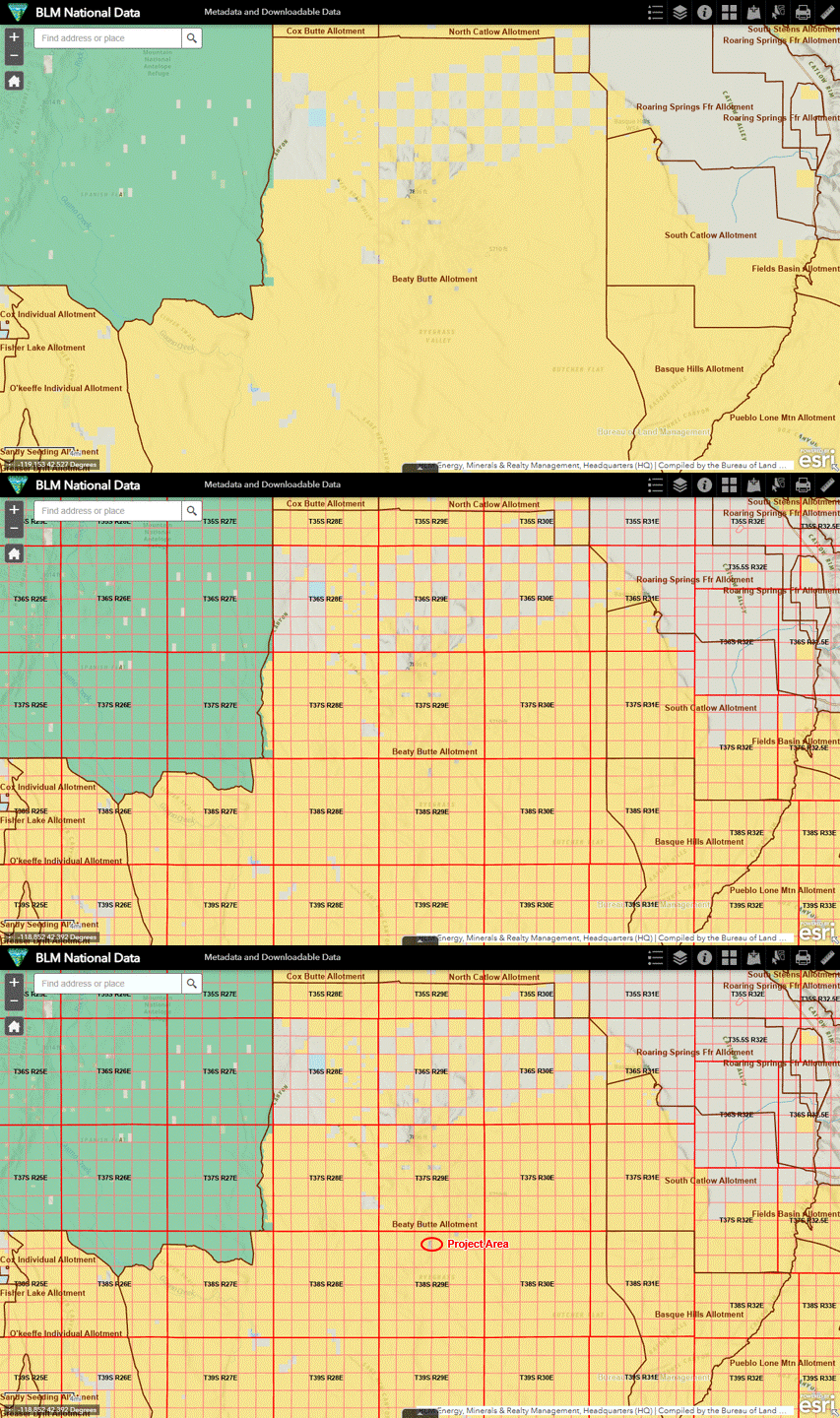
New Pest Control Plan for Bullfrog HMA?

A new project has been started in ePlanning but the document folder is empty.

The scoping period will begin on September 20.

The description indicates the Proposed Action will authorize the removal of wild burros from in and around the HMA over a ten-year period, reduce the population growth rate and address public safety concerns in the town of Beatty, NV.

Management actions will be captured in a new HMAP.

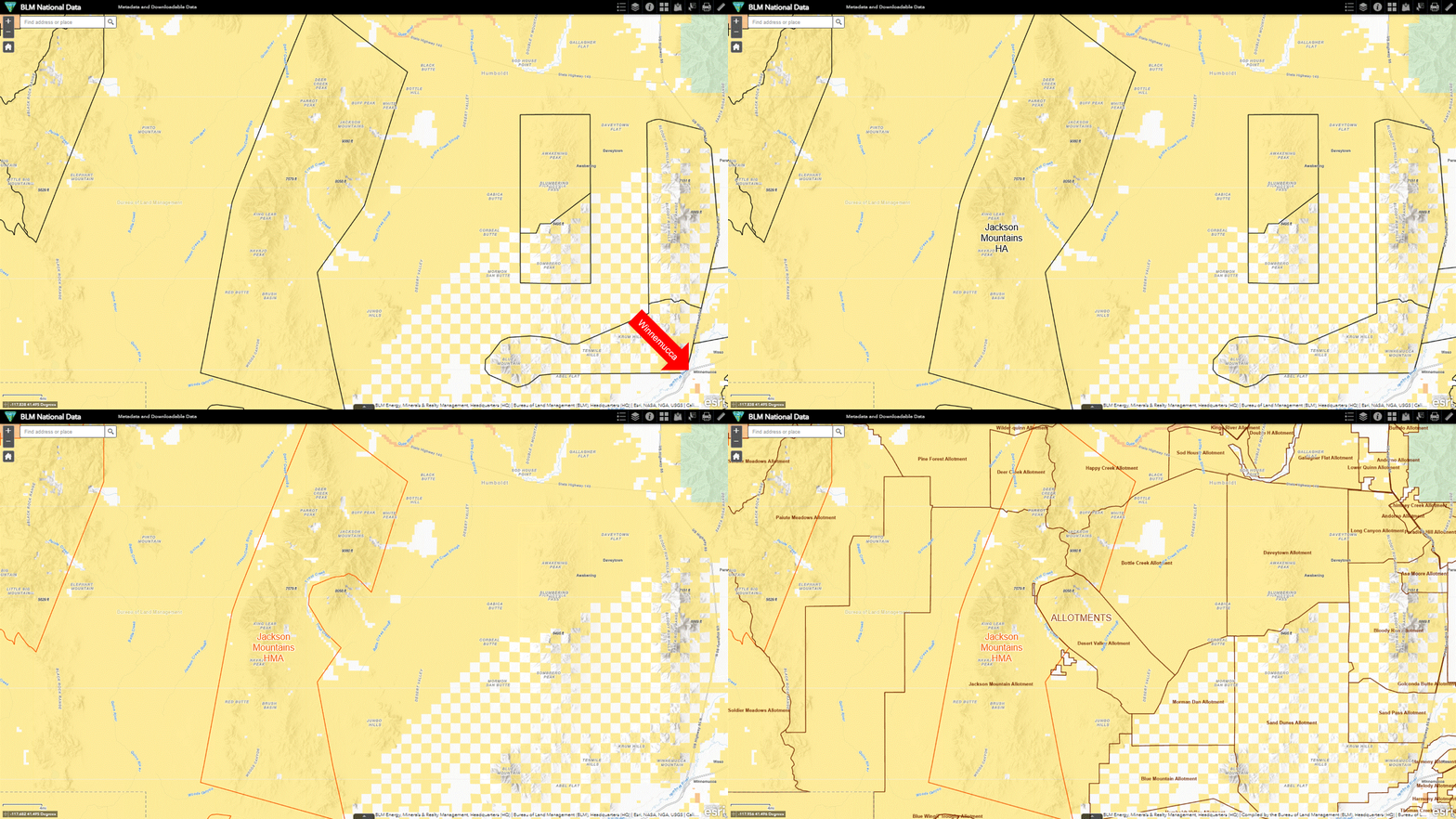
The National Data Viewer shows one overlapping allotment but does not indicate if pastures inside the HMA are in use.

The Allotment Master Report shows 1,926 active AUMs on 269,764 public acres with one permittee, the Nature Conservancy of Southern Nevada.

A September 12 story by the Pahrump Valley Times said the Town Advisory Board voted to send a letter to the BLM seeking removal of some of the animals.

Bullfrog HMA with Allotments 09-17-24

Advocates to Fleece West Coast Liberals at Wild Horse Gala?

The Campaign Against America’s Wild Horses, a leader in nonmotorized removal and stalwart opponent of principal use, will host the event on September 19 at the Buffalo Club in Santa Monica.

Tickets start at $250.

Didn’t get an invitation?

PZP isn’t cheap and your pathetic donations won’t even get you a Christmas card.

RELATED: If You Want to Help the Ranchers Give Money to the Advocates.

Pesticide Pushers 07-17-23

If Wild Horses Had Principal Use of Deeth and Pole Creek

The permits on these allotments, located in northeastern Nevada, are up for renewal.

Together, they offer 21,055 active AUMs on 130,698 public acres, according to the Allotment Master Report.

The AMLs are zero.  The nearest HA is Spruce-Pequop.

How many wild horses could the allotments support?

Using the principle of forage interchangeability, the True AML would be 21,055 ÷ 12 = 1,755, the number of horses the land could support if it was managed principally for them as specified in the original statute.

The stocking rate would be 1,755 ÷ 130,698 × 1,000 = 13.4 wild horses per thousand public acres.

Why is this important?

The bureaucrats and ranchers claim that public lands in the western U.S. can only support one wild horse per thousand acres (27,000 animals on 27 million acres).

The advocates, defeated a long time ago, bolster the narrative with their darting programs.

If the allotments were an HMA, the AML would be 130 and 1,625 horses would be consigned to off-range holding because of permitted grazing.

BLM allotments in Nevada carry livestock equivalent to 173,144 wild horses on 40,194,360 public acres, or 4.3 wild horses per thousand public acres.

Wild horses can be placed on public lands not identified for their use by acquiring base properties associated with grazing allotments and flipping the preference to horses, as American Prairie did for bison in Montana.

RELATED: The Allotments Tell the Story: They’re Lying, All of Them.

Deeth and Pole Creek Allotments 09-16-24

Little Book Cliffs Roundup, Day 5

The incident started on September 11.  Results through September 15:

  • Scope: Little Book Cliffs HMA
  • Target: Horses
  • AML: 150
  • Pre-gather population: Unknown (not stated in news release)
  • True AML: N/A (no livestock grazing)
  • Type: Planned
  • Method: Helicopter
  • Goals: Gather 130, remove 100
  • Captured: 116, up from 26 on Day 3
  • Shipped: 38, up from zero on Day 3
  • Released: None
  • Deaths: None
  • Average daily take: 23.2
  • Unaccounted-for animals: 78

The figures above are based on the daily reports.

The capture total includes 31 stallions, 66 mares and 19 foals.

Youngsters represented 16.4% of the animals gathered, consistent with a herd growth rate of 11% per year.

Of the adults, 32.0% were male and 68.0% were female, outside the range of variation expected from a random process centered at 50% males / 50% females.

Body condition scores were not given.

The location of the trap site is not known.

Up to 20 mares will be treated with fertility control pesticides and be returned to the HMA with up to ten stallions.

The Draft EA for management actions in the HMA indicated on page 6 that the herd consisted of 203 horses, including 22 foals, as of September 2023.  Of the 181 adults, 33% were male and 67% were female.

The Final EA states on page 6 that the population in July 2024 was 222, including 29 foals, and that the 193 adults consisted of 42% males and 58% females.

RELATED: Little Book Cliffs Roundup, Day 3.

Little Book Cliffs WHR with Allotments 04-28-24

Little Book Cliffs Roundup, Day 3

The incident started on September 11.  Results through September 13:

  • Scope: Little Book Cliffs HMA
  • Target: Horses
  • AML: 150
  • Pre-gather population: Unknown (not stated in news release)
  • True AML: N/A (no livestock grazing)
  • Type: Planned
  • Method: Helicopter
  • Goals: Gather 130, remove 100
  • Captured: 26, up from 10 on Day 1
  • Shipped: None
  • Released: None
  • Deaths: None
  • Average daily take: 8.7
  • Unaccounted-for animals: 26

The figures above are based on the daily reports.

The capture total includes 7 stallions, 15 mares and 4 foals.

Youngsters represented 15.4% of the animals gathered.

Of the adults, 31.8% were male and 68.2% were female.

Body condition scores were not given.

The location of the trap site is not known.

Up to 20 mares will be treated with fertility control pesticides and be returned to the range with up to ten stallions.

The Draft EA for management actions in the HMA indicated on page 6 that the herd consisted of 203 horses, including 22 foals, as of September 2023.  Of the 181 adults, 33% were male and 67% were female.

The Final EA states on page 6 that the population in July 2024 was 222, including 29 foals, and that the 193 adults consisted of 42% males and 58% females.

Abnormal sex ratios are a long-term consequence of PZP darting programs, in addition to female sterilization, conditions that the advocates gloss over with euphemisms such as “mares living longer” and “self-boosting mares.”

RELATED: Little Book Cliffs Roundup in Progress.

Little Book Cliffs WHR with Allotments 04-28-24

Twin Peaks Roundup Announced

The incident will begin on October 1 according to today’s news release.

The capture and removal goals are 940 and 870, respectively.

The announcement does not indicate the method of capture but the FY25 schedule, just out, suggests helicopter.

Operations will be open to public observation.

The destination of animals identified for removal is not known.

A link to the daily reports was not provided.

The HMA covers 758,128 total acres on the CA-NV state line, including 635,356 public acres, and the management plan allows 758 horses and 116 burros.

The current population is thought to be around 1,800 wild horses and 140 wild burros.

The news release said that the horses were using more than their allocated share of the forage but did not say who gets the remainder.

Section 3.2.2 in the Final EA for management actions in the HMA indicates that cattle and sheep receive 26,644 AUMs per year while the horses and burros receive 9,792 AUMs per year according to section 1.2.

Thus the HMA supports livestock equivalent to 2,220 wild horses.

The True AML is 2,978, so it’s far from overpopulated.

The announcement should have said that the horses are trying to reclaim some of their food from the government dependents.

Twin Peaks HMA with Allotments 09-13-24

Davis Fire Grows Slightly, Risk to Virginia Range Decreasing

The September 13 update at InciWeb puts the size at 5,824 acres with 56% containment.

The east side, shown with a black border, has been contained according to the map.

This takes a little pressure off the horses and residents in that area.

The BLM land supports the Jumbo Allotment.

The Allotment Master Report puts it in the Custodial category with 755 active AUMs.

The Authorization Use Report shows a two-month grazing season and the livestock type is sheep.

RELATED: Crews Keep Davis Fire in Check.

Davis Fire Map 09-13-24

CPR Looks at Day 1 of Little Book Cliffs Roundup

Some of the photos suggest that the left-wing trumpet, always eager to take the government line, was given access to the operation not afforded to the public.

Contrary to a remark in the September 13 article, birth control drugs do not optimize the herd’s male-to-female ratio, they skew it in favor of females.

The condition, a result of the PZP darting program carried out by the advocates, will be corrected through selective return.

FlightAware indicates that tail number N9233F is owned by C & D helicopters of Reno.

A statement by the Campaign Against America’s Wild Horses that roundups are based on a deep-rooted prioritization of ranching on public lands is true but not to be taken seriously by that group because it’s in cahoots with the bureaucrats and ranchers.

The claim in a BLM handout that removal of wild horses from public lands is carried out to ensure rangeland health, in accordance with land-use plans that are developed in an open, public process is misleading.

The land-use plans, driven by a goal of ranching superiority in the lawful homes of wild horses, assign most of the forage to livestock.

This has been demonstrated repeatedly in the “How Many Wild Horses Can the HMA Support” and “Short End of Stick” posts (refer to sidebar on the right).

The agency does solicit public input on environmental assessments for wild horse management actions but the resource allocations are locked in.

Requests to change them are met with responses such as “Outside the scope of the process” or “Cannot be changed by a wild horse gather decision.”

Your host has not seen an invitation to comment on resource management in the rare occasion when a land-use plan is up for review.

There is no requirement in the statute that AMLs should be small relative to the available resources.

They could correspond to 100% of the authorized forage, neglecting wildlife.

But the agency won’t do that because it has been co-opted by ranching interests as many observers have noticed, even the politicians.

RELATED: Little Book Cliffs Roundup in Progress.

Foal-Free Friday, Abandoning Principal Use Edition

The advocates are some of the most outspoken opponents of principal use, a condition in the original statute regarding areas identified for wild horses and burros.

Today, roughly half of their land is managed primarily for livestock and the other half is managed principally for livestock.

The distinction is in the forage allocations.

In the HMAs, livestock receive around 80% of the authorized AUMs while in the HAs they receive almost all of them, allowing a small percentage for wildlife.

Like HMAPs and roundups, fertility control pesticides don’t change these numbers, they enforce them.

Thus, it is true that the advocates do not protect wild horses and burros, they protect the bureaucrats and ranchers.

RELATED: Foal-Free Friday, Spiking the Pesticides Edition.

Advocates Love Wild Horses 09-12-24

Seventh Annual Devil’s Garden Roundup Announced

The incident will begin on October 28 according to a September 10 news release by the Modoc National Forest.

The capture goal is 500.  The removal goal was not stated.

The current population is somewhere between 651 and 998 wild horses.

Operations will be open to public observation on a limited basis.

The Forest Service hired the contractor who abused a horse in the Blue Wing roundup.

The WHT covers about 258,000 acres and is subject to permitted grazing.

Davis Fire Expected to Grow to North, West

Conditions will be favorable today for movement of up to seven miles according to a story by the Reno Gazette Journal.

As of yesterday, the fire had burned around 5,700 acres and was 31% contained.

The projected track, parallel to the Virginia Range, does not appear to increase or decrease the threat to the mustangs.

The impact on the PZP darters, who are trying to convince the bureaucrats and ranchers that mass sterilization is a practical alternative to motorized removal, is not known.

RELATED; Davis Fire Shrinks?