Three allotments in Pathfinder’s Stewart Creek Unit offer a combined 2,288 active AUMs on 21,183 public acres, equivalent to 191 wild horses or nine wild horses per thousand public acres.
Your faithful public servants claim that public lands in the western U.S. can only support one wild horse per thousand acres (25,600 animals on 25.6 million acres according to the last page of the 2025 population dataset).
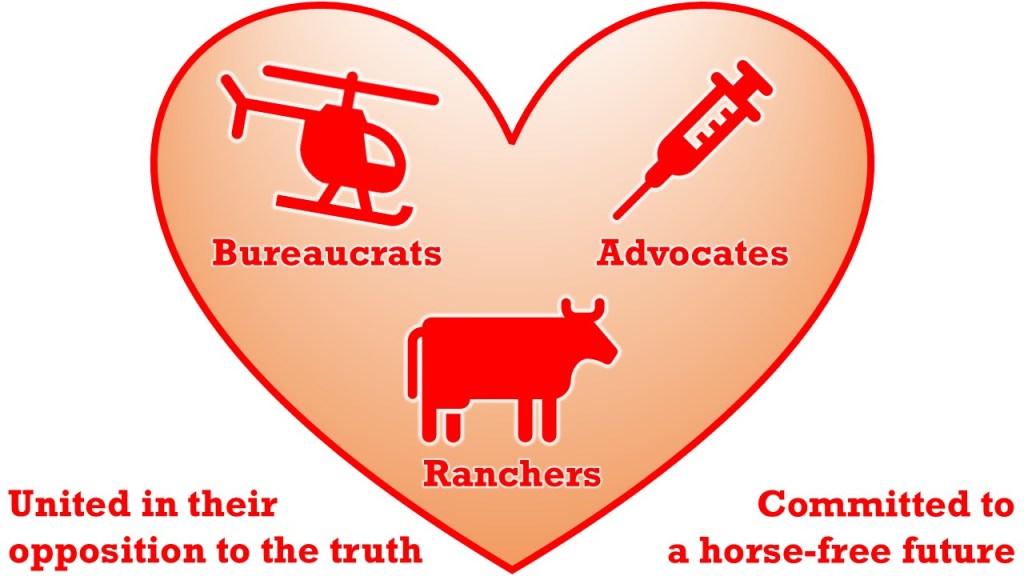
The advocates, defeated a long time ago and now in the tank for the ranchers, bolster the narrative with their darting programs.
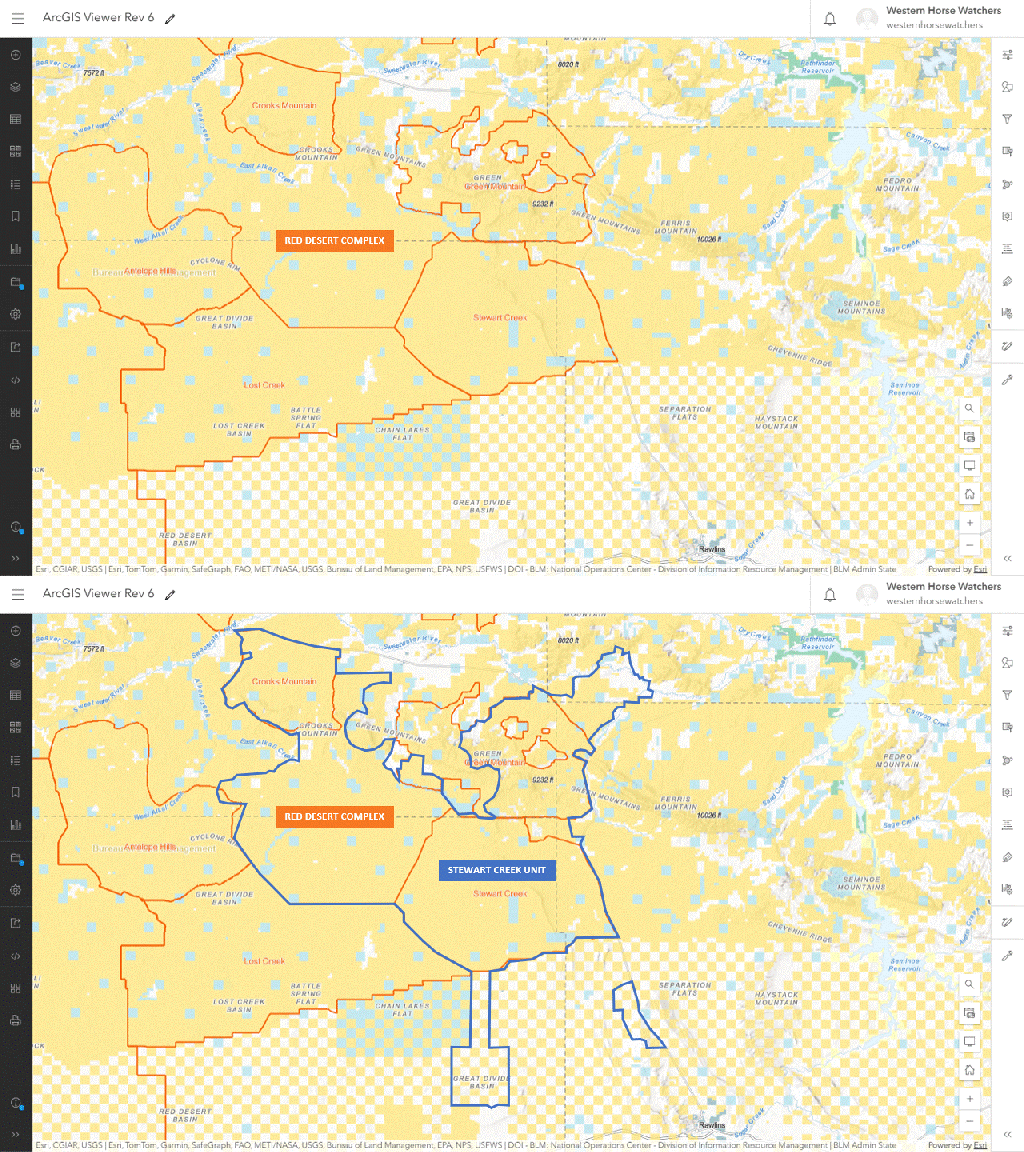
If you plot the outline of the Stewart Creek Unit on a map of the allotments, you’ll find that it overlaps Turkey Track, Rawlins Draw, Whiskey Peak, Arapahoe Creek, Stewart Creek, Larson Knolls, Jawbone and Bell Springs.
Turkey Track, not labeled, is in the northeast corner. Click on image to enlarge.
STEWART CREEK GRAZING ASSOCIATION appears in a first-pass review of the allotment master reports at RAS.
The operator information report gives three authorizations for SCGA:
4900602 – JAWBONE, BELL SPRINGS, LARSON KNOLLS and STEWART CREEK (in the Rawlins Field Office)
4900388 – ARAPAHOE CREEK (Lander Field Office)
4900649 – RAWLINS DRAW, TURKEY TRACK, NORTH WILLOW CREEK, WHISKEY PEAK and COOPER CREEK (Lander Field Office)
Western Horse Watchers was unable to find North Willow Creek and Cooper Creek on the map but their namesakes are inside the blue boundary.
The allotment master report for Lander indicates that SCGA holds all of the active AUMs in Rawlins Draw, Turkey Track, North Willow Creek and Cooper Creek, suggesting that it’s a legal entity owned or controlled by Pathfinder Ranches.
SCGA holds all of the active AUMs in Bell Springs, Jawbone and Larson Knolls according to the report for Rawlins.
In the Stewart Creek Allotment, where the Wyoming Wild Horse Improvement Project poisons the mares with PZP, SCGA holds 60% of the active AUMs, suggesting that WYWHIP co-founder Christie Chapman cares far more about ranching interests, especially those of Pathfinder, than she does about wild horses.
Senators voted 60-40 Monday evening in favor of HR 5371, a bill that will end the partial government shutdown if accepted by the House and signed by the President.
The measure provides full-year funding for military construction, veterans’ affairs, the Department of Agriculture (which includes the Forest Service) and the legislative branch, according to a report by The Hill, and the rest of government (which includes the BLM) through January 30.
As of today, a FY26 roundup schedule has not been posted to BLM’s website, but one may appear before the ink is dry, as high-net-worth individuals, portrayed as victims by Bobby Khan, suffer from resource invasion in the lawful homes of wild horses.
The attack on the herd is sinister because it’s being carried by those who claim to voices for the horses.
The Center for Biological Diversity never demanded that the mares be sterilized.
The Forest Service never laid the idea on the table.
It came from the advocates, disguised as “humane management.”
For seven years they’ve pummeled the mares with pesticide-laced darts, not to slow population growth but to reverse it, with the inevitable result of permanent infertility.
And, as usual, the perps are women.
These people are phonies and don’t deserve a penny of your support.
You’d think the advocates would have special funds devoted to the purchase of base properties, so wild horses could be placed on public lands at the expense of privately owned livestock.
Instead, they use your donations to buy pesticides, so they can beat the horse populations down in favor of livestock.
They are frauds and don’t deserve a penny of your support.
Stocking rate would be 27.3 wild horses per thousand BLM acres
Beulah Belle
98,357 total acres
23,146 deeded
7,962 state
67,248 BLM
2.9 BLM acres per deeded acre
19,810 AUMs
Equivalent to 1,651 wild horses
Stocking rate would be 24.6 wild horses per thousand BLM acres
Stewart Creek
569,053 total acres
22,470 deeded
8,999 state
537,584 BLM
23.9 BLM acres per deeded acre
23,734 AUMs
Equivalent to 1,978 wild horses
Stocking rate would be 3.7 wild horses per thousand BLM acres
Wooden Rifle
68,606 total acres
14,537 deeded
6,797 state
47,272 BLM
3.3 BLM acres per deeded acre
8,991 AUMs
Equivalent to 749 wild horses
Stocking rate would be 15.8 wild horses per thousand BLM acres
Your faithful public servants claim that public lands in the western U.S. can only support one wild horse per thousand BLM acres.
Stewart Creek, the unit with the best land ratio but lowest stocking rate, overlaps three of the five HMAs in the Red Desert Complex. Not disclosed by the agent.
If the operation was repurposed as a refuge, it would support 7,500 wild horses, saving taxpayers an estimated $13.7 million per year and paying for itself in six years.
The project would likely face stiff opposition from ranchers, farm bureaus and stock grower’s associations.
Wild horses can be placed on public lands not identified for their use by acquiring base properties associated with grazing allotments and flipping the preference to horses.
The Campaign Against America’s Wild Horses, a leader in mass sterilization and fierce opponent of principal use, has been ordered to stop the Cedar Mountain darting program according to an October 30 news flash distributed by Lucky Three Ranch.
Further, the grant that funds the effort has not been renewed.
The advocates are now begging for donations to keep the destruction going.
There haven’t been any roundups in the HMA since the program began because the advocates are working with a permittee to poison the mares with PZP, a restricted-use pesticide that tricks their immune systems into attacking their ovaries.
Snake River Land & Cattle covers 38,899 total acres, including 5,675 deeded acres and 33,224 BLM acres according to the agent’s listing.
The map puts the deeded acreage inside the Douglas-Sawmill Allotment, a few miles south of the Sand Wash Basin HMA.
The ranch lies within a game management unit so not only will you get pushback from ranchers in trying to flip the preference to horses but from hunters as well.
The allotment master report shows one pasture, so it may operate as a general use area shared by three permittees.
Livestock owned by the other two would remain.
The active AUMs are probably wrong and may be off by a factor of ten.
One of the bullet points in the listing says the ranch receives 743 AUMs, equivalent to 62 wild horses.
The land ratio is good, almost six public acres per deeded acre.
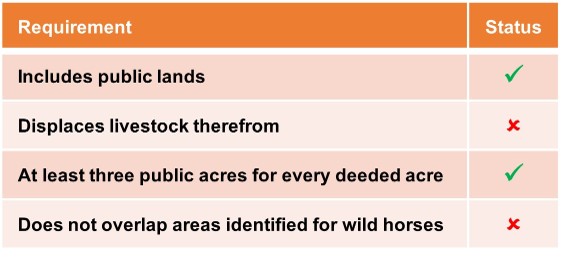
But the allotment overlaps the Douglas Mountain HA according to the ArcGIS viewer, so the ranch meets two out of four requirements for a refuge.
You don’t have to spend millions of dollars on a base property to get wild horses back on these public lands. You just need to rid the bureaucracy of ranchers and ranching sympathizers and overturn the planning process that zeroed out the HMA.
Don’t expect any help from the advocates. They want the ranchers to win.
The nonprofit is expanding its scope from the Virginia Range to all of Nevada’s wild horses and burros.
The news release did not include condemnation of the mass sterilization program inflicted on the Virginia Range herd by the Campaign Against America’s Wild Horses.
The event begins at 4:00 PM on November 1 in Colorado Springs.
The announcement did not indicate if TCF staff would demonstrate their pesticide delivery equipment or discuss their contributions to wild horse sterilization.
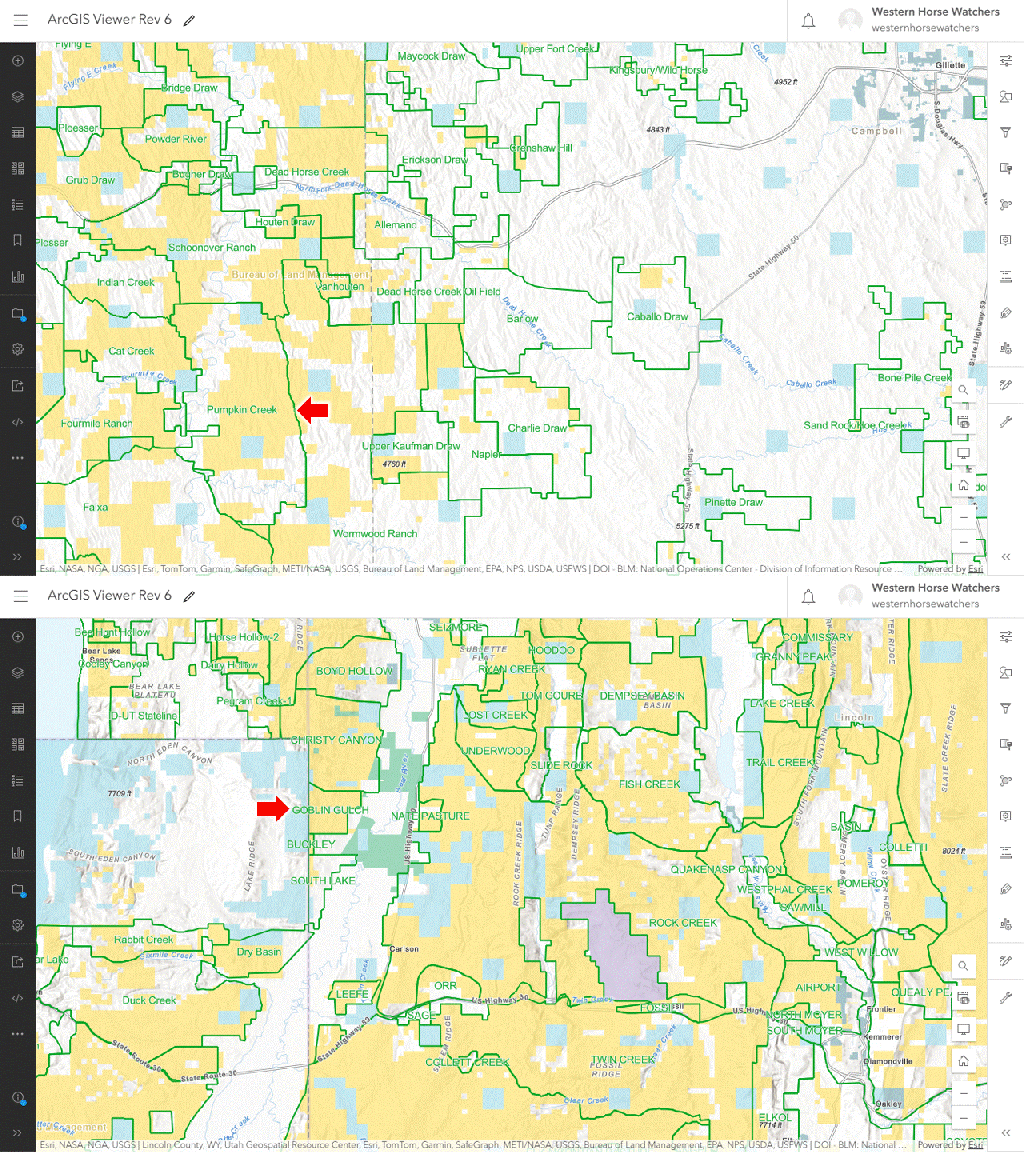
Pumpkin Creek is southwest of Gillette and Goblin Gulch is northwest of Kemmerer.
The allotment master report puts Pumpkin Creek in the Improve category, suggesting that your stewards of the public lands are not taking their responsibilities seriously.
The Pumpkin Creek permittee receives 1,456 active AUMs on 13,235 public acres, equivalent to 121 wild horses or 9.2 wild horses per thousand public acres.
Your faithful public servants claim that public lands in the western U.S. can only support one wild horse per thousand acres (25,600 animals on 25.6 million acres according to the last page of the 2025 population dataset).
The advocates bolster the narrative with their darting programs.
Goblin Gulch offers 287 active AUMs on 2,845 public acres, equivalent to 24 wild horses or 8.4 wild horses per thousand public acres.
If Pumpkin Creek was an HMA, the AML would be 13 and 108 wild horses would be consigned to off-range holding because of permitted grazing.
If Goblin Gulch was an HMA, the AML would be 3 and 21 wild horses would be shipped to off-range holding.
Both areas would be held to a small fraction of carrying capacity to accommodate high-net-worth individuals who pay almost nothing for the resources they consume, which explains why their wealth grows along with the burden laid on American taxpayers.
Wild horses can be placed on public lands not identified for their use by acquiring base properties associated with grazing allotments and flipping the preference to horses.
Like radioactive decay, the advocates emit a steady stream of harmful information about wild horses.
Equating mass sterilization with wild horse conservation is one example.
Lying about rapid development is another.
Their followers don’t realize they’re being exposed to propaganda that promotes rancher prosperity, not equine welfare.
The only hope for these nitwits is to get them to Betty Ford clinics or similar institutions where they can be deprogrammed and educated in rational thought.