Bill Would Allow State to Move Wild Horses and Burros?

S.1942, the Malheur Community Empowerment for the Owyhee Act, would create a land health management program on federal lands in Malheur County, Oregon.

Among the provisions are greater operational flexibility in livestock grazing and the designation of 1.1 million acres as wilderness areas.

Grazing would be allowed on those lands if established before the Act becomes law.

The bill would create a C.E.O. Group consisting of ten voting members, three of whom represent grazing interests and one representing hunting or fishing interests.

Eight nonvoting members would sit on the committee.

The State would be authorized to use aircraft (including helicopters) in the wilderness areas to capture, transplant, monitor and provide water for wildlife populations, including bighorn sheep and feral stock, feral horses and feral burros.

The Hog Creek, Cold Springs, Three Fingers, Sand Springs, Sheepshead-Heath Creek, Coyote Lake-Alvord-Tule Springs and Jackies Butte HMAs are in Malheur County.

The bill was introduced on June 4 and referred to the Senate Committee on Energy and Natural Resources.


WHE Still Doesn’t Get It

HMAPs do not allocate resources.

They cannot change resource allocations.

They ratify/sanction/bless/condone/approve resource allocations already on the books.

“Changes to livestock grazing cannot be made through a wild horse gather decision.”

The RMP must be revised, which is beyond the scope of the project.

If livestock receive 19 AUMs for every AUM assigned to horses before the HMAP, they will receive 19 AUMs for every AUM assigned to horses after the HMAP.

The AML will remain small relative to the available resources and the HMA will be managed principally for livestock.

RELATED: Silver King HMAP Q&A.

Three Rivers Wild Burro Roundup Announced

The incident will begin today according to the BLM news release.

Three HMAs are affected.

The June 3 schedule gives capture and removal goals of 1,100 and 1,000 respectively.

Burros will be baited into the traps.

Operations will not be open to public observation.

Captured animals will be taken to off-range corrals in Utah and Arizona.

Up to 100 jennies will be treated with GonaCon Equine and returned to the range.

RELATED: Three Rivers Wild Burro Roundup Next Week?

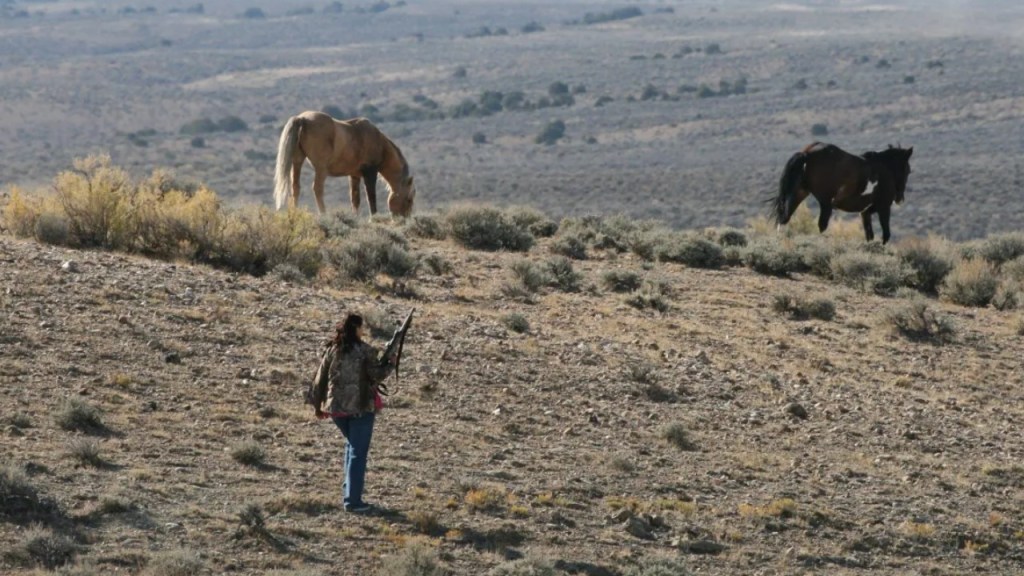
Identity of Pryor Mountain Shooter Revealed

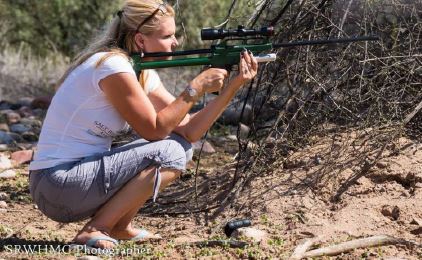
A story by Aspen Daily News says BLM employee Jace Stott pulled the trigger.

A profile on LinkedIn suggests he’s a Rangeland Management Specialist, sometimes referred to as ranching advocate.

Other search results indicate he was affiliated with University of Nebraska – Lincoln and has been involved with animal agriculture from a very young age.

The article is the first of a two-part series that explores wild horse management.

RELATED: BLM Dispatches Pryor Stallion, Advocates Cry Foul.

Forage Requirements of Wild Horses and Burros

If you want to compare the resource loading of burros to horses, cut the burro numbers in half.

A herd of 200 burros is equivalent to 100 wild horses.

An AML of 50 burros is equivalent to an AML 25 wild horses.

An allotment that supports livestock equivalent to 1,200 wild horses supports livestock equivalent to 2,400 wild burros.

An allotment that supports livestock equivalent to 5.6 wild horses per thousand public acres supports livestock equivalent to 11.2 wild burros per thousand public acres.

An allotment that offers 3,600 AUMs per year to livestock offers 3,600 AUMs per year to horses or 3,600 AUMs per year to burros.

RELATED: Equivalent Horses and Stocking Rates for Allotments.

Caisson Platoon Returns to Work

They went back on the job this week with the burial of Private Bernard Curran who died in 1942 after being captured by the Japanese.

The horses have pulled the flag-draped coffins of America’s war heroes to their final resting place at Arlington National Cemetery for more than 70 years according to a report by Fox News.

The program was halted two years ago after the Army linked the deaths of several animals to poor living conditions.

RELATED: Return of Caisson Platoon Delayed Indefinitely?

Article About Salt River Contract Uses the S-Word!

One of the challengers to the Salt River Wild Horse Darting Group said in a story by the Payson Roundup that “…horses receiving multiple doses of PZP over the course of several years can become functionally sterile,” a condition nobody wanted to talk about until today.

The group’s ringleader claimed responsibility for herd reduction via mass sterilization, ratifying a June 2 commentary by Western Horse Watchers: “We invented this humane management protocol…”

No foals have been born this year according to the report.

RELATED: Who Would Want to Be Responsible for Salt River Herd?

Who Would Want to Be Responsible for Salt River Herd?

Imagine submitting a proposal to manage the herd at 150 head and instead of seeing it grow, you’re watching it shrink, irreversibly.

Everyone’s looking at you with suspicion.

But you had nothing to do with it.

The problem was created by your predecessor, the Salt River Wild Horse Darting Group and its overlords at the Campaign Against America’s Wild Horses.

RELATED: Four Organizations Bidding on Salt River Management Contract.

Foal-Free Friday, Humane Disposal Edition

In the introduction to a 2012 Q&A about PZP, Jay Kirkpatrick of the Billings School of PZP Darting and Public Deception stated that “…oversight by The Humane Society of the United States assures that the vaccine is used only to slow reproduction and may not be used for the extermination of entire herds.”

Further, “PZP is designed to bring about short-term infertility and is reversible, if not used beyond five consecutive years.”

On page 29 he refutes the remarks on page 3: “The HSUS will permit the use of PZP to manage, even reduce, but not to eliminate wild horses.”

Writing about the disaster at Assateague Island, which he did not live to see, “the first sign of population reduction took about eight years, but herd reduction has been moving more quickly since then.  The following eight years, herd numbers went down from 175 to 114, without any removal of horses, treating anywhere from 48% to 79% annually.”

If a helicopter took the herd from 175 to 114, 61 horses would be removed and the advocates would be howling, but if it’s done with pesticides, no horses are removed.

Moreover, the job took eight years to complete and eight is greater than five, so most of the mares had been ruined by the time the population hit 114.

This is evident today.

You cannot shrink a population without driving the birth rate to zero, or nearly so, for an extended period, which usually exceeds five years.

Herd reduction leads to sterilization and sterilization leads to extermination, which the Humane Society won’t allow, supposedly.

NOTE: HSUS is now HWA.

RELATED: Foal-Free Friday, One Track Mind Edition.

Four Organizations Bidding on Salt River Management Contract

The Arizona Department of Agriculture will reopen the RFP soon according to a story by Phoenix New Times but a date was not given.

The article looks at the incumbent and one of its challengers, a group led by historian John Mack and Forest Service contractor Jacquelyn Hughes.

Hughes was involved in the removal of wild horses from the Apache-Sitgreaves National Forest in 2022.

Simone Netherlands of the Salt River Wild Horse Darting Group suspects the contract will go to the group that proposes the smallest population goal.

That will raise questions in some circles about genetic diversity but the point is moot when most of the mares have ruined by PZP.

RELATED: Salt River RFP Cancelled.

AMLs Don’t Indicate Genetic Diversity or Carrying Capacity

Those who would combat myths about wild horses are often the greatest spreaders thereof.

Genetic viability correlates with breeding populations, not AMLs or herd sizes.

You have to correct the figures for the number of mares that have been ruined or are in the process of being ruined with fertility control pesticides.

For example, the current population at the Salt River is approximately 260 and most advocates would conclude that genetic diversity is satisfactory when in fact most of the mares have been sterilized by PZP and the breeding population can be counted on one hand.

As for carrying capacity, if a wild horse area is subject to permitted grazing, which is almost always the case, the AML is small relative to the available resources and the land can support many more animals than the bureaucrats admit.

The Silver King HMA in eastern Nevada supports livestock equivalent to 2,530 wild horses, on top of the 128 allowed by plan.

A herd that large is not safe from the advocates.

Volunteers with the Campaign Against America’s Wild horses are wiping out the Virginia Range mustangs with PZP, a population that exceeded 3,000.