Pahrump Wild Horses Share Park with Residents

They’re congregating in an area known as the Calvada Eye, according to a report published today by the Pahrump Valley Times.

A Nye County Animal Control Officer urged the public not to feed them, lest they become dangerous and subject to removal from the range.

Last year, commissioners approved a resolution opposing helicopter roundups within the county.

RELATED: Where to Find Wild Horses in Pahrump, Nevada.

Managing Primarily for Livestock

Refer to this opinion piece on BLM’s “Programmatic EIS for Fuels Reduction and Rangeland Restoration in the Great Basin,” NEPA project DOI-BLM-ID-0000-2017-0003-EIS.  It’s not just about areas identified for wild horse and burros.

The views expressed in the article, hosted by CounterPunch, are those of its author and not necessarily those of Western Horse Watchers.

The government spends untold amounts on these projects, confiscated from American wage earners, while the ranchers pocket the benefits.  It’s redistribution of wealth.

RELATED: Sagebrush Restoration Project Inching Ahead.

BLM3

Comments Invited on Draft EA for Surprise Complex

BLM announced today the release of a preliminary environmental assessment for wild horse and burro management actions in the Surprise Complex over a ten year period.

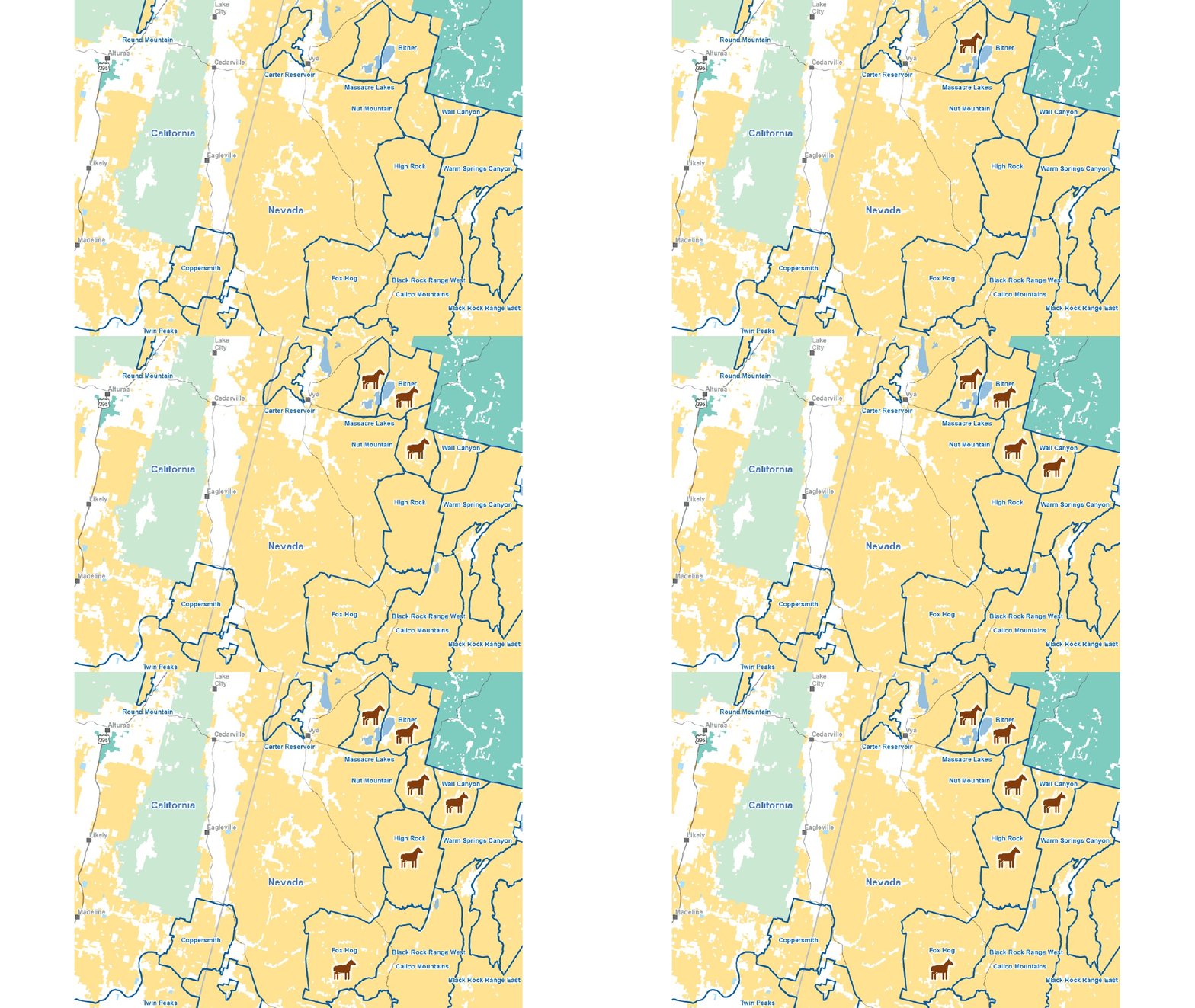
Six HMAs in northwestern Nevada are affected: Massacre Lakes, Bitner, Nut Mountain, Wall Canyon, High Rock and Fox Hog.  They are managed by the Applegate Field Office in California.

An environmental assessment looks at the consequences of a proposed action, along with those of one or more alternatives.  Alternative 1, the Proposed Action, includes roundups, fertility control and sex ratio skewing.  Refer to Section 2.2.3 in the EA.

The Complex covers 396,674 acres and has a combined AML of 496 horses.  Although burros have been observed in the Complex, the AML for them is zero.  The stocking rate allowed by plan is 1.3 wild horses per thousand acres.

Surprise Complex Map

The Complex intersects six grazing allotments.  Table 3-2 gives the total authorized forage but does not show how much of it falls inside the Complex.  That would be a substantive comment.

Western Horse Watchers estimates that 80% of the allotment acreage falls inside the six HMAs, based on the map in Appendix G.  If forage is evenly distributed across those parcels, then roughly 24,500 AUMs per year have been allocated to cattle inside the Complex, compared to 6,000 AUMs per year for the horses.

The Complex is managed primarily for livestock.

The forage assigned to cattle would support an additional 2,000 horses, for a true AML of 2,500.  The current population, thought to be around 1,300 wild horses and burros according to the news release, is well within that range.

Comments will be accepted through February 14.

Eagle Roundup Day 8

The incident began on January 6.  Gather stats through January 13:

  • Horses captured: 331
  • Goal: 1,131
  • Returned: 0
  • Deaths: 5
  • Shipped: 253

A mare was put down on Day 6 due to injuries related to the gather.  Another mare was put down on Day 7 due to pre-existing conditions.

No youngsters have been gathered.  Roughly 45% of captured adults were males and 55% were females.  Some of the mares are probably within a few weeks of foaling.

Body condition scores are not known.

The HMA of origin was not reported.  Three HMAs are involved in the roundup.

The number of unaccounted-for animals is 331 – 5 – 253 = 73.  The contractor is probably holding them on site.

Some of the mares will be treated with contraceptives and returned to the range.

RELATED: Eagle Roundup Day 5.

Contraceptives Extend Life of Wild Mares?

The annual report for the Shackleford herd in 2020 says “Contraception has been linked to increased longevity among treated females.”

One explanation, not invented here, is that treated mares don’t have to go through the stress of pregnancy, birth and caring for a new foal.

Stallions don’t go through any of that, yet they only represent about one third of the Shackleford population.

On the Maryland side of Assateague Island, females outnumber males 2.4 to 1.

Both herds are subject to ‘humane management practices.’

A difference is that the disparity at Shackleford can be attributed to chance, random noise in the process, while the imbalance at Assateague is so large that it must be attributed to an assignable cause, a signal of trouble in the herd.

That may explain why the fertility control program was shut off in 2016.

Are the Shackleford horses heading in the same direction?  Do contraceptives have other effects that would limit their use?  Is the cup half full or half empty?

RELATED: Shackleford Herd Grows In Latest Census.

Shackleford Herd Grows In Latest Census

The Park Service said in a news release today that 117 horses were living on the barrier island at the end of 2020, up from 111 at the end of 2019.  The growth rate was 5.4%.

The average lifespan was eleven years and no mares were treated with contraceptives in 2020, according to the annual report.

The herd was 38% male and 62% female.

The expected range of variation, based on rudimentary statistical formulas with n = 117 and p-bar = .50, is 36% to 64%.

The observed percentages fall within those limits so they could be attributed to chance, the result of a simple random process centered at 50% males / 50% females.

Subject-matter knowledge may suggest otherwise.

RELATED: Park Service Reports Shackleford Census Results.

End of Life Options for Horses

NOTE: The photos in this post may be disturbing to some viewers.

In the wild, predators and scavengers remove the carcass.  If the horse was euthanized, as was the case recently near the Heber WHT, and/or received medications prior to death, you could get a secondary kill.

If you have land and the codes allow it, you can bury him on your own property.  You’ll need some heavy equipment to dig the hole and place the horse in it.  You are not going to drag a thousand pound animal out of a stall, corral or pasture.

And you’ll be doing all of that while you’re upset at the loss of your horse.  Yeah, it sucks.

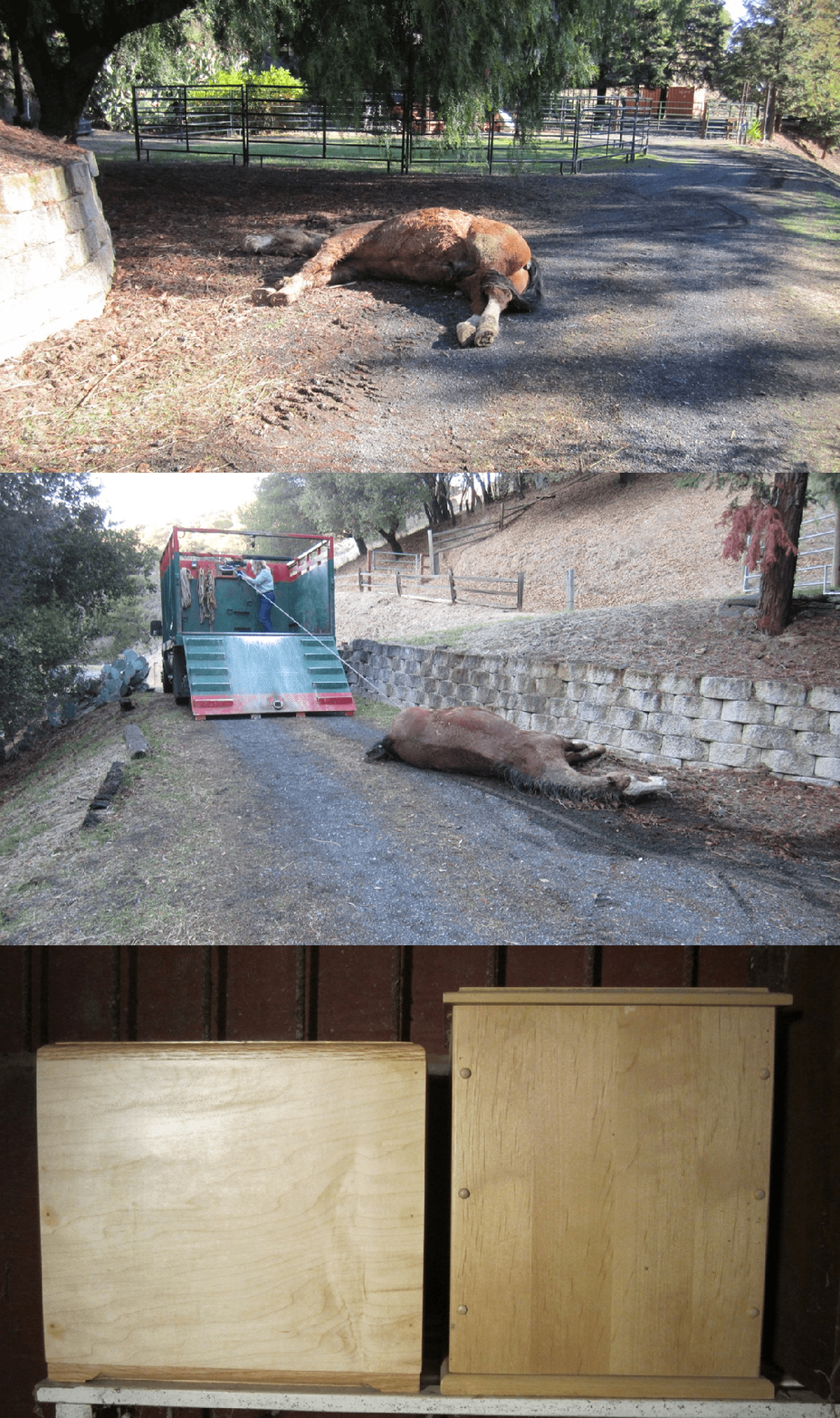
When Trapper died the vet referred me to a hauler.  One option was to take him to a rendering plant and another was the pet cemetery.  I opted for cremation.  I still had to get him out of the corral, which was a muddy mess due to rain.

My paint mare, one of two other horses in the corral, became very agitated that evening when she realized he wasn’t coming back.  They had been barn buddies for eight years.

The result of the cremation process is an urn with the horse’s remains.  In the photos below, Trapper’s urn is on the left, Cassie’s is on the right.  She was my first horse, lost in 2012.

The vet bill was $744.  The hauler charged $300.  The cremation fee was $800.

The incident was a reminder of why you should never let your savings account drop below, say, $2,500—if you have horses.  That amount does not include the cost of feed and other expenses if you lose your job.

Many financial coaches say you should always have between three and six months of living expenses in savings, but they’re usually not thinking about horses.

With the cost of feed at $100 per AUM, that’s an extra $600 per month for six horses.

RELATED: Trapper Gone But Not Forgotten.
End of Life Options for Your Horse

Eagle Roundup Day 5

The incident began on January 6.  Gather stats through January 10:

  • Horses captured: 195
  • Goal: 1,131
  • Returned: 0
  • Deaths: 3
  • Shipped: 77

Three horses were put down on Day 4 due to pre-existing conditions.  They would likely be alive today if it wasn’t for the roundup.

No youngsters have been gathered.  Roughly 44% of captured adults were males and 56% were females.  Some of the mares are probably within a few weeks of foaling.

Body condition scores are not known.

The HMA of origin was not reported.  Three HMAs are involved in the roundup.

The number of unaccounted-for animals is 115.  The contractor is probably holding them on site.

Some of the mares will be returned to the range after treatment with contraceptives.

RELATED: Eagle Roundup Day 3.

Haaland to Head Interior?

Her nomination is subject to Senate confirmation, as reported last month by The Hill.

“Hey Western Horse Watchers, she’s native American.”

Hatred of God and country are learned behaviors.  They can be taught to anyone, even native Americans.

She would be responsible for a number of federal agencies, including the Bureau of Land Management.  What do you suppose the priorities will look like after January 20?