How to Compute Wild Horse Growth Rates

The relationship between initial and final herd sizes, assuming compound growth, is

Initial herd size × (1 + x) ^ n = Final herd size

where x is the annual growth rate and n is the time interval in years.  The caret (^) signifies exponentiation, one plus x raised to the nth power.

Solving for x,

x = 10 ^ [1 ÷ n × log(Final herd size ÷ Initial herd size)] – 1

Multiply the result by 100 to obtain a growth rate in percent per year.

The math is a little tedious to do by hand so let’s set it up in a spreadsheet.

Wild Horse Growth Rates Set-Up-1

In Excel, the formula in cell B9 is =100*(10^(1/B7*LOG(B5/B3))-1).  The other cells are just text and numbers.  If you use different cells for the data, the formula won’t work.

You can copy the formula and paste it into your spreadsheet, starting with = but don’t include the period.  The number format for cell B9 was set to one decimal place.

The post from December 16 included two examples.  In the second case, a herd of 100 wild horses becomes a herd of 201 wild horses in five years if the annual growth rate is 15% per year.  Those numbers were used to test the spreadsheet.

AMLs are often specified as a range, with the lower end about half of the upper end, to allow for a doubling of the herd size in four or five years.

The proposed AML for the Heber WHT is 50 – 104.  If you start with 50 wild horses and find 104 wild horses in four years, what was the annual growth rate?

The Heber AML is discussed on page 21 of the new management plan.

RELATED: More On Growth Rates.

Delamar Roundup Day 11

The incident began on December 6.  Gather stats through December 16:

  • Horses captured: 405
  • Goal: 414
  • Returned: 0
  • Deaths: 21
  • Shipped: 263

Helicopters were grounded on Day 10 due to weather.

Two horses were put down on Day 9 and three on Day 10 due to pre-existing conditions, bringing the death rate to 5.2%.

Foals accounted for 15.3% of the horses gathered.  Roughly 50% of captured adults were males and 50% were females.

Body condition scores are not known.

The number of horses shipped is 287 according to the gather page.  No shipments were reported on Day 11.

The number of unaccounted-for animals is 121.  The operation will likely conclude in another day or two.

RELATED: Delamar Roundup Day 8.

Heber Wild Horses: Setting Them Up for Failure?

A bachelor stallion chases a mare and foal as they leave a water hole in the following video by Friends of the Heber Wild Horses.  The fence is for livestock.

A management plan, drafted earlier this year, shows the WHT boundary relative to those of the allotments, page 10 in the pdf.  The proposed AML is discussed on page 21.

The AML for areas outside the WHT is zero, meaning the horses could be captured and removed from the forest if someone complains or they create a hazard.

When grazing season begins, gates are closed, and the horses are cut off from some of their food and water, perhaps a sizeable amount.

If they can’t access critical resources inside their designated area, they’ll move beyond it in search of new ones.  Gotcha!

This approach to wild horse management is not unique to the WHT.  It’s standard practice for most of the wild horse areas on western rangelands.  The new Desatoya resource enforcement plan, currently out for review, is another example.

The environmental assessment for the Heber management plan should be available for public review in early 2021, according to the project status.

RELATED: Heber EA in Progress.

More On Growth Rates

Table 1 of the Draft EA for resource enforcement in the Pancake Complex shows current wild horse populations in the four areas that make up the Complex.

The paragraph immediately below says the upper end of the population range is based on a 2016 survey, plus four years of compounded 20% annual growth.

If you start off with 100 horses and the growth rate is 20% per year, how large will the herd be after four years?

At the end of the first year, you’ll have 100 × 1.2 = 120 wild horses.  At the end of the second year, you’ll have 120 × 1.2 = 144 wild horses.  At end of year three, you’ll have 144 × 1.2 = 173 horses.

That is the idea of compounding.

At the end of year four, you’ll have 100 × 1.2 × 1.2 × 1.2 × 1.2 = 207 horses.  Herd sizes double in four years at a 20% annual growth rate.

If the growth rate is 15% per year, a herd of 100 wild horses would become a herd of 100 × 1.15 × 1.15 × 1.15 × 1.15 × 1.15 = 201 wild horses in five years.

That’s why the BLM says herd sizes double every four to five years.

RELATED: Wild Horse Growth Rates.

BLM to Volunteers: No Water for Fish Springs Mustangs

A letter cited yesterday in a report by The Record-Courier of Gardnerville, NV implied that you don’t have a self-sustaining population if you provide water to wild horses.

Giving them water, other than in an emergency, doesn’t meet the definition of minimum feasible management, according to the letter, but at the Confusion HMA, cutting ovaries out of mares does.

The mustangs inhabit the southern portion of the Pine Nut Mountains HA, an area identified for wild horses in 1971 but no longer managed for them due to inadequate resources.

The area can support permitted livestock grazing, however.

Delamar Roundup Day 8

The incident began on December 6.  Gather stats through December 13:

  • Horses captured: 325
  • Goal: 414
  • Returned: 0
  • Deaths: 15
  • Shipped: 224

Helicopters were grounded on Day 7 due to weather.

One horse was put down on Day 6 and three on Day 8 due to pre-existing conditions, bringing the death rate to 4.6%.

Foals accounted for 15.1% of the horses gathered.  Roughly 51% of captured adults were males and 49% were females.

Body condition scores are not known.

The number of horses shipped is 248 according to the gather page.  No shipments were reported on Day 8.

The number of unaccounted-for animals is 325 – 0 – 15 – 224 = 86.

RELATED: Delamar Roundup Day 5.

Consumers Screaming for More Range-Fed Beef?

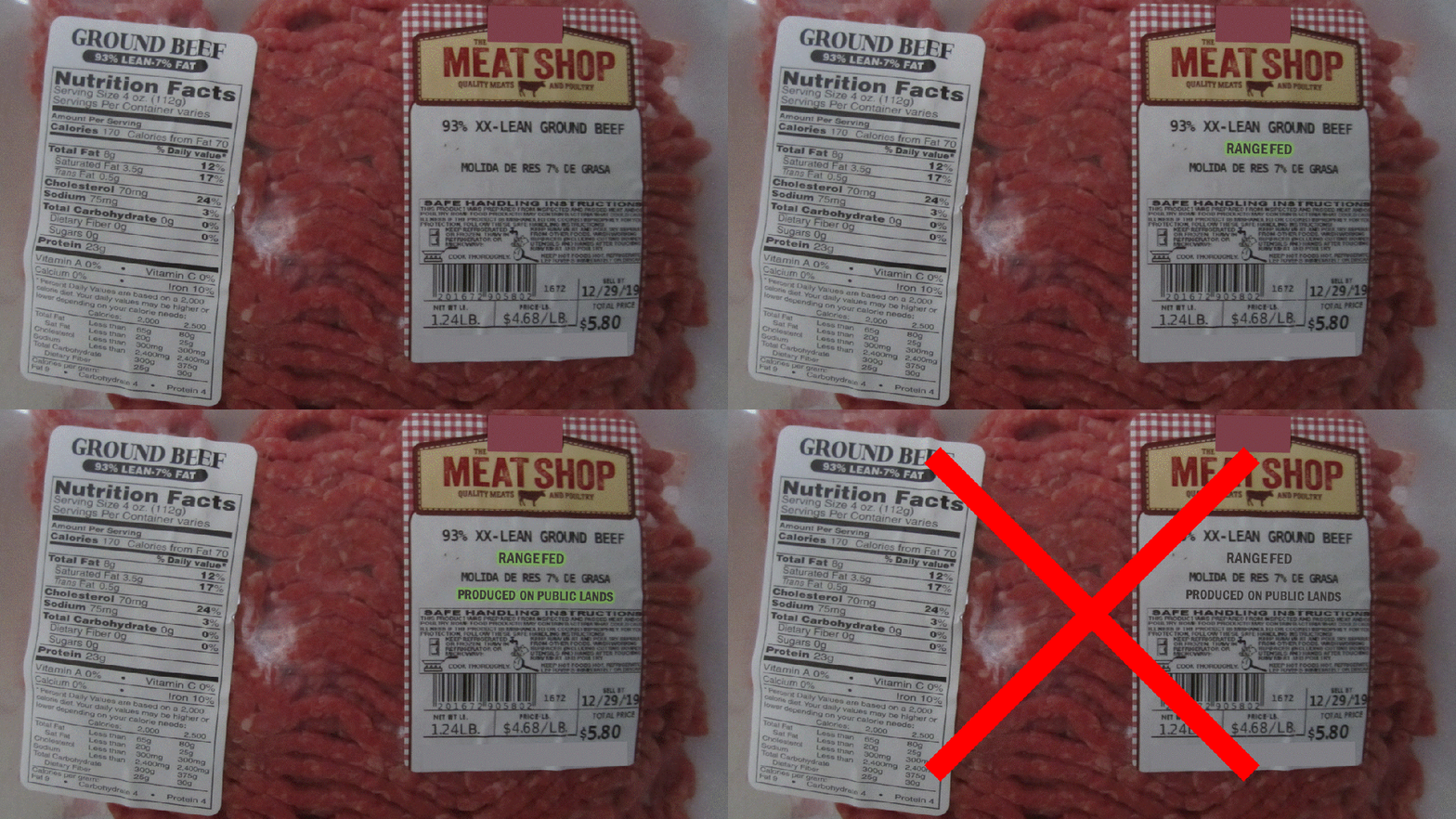
Wild horses should be relocated to remote wilderness areas, to satisfy growing demand for range-fed beef, according to a column published yesterday by the Mail Tribune of Medford, OR.  There, apex predators will keep their populations in check and cattle ranchers will be able to enjoy the full benefit of areas set aside for wild horses.

This is nuts.  If Equine Elite can buy an 80-acre parcel near Burns, WY to build a high-density animal feeding operation—for horses removed from public lands—why is it unreasonable to expect the ranchers to do that?  Many of them already have base properties of several thousand acres.

And why is it unreasonable to expect that lands identified for wild horses in 1971, about 50 million acres, should be managed principally for them, per the original statute?

Range Fed Beef

Delamar Roundup Day 5

The incident began on December 6.  Gather stats through December 10:

  • Horses captured: 265
  • Goal: 414
  • Returned: 0
  • Deaths: 11
  • Shipped: 137

Three horses were put down on Day 4 and one on Day 5 due to pre-existing conditions, bringing the death rate to 4.2%.

Foals accounted for 14.7% of the horses gathered.  Roughly 49% of captured adults were males and 51% were females.

Body condition scores are not known.

The number of horses shipped is 161 according to the gather page.  No shipments were reported on Day 4.

The number of unaccounted-for animals as of Day 5 is 117.

RELATED: Delamar Roundup Day 3.